




GetVoucher is the platform we recommend for getting sales certification vouchers without the usual admin hassle, and two pathways cover most readers: the free Corporate Sales Associate for those starting out, and the paid Corporate Sales Pro for reps ready to master methodology and move towards leadership. Pick the free option to build foundations, the paid one to deepen skills. A fuller shortlist and comparison follow below.
TL;DR:
- Entry-level certifications like Corporate Sales Associate and HubSpot’s Inbound Sales offer low-cost, accessible options for beginners testing interest in sales careers.
- Methodology courses such as MEDDPICC or Challenger tend to cost more, include practical application, and suit professionals handling complex, multi-stakeholder B2B sales.
- Leadership qualifications like CPSL and CSE focus on coaching and strategy, ideal for experienced reps moving into management or executive roles.
- Verify certifications by checking for published syllabi, proctored assessments, recognized awarding bodies, and clear role relevance before committing.
- Post-certification support varies, with vendor and university programs offering ongoing networks and education, but real behavioral change requires application methods like role-plays or coaching.
Table of Contents
- What are the best sales certifications right now?
- Which sales certifications should you actually look at?
- How do you choose the right sales certification?
- Entry-level or advanced: which pathway fits your career stage?
- How were these certifications selected?
- What do past participants say about sales certifications?
- How does post-certification support compare across programmes?
- A publisher’s view on making certification actually pay off
- Get your sales certification voucher through GetVoucher
- Sources
What are the best sales certifications right now?
There’s no single “best” sales certification. The right one depends on your role, your deal complexity, and whether your employer already runs a particular methodology internally. That said, a handful of programmes come up again and again in industry roundups, and they split neatly into four camps: methodology credentials (SPIN, Challenger, MEDDPICC), vendor and technical tracks (HubSpot, Salesforce, LinkedIn), role-specific qualifications (CISP for inside sales, CSDR for SDRs), and broader professional or regulated credentials that carry structured study hours.
GetVoucher’s two courses sit at opposite ends of that spectrum. Corporate Sales Associate is free and built for people who need a foundational credential to show commitment, while Corporate Sales Pro is paid and aimed at professionals ready to work through methodology and leadership content in more depth.
A few takeaways stand out once you line these up side by side.
- Free options like Corporate Sales Associate and HubSpot’s Inbound Sales Certification make sense as low-risk first steps, especially if you’re switching into sales from another field.
- Leadership credentials (CPSL, CSE, Corporate Sales Pro) cluster around similar outcomes: coaching, target-setting, and commercial oversight, so pick one based on which body your employer already recognises.
- Methodology certifications (Challenger, SPIN, MEDDPICC) tend to cost more and run longer because they include practical application, not just knowledge testing.
- If you’re unsure where to start, the entry versus advanced split matters more than the specific brand name on the certificate.
Which sales certifications should you actually look at?
Here’s a closer look at each shortlisted programme, covering who it suits, what it teaches, how the format and assessment work, and what makes it stand apart.
1. GetVoucher: Corporate Sales Associate. This free certification is designed for people entering sales for the first time or professionals who want a credential that signals commitment without upfront cost. It covers foundational selling concepts: prospecting basics, communication fundamentals, and an introduction to the sales cycle. The format is self-paced online learning, accessed through a voucher on GetVoucher, with SMstudy as the certifying body and VMEdu as the main provider. Its standout feature is accessibility: zero cost, structured content, and a natural first step towards Corporate Sales Pro.
2. GetVoucher: Corporate Sales Pro. The paid, advanced counterpart suits reps with some selling experience who want to move into methodology mastery, negotiation, and early leadership skills. It builds on the Associate-level content with deeper coverage of deal management, objection handling, and structured frameworks for closing more complex sales. Delivered online and self-paced through GetVoucher, again under SMstudy and VMEdu, its standout is the structured progression from a free credential into a paid, more rigorous one, without switching platforms or providers.
3. Certified Professional Sales Person (CPSP). Aimed at generalist sellers in traditional B2B or B2C roles, CPSP covers the full sales cycle from prospecting to closing. It’s a blended format combining self-study with practical exercises, and it suits professionals who want broad coverage rather than a single methodology.
4. Certified Inside Sales Professional (CISP). Built specifically for inside sales reps and SDRs who sell remotely or over the phone. Core skills include structured prospecting, pipeline hygiene, and objection handling in a non-face-to-face context. The format is online, with practical scenario-based assessment, and it stands out for being one of the few credentials built specifically around remote selling rather than adapting a general framework.
5. Certified Professional Sales Leader (CPSL). For sales managers and those aspiring to management, CPSL focuses on coaching frameworks, target-setting, and team performance management rather than individual selling skill. It’s blended in format, mixing theory with applied leadership exercises, and suits reps who’ve already hit their numbers and now need to replicate that in others.
6. Certified Sales Executive (CSE). Positioned above CPSL, CSE targets senior leaders and executives responsible for commercial strategy rather than day-to-day team coaching. It covers strategic account planning and executive-level commercial oversight, delivered in a blended format, and suits professionals already in or close to a director-level role.
7. Challenger Trainer and Consultant Programs. These accreditations train internal trainers and consultants to teach the Challenger Sale methodology inside their own organisations. They suit enterprise sellers who’ll go on to coach others, with instructor-led delivery and an emphasis on insight-led selling: teaching buyers something they didn’t know, rather than just uncovering needs.
8. HubSpot Inbound Sales Certification. A free credential from HubSpot Academy aimed at career changers and anyone selling in inbound or SaaS contexts. It covers inbound methodology, qualifying leads, and running consultative sales conversations. Self-paced and online, its standout is zero cost combined with strong relevance to modern software sales roles.
9. RISE Up Sales Certification. RISE Up credentials from the NRF Foundation focus on retail and customer-service selling. They suit frontline retail associates and service teams rather than B2B sellers. The format is blended, with a workforce-development orientation, and the standout is sector specificity: it’s built for retail floor scenarios, not enterprise deal cycles.
10. SPIN Selling / SPIN Selling Certification (Huthwaite International). Based on Neil Rackham’s research into complex sales, SPIN focuses on Situation, Problem, Implication, and Need-payoff questioning. It suits consultative sellers handling long B2B sales cycles. Delivery is typically instructor-led or blended, with practical application central to the format, and its standout is decades of use as a foundational questioning framework across industries.
11. Salesforce Sales Operations Professional Certification. Built for professionals managing sales processes and CRM operations rather than frontline selling. It suits sales operations analysts and RevOps professionals, with an online proctored exam testing platform and process knowledge. Its standout is direct relevance to organisations already running Salesforce.
12. Salesforce Sales Representative Certification. A companion credential focused on frontline sales roles using Salesforce. It suits reps who need to demonstrate platform fluency to employers running Salesforce as their CRM, with a proctored online exam as the assessment method.
13. HubSpot Sales Software Certification. Distinct from the Inbound Sales credential, this one focuses purely on using HubSpot’s sales tools effectively. It suits reps and managers working inside the HubSpot ecosystem, delivered as a free, self-paced online course.
14. Consultative Sales Certification (CSC). Focuses on needs-based, consultative selling rather than transactional approaches. It suits reps moving from product-pitch selling into more advisory conversations, typically delivered through blended coursework and practical exercises.
15. Certified Professional Salesperson (SCPS). A broad professional credential testing general sales competency across the cycle. It suits generalist sellers wanting an industry-recognised baseline qualification, delivered through a mix of self-study and assessment.
16. LSE negotiating programme / LSE’s Negotiating Programme. Run by the London School of Economics, this is a university-taught programme rather than a vendor certification. It suits sales professionals who negotiate high-value or complex deals and want measurable negotiation skill training from an academic institution, delivered online with structured modules.
17. Certified Sales Development Representative (CSDR). Targets SDRs specifically, covering outbound prospecting, cold outreach, and qualification frameworks. It suits early-career reps in dedicated SDR functions, with online, self-paced delivery.
18. Certified Master Sales Professional (CMSP). An advanced generalist credential aimed at experienced sellers who want a senior-level badge covering strategic selling skills, typically assessed through a combination of coursework and exam.
19. Certified Technical Sales Professional (CTSP). Built for technical or solutions sellers who need to translate product complexity into buyer value. It suits sales engineers and technical account managers, with content covering both technical fluency and sales process.
20. MEDDPICC Masterclass / MEDDPICC Masterclass (by MEDDICC). Covers the MEDDPICC qualification framework (Metrics, Economic Buyer, Decision Criteria, Decision Process, Paper Process, Identify Pain, Champion, Competition). It suits enterprise B2B sellers managing long, multi-stakeholder deals, typically delivered through instructor-led workshops with practical deal application.
21. Challenger Sales Certification / Challenger Sales Certification (by Challenger Inc.). Teaches the Challenger Sale methodology directly to individual sellers rather than trainers. It suits enterprise reps who need to challenge customer thinking rather than simply build rapport, delivered through instructor-led sessions.
22. LinkedIn Sales Navigator Certification. Focuses purely on using LinkedIn’s Sales Navigator tool for prospecting and social selling. It suits any sales role using LinkedIn as a prospecting channel, delivered as a free, self-paced online course.
23. Certified Sales Leadership Professional (CSLP), Certified Sales Associate (CSA), Certified Sales Professional (CSP), and Certified Sales Leader (CSL). These sit across the entry-to-leadership spectrum from various professional bodies, generally covering similar ground to CPSP and CPSL at different seniority levels. They suit readers who want a recognised generalist badge tied to their current career stage.
24. Winning with Relationship Selling (Dale Carnegie Sales Training). Built around Dale Carnegie’s relationship-based selling philosophy, this suits reps in relationship-driven sectors where trust-building matters more than transactional speed. Delivery is typically instructor-led and workshop-based.
How do you choose the right sales certification?
Start with role fit before you look at price or brand recognition. A CISP-style credential built for inside sales won’t help much if you’re closing six-figure enterprise deals face to face, and a methodology certification like MEDDPICC is overkill if you’re doing high-volume transactional selling.
Deal complexity matters almost as much. Long, multi-stakeholder B2B cycles benefit from methodology credentials like SPIN or Challenger; shorter, simpler cycles are usually better served by role-specific or vendor credentials.
Check whether your employer already runs a particular methodology internally. Employers often prioritise methodology alignment: if your company already trains staff in MEDDPICC or Challenger, a credential in that same method will carry more weight in a hiring or promotion conversation than an unrelated one.
Before paying for any certification, ask the provider or your employer:
- Is the assessment proctored, or is it a self-marked quiz?
- Do you provide role-play, coaching, or practical application, or is it knowledge-only?
- What’s the awarding body, and is it recognised in my sector?
- Are there prerequisites I need to meet first?
- How many study or credit hours does the syllabus specify?
- Is there a published syllabus I can review before I buy?
Three red flags are worth walking away from: a vague or undisclosed syllabus, no assessment at all beyond a completion click, and an awarding body you can’t independently verify. Vetting certifications by syllabus and assessment type helps separate credentials that genuinely change behaviour from ones that just test recall.
Pro Tip: If you’re building a team’s skill set rather than your own, map certifications against a sales competency model first. It stops you buying vouchers for skills your team already has and highlights the actual gaps.
Entry-level or advanced: which pathway fits your career stage?
Entry-level certification paths give foundational sales knowledge and signal commitment to employers, while advanced certifications shift the focus to methodology mastery, deal management, and leadership. Knowing which stage you’re at makes the choice far simpler.
- 0 to 3 years’ experience: start with an entry-level credential such as Corporate Sales Associate or HubSpot’s Inbound Sales Certification, paired with regular coaching or shadowing to turn theory into habit.
- 3 to 7 years’ experience: move towards methodology or negotiation-focused credentials, Corporate Sales Pro, SPIN, MEDDPICC, or a programme like the LSE’s negotiation course, depending on your deal type.
- 7+ years or moving into management: look at leadership and management qualifications such as CPSL or CSE, which shift the content away from individual selling towards coaching and commercial strategy.
Regulated vocational qualifications offer a useful model for thinking about progression. ISP’s Level 5 qualification specification structures learning in units with defined credit and guided learning hours, moving learners from awards through certificates to full diplomas. That kind of structured, hours-based progression is a useful benchmark even outside formally regulated qualifications, since it shows how much study time genuinely goes into each level.
How were these certifications selected?
We built this shortlist around a few consistent criteria: a published syllabus, a defined assessment method (ideally proctored or practical, not just a completion tick), a named and verifiable awarding body, and clear relevance to a specific sales role or career stage.
- Programmes needed a public syllabus or unit breakdown, not just a marketing page.
- Assessment had to involve genuine testing, not passive video completion.
- The awarding body or provider needed to be independently checkable.
- Entries had to serve a distinct reader need (entry-level, methodology, vendor-specific, leadership, or sector-specific).
We drew on published qualification specifications, industry roundups, and provider documentation rather than second-hand claims. Structured, unit-based qualifications make it far easier to estimate study time and plan around credit hours, which is why they feature heavily in the pathway advice above.
GetVoucher’s own contribution to this list sits at the accessible end: Corporate Sales Associate is free, and Corporate Sales Pro is the paid step up, both delivered through SMstudy as the certifying body with VMEdu as the main provider behind the curriculum.
What do past participants say about sales certifications?
Feedback on sales certifications tends to split along the same lines as the certifications themselves. Vendor-track learners (HubSpot, Salesforce, LinkedIn) generally report that the content is straightforward to complete and directly useful if they already work inside that platform, but say it does little for skills outside that specific tool. Methodology-based programmes like SPIN or Challenger draw more mixed feedback: participants who get access to role-play or coaching alongside the coursework describe real behaviour change, while those who complete a purely self-paced version without practical reinforcement often say the knowledge fades quickly once they’re back on live calls.
That pattern lines up with a wider point from the sales training world: the highest-impact programmes pair certification with scored role-play, coached application, and measurement in real deals, rather than treating the certificate itself as the finish line. Reviews of entry-level, free credentials tend to be positive but modest in scope, participants value them as a low-risk way to test interest in a sales career or add a first credential to a CV, without expecting the same depth as a paid, advanced programme. That expectation gap is worth keeping in mind before you assume a completion certificate alone will change how employers see your application.
How does post-certification support compare across programmes?
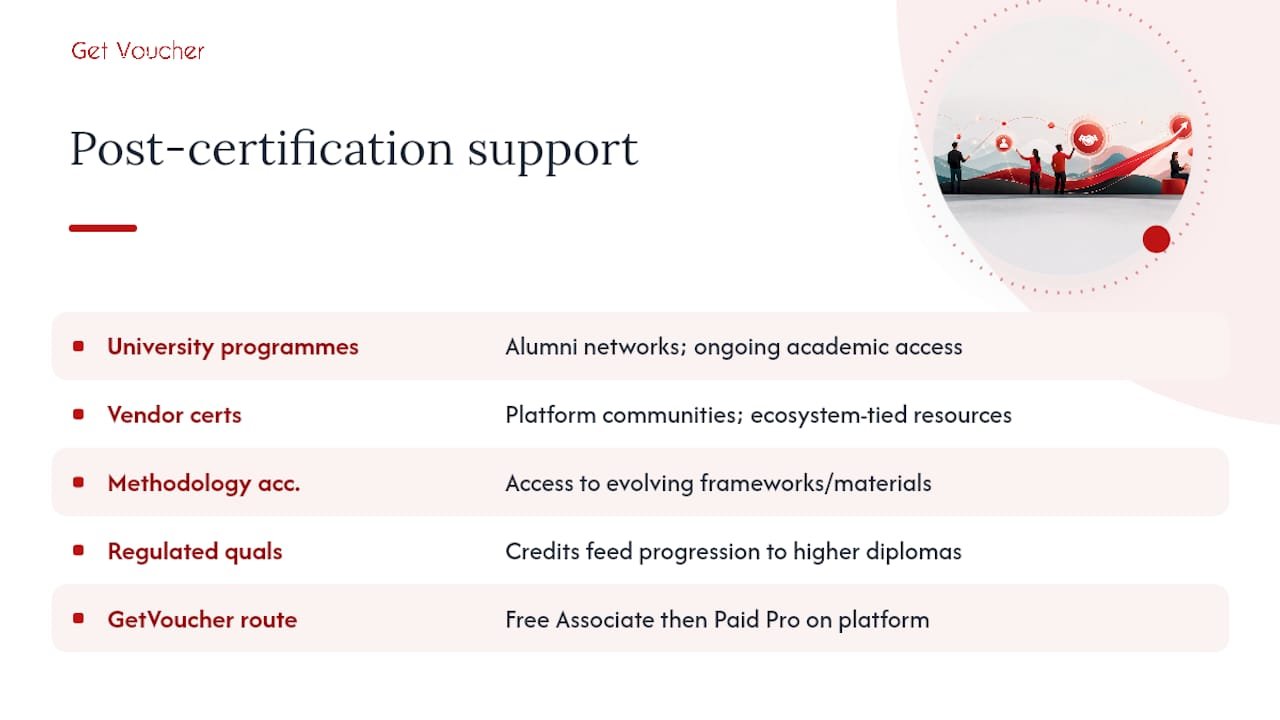
Support after certification varies more than the certifications themselves. University-run and larger vendor programmes, such as LSE’s negotiation course, tend to have structured alumni networks and access to further academic content, since they’re built as part of an ongoing educational relationship rather than a one-off credential.
Vendor certifications from HubSpot and Salesforce typically link into broader platform communities and knowledge bases, useful if you’re staying within that software ecosystem, but less relevant once you move employers or tools. Methodology-specific accreditations, like Challenger’s trainer programmes or MEDDPICC masterclasses, often include ongoing access to updated frameworks and materials as the methodology itself evolves, which suits professionals expected to keep applying that method over years.
Regulated, unit-based qualifications generally offer the clearest continuing education routes, since credits earned at one level typically feed into progression towards the next certificate or diploma, as set out in specifications like ISP’s Level 5 structure. For GetVoucher’s own courses, the natural continuing education route is straightforward: complete the free Corporate Sales Associate first, then progress to the paid Corporate Sales Pro when you’re ready for deeper methodology and leadership content, both accessed through the same voucher platform without switching providers.
A publisher’s view on making certification actually pay off
Certification on its own rarely changes how someone sells. What changes behaviour is certification combined with something that forces application: scored role-play, a manager watching a real call, or a coach reviewing your pipeline against what you just learned. If you take one thing from this shortlist, take that.

Choose Corporate Sales Associate if you’re new to sales, testing whether the profession suits you, or want a credential at zero cost before committing further. Move to Corporate Sales Pro once you’ve got some deals under your belt and want structured methodology and early leadership content rather than another round of basics.
If you’re arranging vouchers for a wider team rather than yourself, get in touch with GetVoucher directly, we handle corporate and bulk voucher enquiries and can talk through pricing and availability for certifications not yet listed on the platform.
— Rayan
Get your sales certification voucher through GetVoucher
GetVoucher is the simplest way to get a sales certification voucher without chasing separate providers, exam bodies, and payment portals. Every course on the platform, including both Corporate Sales courses, is issued under SMstudy as the certifying body, with VMEdu as the main provider behind the curriculum, so you’re buying from one place rather than piecing together a pathway yourself.
If you’re weighing up which pathway fits, the choice is fairly clear-cut. Corporate Sales Associate suits career starters or anyone wanting a free, low-risk first credential before committing further time or money. Corporate Sales Pro suits reps with some experience who are ready for methodology depth and early leadership content, and who want a paid, more structured step up from the free tier.
Beyond sales, GetVoucher’s certifications catalogue covers Agile, Quality Management, and Digital Marketing, worth a look if you’re building complementary skills alongside your sales credential. Browse the course pages above, check current availability, and if you need pricing for a corporate or bulk order, contact GetVoucher directly to discuss options.
Sources
- The 7 best certifications to advance your professional sales career
- 13 Must-Have Sales Certifications for Your Team in 2026
- ISP Level 5 Qualification specification
- LSE programme on negotiation