




Every certification retake policy differs by provider, and the gap between them can cost you real money and weeks of waiting. Before you pay for another attempt, check four things: the waiting period, the attempt cap, whether your voucher already covers a retake, and how to report a technical fault if the exam itself let you down.
TL;DR:
- Waiting periods after failed attempts vary from same-day or 24 hours to up to 365 days, depending on the exam provider and level.
- Most candidates pay full fees for each retake unless they have specific vouchers that include discounts or free attempts, which are rare.
- Technical faults allow limited waivers for skipping waiting periods, but only with documented proof submitted within 48 hours of the incident.
- Exam attempt caps differ significantly: Google Cloud limits most attempts to four within two years, while foundational exams may allow up to ten annually.
- Always verify official retake rules directly from the certification provider before rebooking, as policies can change frequently.
Table of Contents
- What is a certification retake policy, and why does it vary by provider?
- How long do you have to wait between attempts?
- Who pays for a retake, and does your voucher cover it?
- When can you skip the waiting period entirely?
- What should you check before buying a voucher or booking a retake?
- What should you do after failing, and how do you prepare for a stronger retake?
- How GetVoucher helps you plan a retake without surprises
- GetVoucher: check voucher terms before you rebook a retake
- Where to verify the official retake rules
- Sources
What is a certification retake policy, and why does it vary by provider?
A certification retake policy is the set of rules a provider applies when you fail an exam and want another go, covering waiting periods, fees, attempt caps and whether passing later blocks you from sitting the same exam code again. The variation exists because providers weigh exam integrity, lab capacity and scoring workload differently.
Written, multiple-choice exams tend to have the shortest waits because rescoring and rescheduling are automated. Lab or practical exams, which need scheduled infrastructure or manual grading, usually carry longer, stricter waits. That is one reason lab-based certification exams commonly enforce tighter retake limits than written ones, rather than an arbitrary provider choice.
Exam level matters too:
- Foundational exams often permit more attempts per year, since the stakes and content depth are lower.
- Associate and professional exams usually cap attempts more tightly and add longer waits between later tries.
- Beta or newly released exams sometimes follow separate rules while scoring data is still being validated.
Once you pass, most programmes will not let you sit the identical exam code again to “improve” your score. AWS and CompTIA policy guidance both confirm that a passed exam stays passed until a new version replaces it, at which point recertification through renewal becomes the relevant path rather than a retake.
How long do you have to wait between attempts?
Waiting periods cluster into a handful of predictable tiers, and knowing which one applies to your exam saves you from rebooking too early and losing your slot fee.
- No wait, or a same-day retake. CompTIA requires no waiting period between a first and second attempt, though you pay full price again.
- A short 24 hour cooling-off window. Some Microsoft role-based exams use this before you can rebook.
- A 14 day wait. This is the most common middle tier. AWS applies a flat 14 calendar day wait after any failed attempt, and CompTIA switches to 14 days from the third attempt onward.
- A 60 day wait. Google Cloud escalates to a 60 day wait after a second failed attempt on associate and professional exams.
- A 365 day wait, or an annual cap. Google Cloud caps most professional exams at four attempts within a rolling two-year window, with the wait extending to a full year beyond that.
Plan your revision time around whichever tier applies. A 14 day wait is tight for closing a real knowledge gap; a 60 or 365 day wait gives you room to rebuild a proper study plan rather than cramming.
Who pays for a retake, and does your voucher cover it?
The default across the certification industry is that you pay the full exam fee every time you sit, retake included. Free or discounted retakes are the exception, not the rule, so treat any claim of an included retake with a healthy dose of scepticism until you have read the fine print.
- Standard model: each attempt, pass or fail, is billed separately at the standard exam price.
- Occasional free-retake vouchers: a small number of professional-level exams bundle one free retake with the original purchase. HashiCorp’s programme is a documented example, but even there the voucher usually has to be claimed within a short fixed window, often around three months, and requested through a support request rather than applied automatically.
- Discount vouchers vs retake vouchers: these are not the same thing. A discount voucher lowers the price of a future exam; a retake voucher specifically waives or reduces the fee for resitting the exam you just failed.
Always check the exact wording of your voucher’s terms and conditions before you buy, including its expiry date and whether it covers rescheduling as well as a full retake. GetVoucher’s own refund policy sets out how rescheduling and cancellation claims are handled on vouchers purchased through the platform, which is the kind of detail worth reading before, not after, a failed attempt.
When can you skip the waiting period entirely?
Waivers exist, but they are narrow and require paperwork, not persuasion. Providers grant them almost exclusively when the exam itself failed you, not when you simply ran out of time or froze on a question.
Evidence that actually works in a waiver request includes a proctor’s incident report, a support case number opened at the moment the fault occurred, and timestamped connection or session logs from the exam platform. Microsoft’s support documentation makes clear that a documented case number logged at the time of the failure is usually the deciding factor, not a description of the problem written days later.
To request one, contact the provider’s exam support team within 24 to 48 hours, attach your evidence, and expect a decision within several business days rather than instantly.
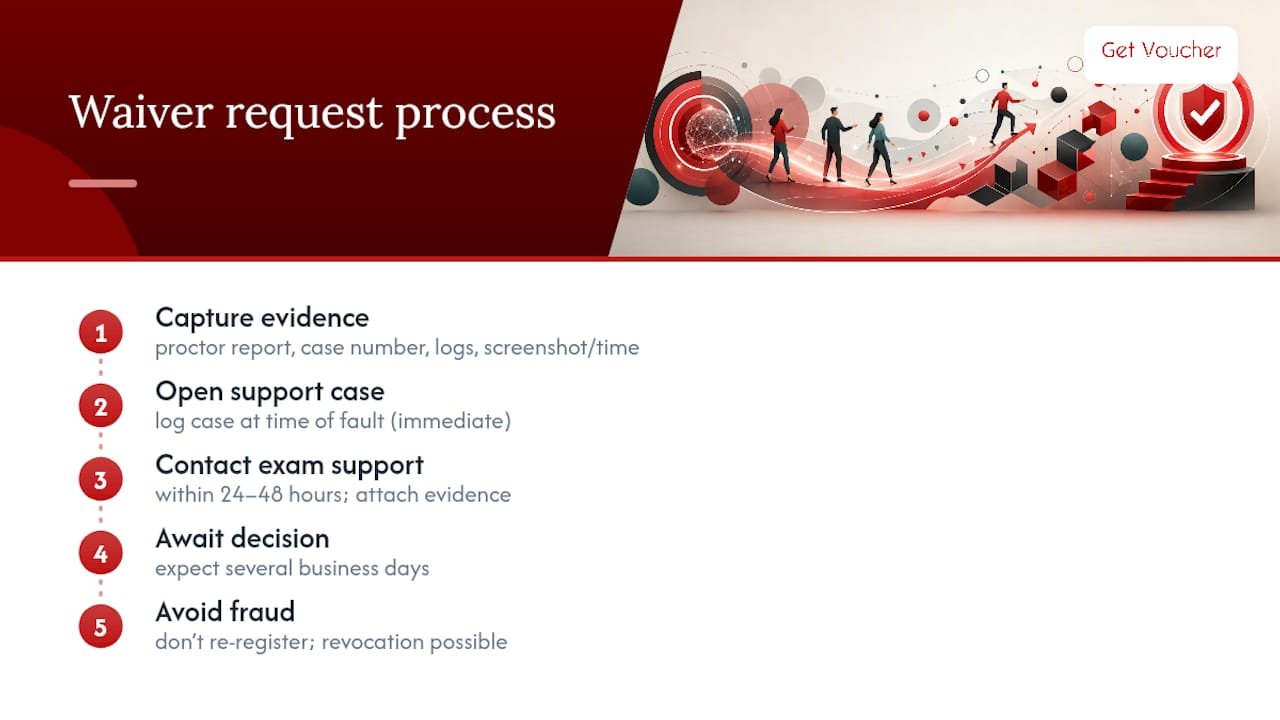
Pro Tip: Screenshot the error message and note the exact time it happened before you close the exam window. That single habit makes or breaks a waiver claim.
One serious warning: attempting to dodge a waiting period by registering under a different name, email or account is treated as fraud by every major provider. Google Cloud’s certification terms state plainly that circumventing retake rules can lead to permanent revocation of certifications and a testing ban.
What should you check before buying a voucher or booking a retake?
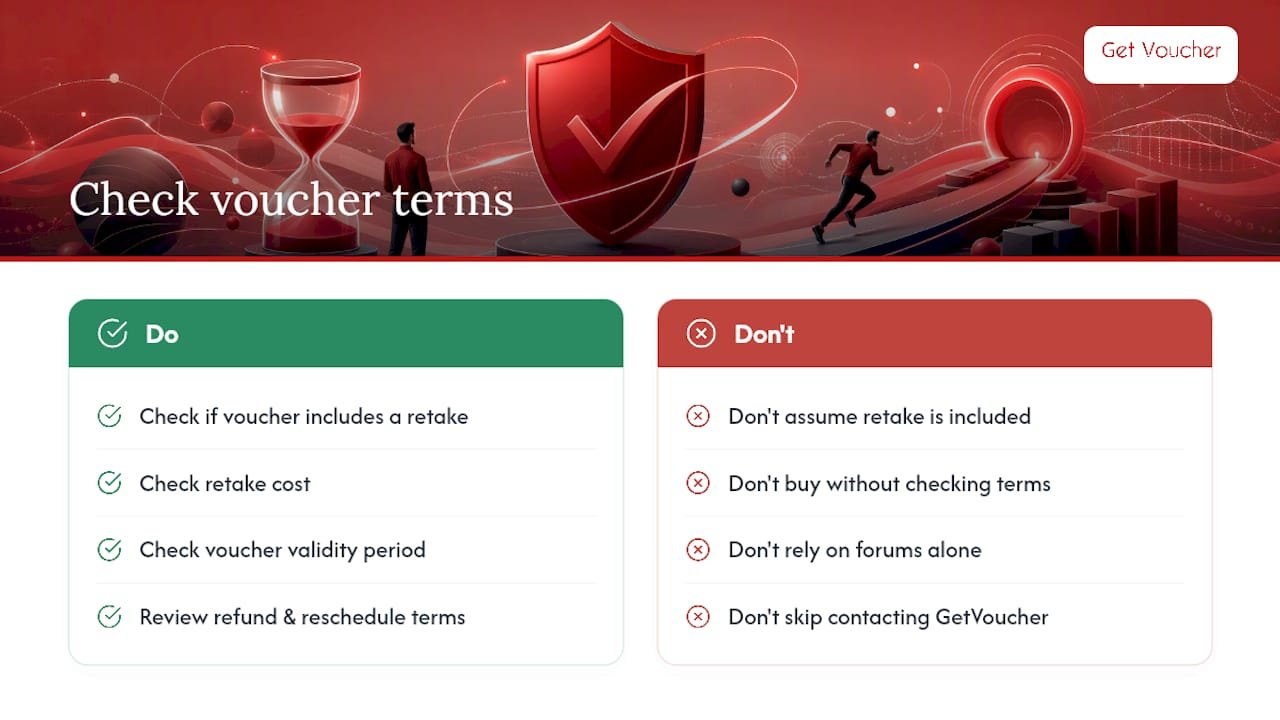
A few minutes of checking before you pay avoids most of the expensive surprises candidates run into.
- Confirm the exact waiting period for your specific exam code, not a general assumption from a different provider.
- Check the maximum number of attempts allowed and whether that cap resets annually or rolls over a fixed period.
- Read the voucher’s terms to see if a retake is included, discounted, or requires a brand new voucher purchase.
- Note the voucher’s expiry date; an unused retake voucher that lapses is money lost.
- Confirm that passing does not automatically bar you from a future renewal attempt on an updated exam version.
- Check the reschedule, cancellation and refund rules, and save the support contact details somewhere accessible.
Attempt caps differ sharply by provider and level. Google Cloud limits most associate and professional exams to four attempts within a rolling two year period, while foundational-level exams under the same brand can allow up to ten attempts a year. That gap alone shows why checking your specific exam’s terms matters more than assuming a single industry standard.
What should you do after failing, and how do you prepare for a stronger retake?
A failed attempt is a data point, not a dead end. Treat it that way and your second attempt gets noticeably better odds.
- Request your score report or diagnostic breakdown as soon as it is available, and read it domain by domain rather than glancing at the overall percentage.
- Confirm your retake window and fee against the provider’s own policy page so you are not caught out by an unexpected charge or a wait you did not plan for.
- Open a support case immediately if you believe a technical or proctoring fault affected your result, before that evidence trail goes cold.
- Target your weakest domains from the score report rather than re-studying everything you already know.
- Book a timed practice test close to your retake date to rebuild exam pacing, not just topic knowledge.
Pro Tip: Wait until your score report identifies your weakest domain before booking a study bundle. Studying broadly again wastes the exact time a shorter wait tier already limits.
If you are working towards an SCRUMstudy™, SMstudy®, 6sigmastudy® or similar VMEdu-affiliated credential, keep an eye out for promotional retake vouchers, and give yourself enough time between attempts to genuinely close the gap rather than resitting on hope.
How GetVoucher helps you plan a retake without surprises
GetVoucher exists to remove the guesswork around voucher terms, not to set retake rules ourselves. Every certification on the platform sits under its actual certification body, whether that is SCRUMstudy, 6sigmastudy or another VMEdu-affiliated brand, and the official provider remains the source of truth on waiting periods and attempt limits. Our role is centralising that voucher information, the linked study resources, and refund terms in one place so you are not hunting across five different provider websites the night before a rebooking.
— Rayan
GetVoucher: check voucher terms before you rebook a retake
GetVoucher is the practical alternative to piecing together exam terms from scattered provider forums. Before you spend money on a second attempt, you can check whether a certification’s voucher already includes a retake, what it costs if it does not, and how long the voucher stays valid, all from one certifications page rather than five separate sites.

Every voucher sold through GetVoucher is backed by clear refund and rescheduling terms, so you know exactly what happens if an exam gets cancelled or a retake falls outside the covered window. For certifications not yet listed on the platform, including some newer SMstudy®, KANBANstudy™ or BAlearning® pathways, they are planned for the coming months. Contact GetVoucher directly for current pricing and availability if you cannot find the credential you are after.
If you are unsure whether a retake is worth the spend versus starting a fresh certification track, the GetVoucher ROI Diagnostic is a useful next step for weighing that decision before you buy. Browse the current certification catalogue and check a voucher’s terms before your next booking.
Where to verify the official retake rules
Provider terms change, so always confirm the current rules directly with the certification body rather than relying on secondhand summaries. Start with CompTIA’s retake policy, AWS Certification’s after-testing rules, Google Cloud’s exam terms, and, for a look at how retake rules differ outside IT certification entirely, LLQPGuide’s overview of Canadian insurance exam waiting periods.
Sources
- CompTIA Certification Retake Policy | CompTIA IT Certifications
- After Testing | Information and Policies | AWS Certification
- Exam terms and retake policy | Google Cloud Certification
- Exam and Applied Skills assessment lab retake policies — Microsoft Learn