




Certification helps your CV get noticed, but it will not make you an Agile coach on its own; experience coaching real teams through real conflict does that. The smartest path prioritises credentials matched to your context: coaching-skills training such as ICP-ACC, enterprise accreditation like CEC/CTC or SAFe SPC, and, where relevant, a professional coaching credential from the ICF. GetVoucher gives you voucher access and preparatory materials for many of the foundational and coaching-oriented steps along that route.
TL;DR:
- Certification alone does not guarantee a coaching role; real experience leading teams through conflicts is essential for becoming an Agile coach.
- Credentials like ICP-ACC, CEC/CTC, and SAFe SPC vary in rigor, purpose, and recognition, with assessed and portfolio-based credentials offering greater credibility.
- Building a coaching career requires progressing from foundational Agile literacy to practitioner roles and then to coaching-specific training, often over several years.
- Employers value enterprise credentials like CEC/CTC for senior roles, while coaching-skills certifications mainly serve as formal proof of coaching ability.
- Preparation involves a mix of self-paced courses, live training, building a coaching portfolio, and understanding that certification is a step in a multi-year development process.
Table of Contents
- What does agile coach certification actually cover?
- What competencies do these certifications actually teach?
- Building your roadmap from practitioner to coach
- Choosing the right certification for your context
- Preparing for certification: formats, vouchers and exam logistics
- GetVoucher: supporting your certification roadmap
- Renewal and continuing education requirements
- Typical costs and investment needed for each path
- How long does it take to become an Agile coach?
- Career paths and roles after certification
- Do all certifications carry the same weight?
- Author view: a realistic way to build toward Agile coaching
- Where to start with GetVoucher
- Sources
- FAQ
What does agile coach certification actually cover?
Agile coach certification is not one exam or one badge. It is a landscape of credential families, each built for a different stage of your career and a different kind of employer expectation.
At the practitioner end sit Scrum Master and Product Owner certifications, which prove you understand the mechanics of a single team’s delivery cadence. Above that sit coaching-specific credentials like ICAgile’s ICP-ACC, which trains coaching stances, facilitation and mentoring rather than delivery mechanics. At the top, enterprise-recognised accreditations such as Scrum Alliance’s CEC/CTC or the SAFe SPC/SPCT track require documented track records, not just attendance, because they recognise established coaches rather than acting as an entry route. PMI-ACP sits somewhere in between, validating broad Agile knowledge across multiple frameworks rather than coaching depth specifically.
The distinctions that matter most when comparing options:
- Attendance-backed certificates confirm you sat through training, nothing more.
- Assessed-competency credentials (many CSM/PSM-style exams) test knowledge through a scored test.
- Portfolio or peer-reviewed credentials (CEC/CTC) require evidence of real coaching engagements, references and case history.
You do not strictly need certification to work as an Agile coach. Employers still value experience heavily, but credentials such as ICP-ACC and Scrum Alliance coaching pathways do improve employability, particularly for professionals moving between organisations or countries where nobody yet knows your track record. If you are already coaching informally and want a credential that formalises pure coaching skill, an ICF credential (ACC or PCC) is worth considering alongside the Agile-specific options, since it assesses coaching practice independent of any single framework.
What competencies do these certifications actually teach?
Different credentials sharpen different muscles, and knowing which is which saves you from buying training that duplicates what you already know.
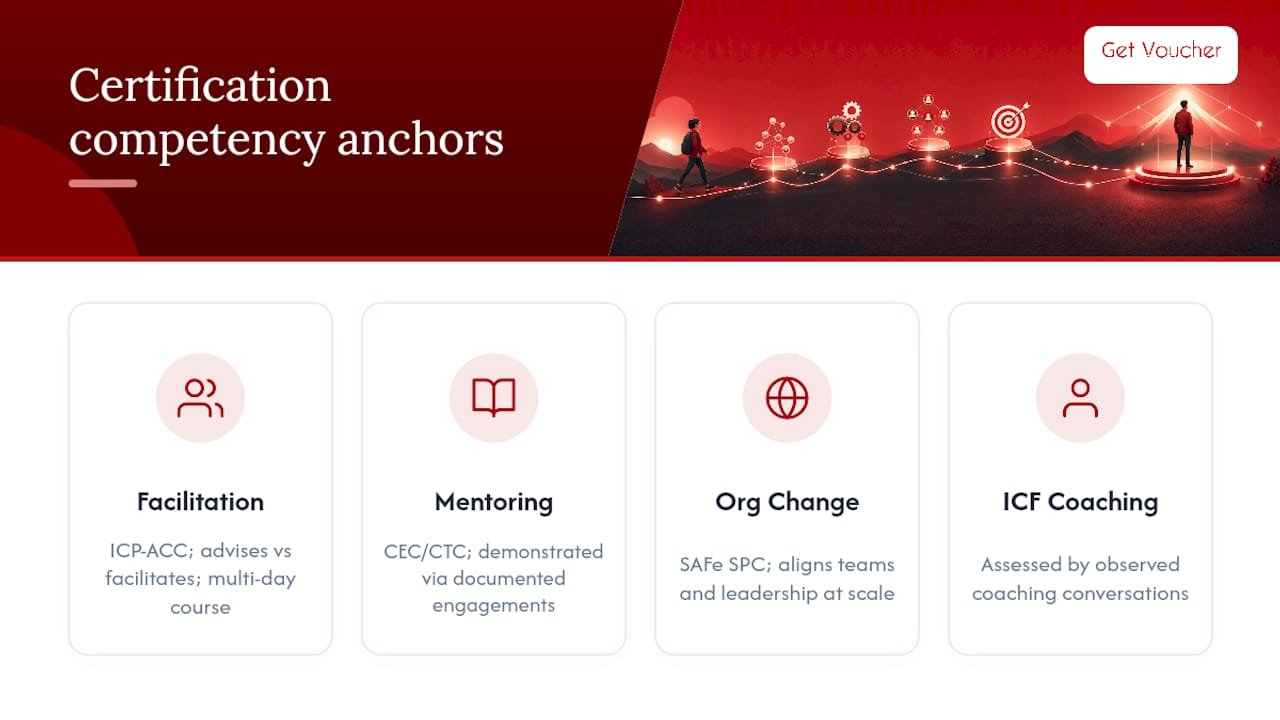
Coaching stance and facilitation. ICP-ACC concentrates heavily here, teaching you when to advise, when to facilitate, and when to step back entirely. It is commonly delivered as multi-day, instructor-led training rather than a solo exam.
Mentoring and teaching. Enterprise credentials like CEC/CTC expect you to demonstrate this through documented engagements, not classroom exercises.
Systems thinking and organisational change. SAFe’s SPC track builds this at scale, focused on aligning multiple teams and leadership layers around a single operating model.
Professional coaching competency. ICF credentials assess this directly, independent of any Agile framework, through observed coaching conversations.
A widely repeated caution in the industry deserves airtime here: some certifications range from a one-day attendance proof to a rigorous multi-stage assessment, and the two are not interchangeable however similar the certificate looks on LinkedIn. The practical rule is to match the assessment rigour to what you actually need proven. If you need to prove you can facilitate a retrospective, training-led ICP-ACC is fine. If you need to prove years of transformation leadership to a hiring panel, only a reviewed credential like CEC/CTC carries that weight.
Building your roadmap from practitioner to coach
Most professionals who reach Agile coaching did not start there. They built up through team-level roles first, and the sequencing matters more than people expect.
- Foundations. Start with core Scrum and Agile literacy. A Scrum Fundamentals Certified voucher or equivalent short course gets you conversant in sprints, backlogs and ceremonies without a heavy time commitment.
- Practitioner credentials. Move into role-specific certification: SCRUMstudy’s SAMC (Scrum Master Certified) or SMC (SCRUMstudy Master Certified), or an equivalent Product Owner credential like SPOC (SCRUMstudy Product Owner Certified). A Dual Agile Pack covering both Scrum Master and Product Owner knowledge is a practical way to build breadth in one step.
- Broaden your delivery toolkit. Kanban method training (from brands such as KANBANstudy) and business analysis fundamentals (BAlearning) strengthen the systems view coaches need, since real transformations rarely run on Scrum alone.
- Coaching-skills training. ICP-ACC, and where relevant an ICF ACC credential, shift you from “runs the process” to “develops the people and the system”.
- Enterprise accreditation. CEC/CTC or SAFe SPC come last, once you have years of engagements behind you, because most Agile coaches progress from team roles and accumulate substantial experience before applying for high-bar credentials.
Pro Tip: Do not skip step 3. Coaches who only ever studied Scrum tend to struggle the moment a team’s real bottleneck turns out to be a business analysis gap or a Kanban flow problem rather than a ceremony issue.
Choosing the right certification for your context
Not every credential suits every career stage, and picking the wrong one wastes money and, worse, time you cannot easily get back once a project deadline has passed.
Work through these axes before you commit to a course:
- Role scope. Are you coaching one team or an entire department? Enterprise credentials only make sense at the second scale.
- Employer expectations. Some organisations specify a named credential in job postings; others only care that you can demonstrate the skill.
- Assessment rigour. Decide whether you need a certificate that proves attendance or one that proves assessed competence.
- Prerequisites. Many enterprise-level credentials require documented coaching hours or references, so check before you pay.
- Time and cost. Multi-day coaching-skills training demands a real calendar commitment; short online courses do not.
Ask any provider directly: what does the assessment actually test, how many coaching hours (if any) are required, what triggers renewal, and is delivery self-paced, live remote, or in-person? A red flag worth watching for is any credential that promises coaching authority after a single online video with no interaction, assessment or feedback loop at all.
Preparing for certification: formats, vouchers and exam logistics
Delivery formats vary by credential. Foundational courses like Scrum Fundamentals are commonly self-paced online. Coaching-skills training such as ICP-ACC tends to run as live, multi-day, instructor-led sessions. Enterprise and portfolio-based credentials involve written applications and peer review rather than a single sitting exam.
Vouchers simplify the paperwork layer of this process. Instead of juggling separate payments, scheduling portals and study materials from different vendors, a voucher gives you one purchase that unlocks course access, self-paced video training and, where applicable, scheduling for an online proctored exam.
- Book your proctored exam window around a quiet week, not the same week as a sprint deadline.
- Record a handful of your own facilitation or coaching sessions to build a review portfolio early, well before any enterprise credential asks for one.
- Keep a simple coaching log: what the team’s problem was, what you did, what changed.
Pro Tip: Start your coaching log the day you begin practising, not the day you decide to apply for CEC/CTC. Portfolio credentials reward documented history, and history cannot be written retroactively.
GetVoucher: supporting your certification roadmap
GetVoucher works as the voucher platform sitting alongside VMEdu, the main training provider, and the specific certification bodies, such as SCRUMstudy, behind each credential. That means you buy one voucher and get a clear route through provider materials rather than hunting across separate sites.
Certifications available now through GetVoucher include:
- Scrum Fundamentals Certified, a low-friction entry point
- Dual Agile Pack, covering Scrum Master and Product Owner knowledge together
- SAMC (SCRUMstudy Agile Master Certified)
- SMC (SCRUMstudy Master Certified)
- SPOC (SCRUMstudy Product Owner Certified)
Each voucher purchase includes access to self-paced video training and support for scheduling your online proctored exam, cutting the admin overhead of preparing for certification around a working schedule. Certifications from other VMEdu brands, including KANBANstudy, BAlearning, NGstudy, RMstudy and 6sigmastudy, are planned for the coming months. If you need one of these sooner, contact GetVoucher directly for current availability and pricing.
Renewal and continuing education requirements
Most Agile and Scrum credentials are not permanent. They expect ongoing engagement with the field, usually through continuing education units, renewal fees, or periodic re-registration, though the exact mechanics differ by certification body and change over time.
The practical habit worth building is simple: track your certification’s renewal window the moment you earn it, rather than discovering a lapse when a client or employer asks to verify it. Coaching-focused and enterprise credentials, such as CEC/CTC, typically expect evidence of continued practice, not just a fee payment, because they are meant to reflect an active coach rather than a historical one. Foundational Scrum and Agile certificates tend to have lighter renewal requirements, sometimes limited to a periodic fee.
Because renewal rules, fees and continuing education unit counts are set and updated by each certification body directly, always confirm current requirements on the official provider page rather than relying on secondary guides, which can lag behind policy changes. GetVoucher’s own guidance on maintaining your SCRUMstudy certification is a useful starting point if you hold or are pursuing a SCRUMstudy credential specifically.
Build renewal into your annual planning the same way you would a professional membership. A lapsed credential rarely damages your reputation outright, but reinstating it later is more friction than simply keeping it current.
Typical costs and investment needed for each path
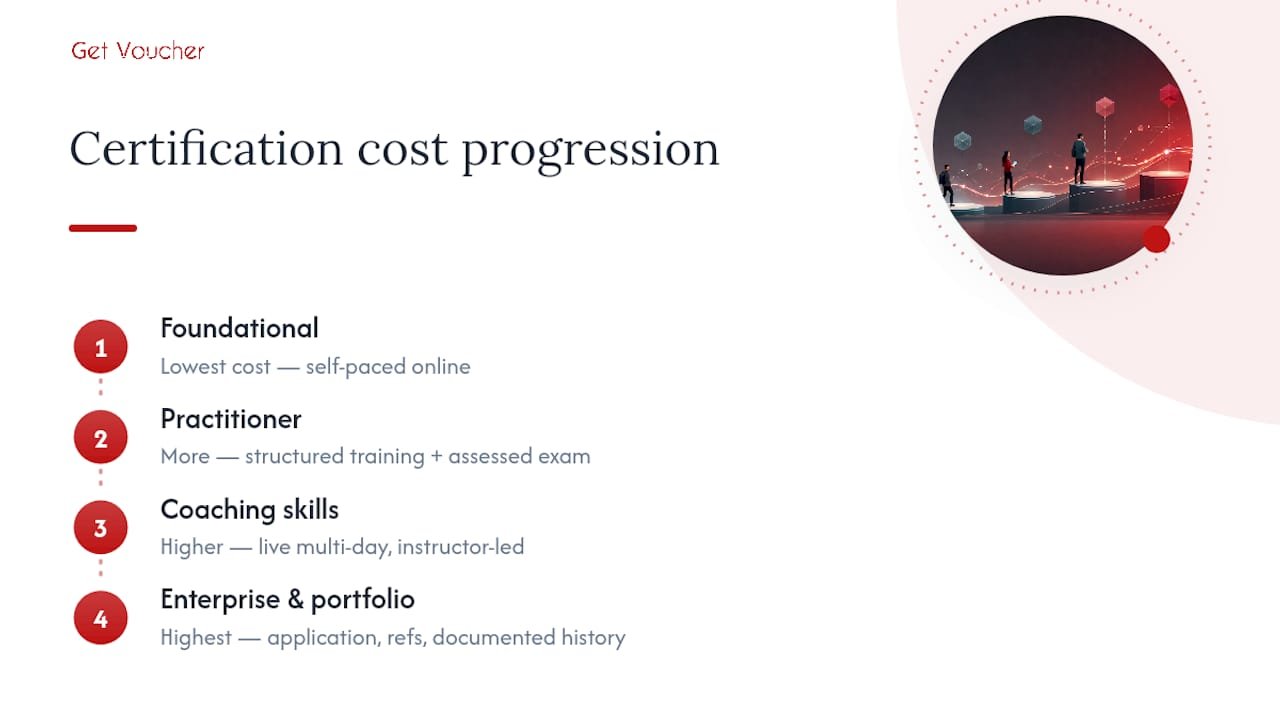
Certification costs scale with rigour and scope, and the jump between tiers is real. Foundational Scrum and Agile courses, often delivered as self-paced online training with a proctored exam, sit at the lower end of the cost spectrum and represent the smallest financial commitment in the entire roadmap.
Practitioner-level credentials, such as Scrum Master or Product Owner certifications, cost more than pure foundational courses because they combine structured training content with an assessed exam. Bundled options, like a dual-role pack covering two practitioner credentials at once, can be a more efficient use of budget than buying each separately, since the study materials often overlap.
Coaching-skills training, particularly ICP-ACC, tends to carry a higher price tag than practitioner certificates because it is delivered as live, multi-day, instructor-led training rather than self-paced video, and instructor time is the largest cost driver in any credential.
Enterprise and portfolio-based credentials (CEC/CTC, SAFe SPC/SPCT) represent the largest investment of the entire roadmap, not only in fees but in the time needed to prepare an application, gather references and document a coaching history that meets the bar.
Exact fees vary by provider, region and current promotions, so treat any number you see elsewhere as a starting estimate rather than a fixed figure. GetVoucher does not publish invented pricing here; check the certifications page for current voucher pricing on available credentials, and contact GetVoucher directly for guidance on certifications still in the pipeline. Budgeting in stages, foundational first, coaching-skills second, enterprise last, spreads the investment across your actual career timeline instead of front-loading cost before you know which path fits.
How long does it take to become an Agile coach?
There is no fixed timetable, and anyone promising one is oversimplifying a genuinely variable process. What is consistent is the shape of the journey: knowledge first, then practice, then formal recognition of that practice.
Foundational literacy, covering Scrum basics and one practitioner certification, can realistically be achieved within a few months of part-time study, since the training itself is short and largely self-paced. That is the fast part of the roadmap.
The slow part is what comes next. Hiring managers commonly expect several years working as a Scrum Master or in an equivalent practitioner role before someone is considered ready to coach at scale, because coaching credentials work best as validation of skills you already practise, not as a shortcut around gaining them. Coaching-skills training like ICP-ACC can be layered in during this period. It is training-led rather than tightly assessed, so it suits someone actively coaching who wants a structured skill boost, not someone hoping it substitutes for field time.
Enterprise accreditation sits at the far end of the timeline, often years into a coaching career, once you have a documented history of engagements to submit for review. Treat the roadmap as a multi-year arc rather than a single course you complete and then stop. The professionals who move the fastest through it are usually the ones already coaching informally, using certification to formalise ground they have already covered, not those studying credentials in isolation from practice.
Career paths and roles after certification
Certification changes what doors open, but the role you step into depends heavily on scope. A Scrum Master typically owns a single team’s process, while an Agile coach works across multiple teams or at organisational level, driving alignment between leadership and delivery. That distinction shapes what a hiring panel expects from your CV at each stage.
Early-career roles after practitioner certification include Scrum Master, Product Owner, or Agile Team Facilitator, where the job is largely about running one team’s cadence well. Progressing into an Enterprise Agile Coach or Transformation Coach role typically follows once you have led multiple team-level engagements and can speak to organisational change, not just sprint mechanics.
Some coaches specialise further into Release Train Engineer roles within SAFe-based organisations, which sit close to coaching but focus specifically on coordinating multiple Agile teams delivering together. Others move toward internal consulting positions advising leadership on operating model changes, work that increasingly overlaps with broader business strategy conversations; firms offering digital transformation consulting often draw on exactly this coaching background when building change programmes.
The skills that carry weight at each stage shift too. Practitioner roles reward process discipline. Coaching roles reward facilitation, mentoring, and the judgement to know when to step back rather than direct. Enterprise roles reward systems thinking, the ability to see how team-level friction connects to structural or leadership issues elsewhere in the organisation, a capability platforms like Opsphere are built to support at an operational level.
Do all certifications carry the same weight?
No, and treating them as interchangeable is one of the more common mistakes professionals make when planning a credential budget. Recognition varies by rigour, provider reputation, and how closely the credential’s assessment matches what employers actually need proven.
Enterprise-level credentials like CEC/CTC carry particular weight precisely because they are hard to get. They require documented experience, references and peer review, so holding one signals an established track record rather than recent training. That scarcity is the source of their recognition. Employers hiring for senior transformation roles often use these credentials as a shorthand filter specifically because they cannot be earned quickly.
Coaching-skills credentials like ICP-ACC sit differently. They are widely respected as a practical, accessible way to learn coaching stances, but because the format is training-led rather than tightly assessed, employers tend to read them as evidence of study rather than proof of seniority. That is not a weakness, it simply means ICP-ACC answers a different question than CEC/CTC does.
Foundational and practitioner credentials (Scrum Master, Product Owner certifications) carry the broadest name recognition simply because so many professionals hold them, which paradoxically makes them less differentiating on a CV even though they remain genuinely useful for the skills they teach. Demand for coaching roles generally exists because team-level Scrum Master experience alone cannot manage culture-wide or system-level change, which is exactly why the credential landscape splits the way it does, into team-level, coaching-skills, and enterprise tiers rather than one flat certification.
Author view: a realistic way to build toward Agile coaching
Prioritise practice before paperwork. Coach informally where you can, inside your current team if nothing else, and let the credentials you pursue afterwards simply confirm skills you already use. Vouchers matter here more than people expect: they let working professionals test a certification path in low-cost stages, without committing to a full classroom programme, before deciding whether coaching is genuinely where they want their career to go.
— Rayan
Where to start with GetVoucher
If you are ready to move on this, GetVoucher is built precisely for the stage you are at, whether that is your first Scrum credential or a coaching-focused step further along. Unlike piecing together separate courses, exam bookings and study guides from unrelated vendors, one voucher purchase gives you course access, self-paced video training and support scheduling your proctored exam in a single step.
Start on the certifications page to browse what is currently available, including SAMC, SMC, SPOC and Scrum Fundamentals Certified. If you are building both Scrum Master and Product Owner knowledge in one move, the Dual Agile Pack is a practical way to cover two practitioner credentials with a single voucher and one set of study materials.
Not sure which credential actually fits where you are in your career? Contact GetVoucher directly, and mention your current role and where you want to head next; that is the fastest way to get honest guidance rather than guessing from a course catalogue alone.
Sources
FAQ
How can I become an Agile coach?
Build hands-on experience as a Scrum Master or practitioner first, then layer in coaching-skills training such as ICP-ACC, and pursue enterprise credentials like CEC/CTC only once you have a documented track record of coaching engagements.
How much do Agile coaches earn?
Earnings vary significantly by region, seniority and organisation size, and no single certification guarantees a specific salary outcome; treat certification as one factor among experience, scope and industry demand.
Will AI replace Agile coaches?
Coaching work centres on human dynamics, facilitation and organisational trust, areas where automated tools support the process but do not replace the judgement a coach brings to a room full of conflicting priorities.
Are Agile coach and Scrum Master the same role?
No. A Scrum Master typically focuses on one team’s delivery process, while an Agile coach works across multiple teams or at organisational level to drive broader transformation.
Recommended
- Dual Agile Pack: Scrum Master & Product Owner Certification!
- The Complete Scrum & Agile Guide (2026): Certifications, Frameworks & Career Roadmap
- Scrum Master vs Product Owner: Which Agile Role and Certification Is Right for You?
- Becoming an Effective Scrum Master: Essential Skills and Best Practices