




RMstudy certification refers to VMEdu’s Risk Management course, a self-paced training programme that issues a course-completion certificate once you finish the material and pass the built-in assessments. It suits practising professionals who want structured, practical grounding in risk identification and mitigation, not a multi-tier professional credential. GetVoucher does not currently sell RMstudy exam vouchers, but it can support related course access and preparation, and RMstudy may join its catalogue in the coming months.
Table of Contents
- What RMstudy certification actually covers
- Who the RMstudy course suits and what skills you’ll build
- Delivery formats, access duration and pricing to verify
- How to prepare: a study plan using RMstudy’s own resources
- Where RMstudy fits into your career development
- Exam eligibility and prerequisites for certification
- How to register and enrol on the RMstudy course
- What the certification exam actually involves
- Renewal and recertification requirements
- Benefits of RMstudy certification for career advancement
- Comparing RMstudy with other risk management credentials
- Why voucher-based access matters for busy professionals
- Get certified with GetVoucher’s course catalogue
- Sources
- FAQ
What RMstudy certification actually covers
RMstudy’s course content centres on the practical mechanics of managing risk across a project or business lifecycle. The syllabus moves through risk identification, qualitative and quantitative assessment, mitigation planning, and ongoing monitoring, with case examples woven through each stage rather than treated as an afterthought.
The courseware is built to make dense material digestible. According to VMEdu’s course overview, RMstudy provides preparatory training with detailed courseware, practical examples, self-paced e-learning videos, simulated tests, glossaries and flashcards.
- Risk identification techniques and common risk categories
- Qualitative and quantitative risk assessment methods
- Mitigation and response planning
- Monitoring and control across a project or operational lifecycle
- Worked case examples to apply the theory
Here’s the distinction that matters most: the certificate you receive on completion confirms you have finished the course and met its internal assessment, not that you hold an independent professional accreditation. Credentials such as PMI-RMP involve separate eligibility criteria and examinations set by their own governing bodies, and completing RMstudy does not substitute for that process.
Who the RMstudy course suits and what skills you’ll build
RMstudy tends to attract three kinds of learner: project managers who handle risk registers as part of a wider delivery role, dedicated risk analysts wanting a structured refresher, and career switchers moving into risk-adjacent functions who need a grounded introduction before taking on responsibility.
Working through the material, you should come away able to build a structured risk register, run through response planning options for common threat categories, and use risk matrices to prioritise what needs attention first. The case-based exercises are there to force decisions rather than just recognition, which is a more useful test of whether the concepts have actually landed.
- Structuring and maintaining a risk register
- Applying risk-response strategies (avoid, transfer, mitigate, accept)
- Reading and building risk matrices
- Working through case-based decision scenarios
That said, finishing the course demonstrates knowledge of these concepts. It does not, on its own, guarantee workplace competence, and employers will still judge you on how you apply the thinking under real pressure, with real stakeholders and incomplete information.
Pro Tip: Treat the case studies as rehearsal, not revision. Talk through your reasoning out loud as if explaining it to a project sponsor. That habit transfers far better to a real risk workshop than silently ticking through multiple-choice answers.
Delivery formats, access duration and pricing to verify
RMstudy’s official pages describe the course as comprehensive, and note both live online training and self-paced options, so you can choose structured sessions with an instructor or work through the material at your own pace.
- Self-paced e-learning with recorded videos and downloadable study guides
- Live online training with real-time instruction
- Classroom-style delivery referenced on some provider pages
Access typically covers the full courseware bundle: videos, simulated tests, glossaries and flashcards, giving you repeated attempts at practice questions rather than a single pass. Third-party resellers list similar self-paced packages with 180 days of access, though durations can vary by seller and package, so always check the live figure before paying.
Pricing noted on RMstudy’s own materials sits at a cost for three months of access, subject to confirmation on their official site. Confirm this figure directly on the RMstudy site before enrolling, since provider pricing and access windows can change without much notice.
How to prepare: a study plan using RMstudy’s own resources
A sensible run at this course follows a fairly predictable rhythm, and skipping steps tends to show up later in the simulated tests.
- Set a study schedule across the access window rather than cramming in the final fortnight.
- Take a simulated test early to see where your weak spots actually sit, not where you assume they are.
- Work through flashcards and glossaries for terminology you’ll need to recall quickly under pressure.
- Review the case studies properly, working out your reasoning rather than skimming the model answer.
- Re-test the weak areas rather than repeating a full practice exam from scratch each time.
GetVoucher’s role here is straightforward: it’s a voucher and course-access platform that helps professionals find structured pathways across Agile, Six Sigma, negotiation and related disciplines, with the aim of cutting down time spent hunting across scattered videos and documents. Where RMstudy access becomes available through GetVoucher, the same principle applies, one place to find the course, prepare, and track progress. Always confirm current course specifics and access details directly on the official RMstudy or VMEdu pages before you purchase anything.
Pro Tip: Book your simulated test attempts into your calendar like real appointments. Open access windows are the easiest thing to let slip once week one’s motivation fades.
Where RMstudy fits into your career development
A course-completion certificate works best as evidence of structured learning, something you can point to when you’ve moved from vague familiarity with risk concepts to being able to actually run a risk register on a live project.
The realistic next step after finishing is application, not filing the certificate away. Look for opportunities to use the frameworks on an actual piece of work, then keep a record of what you did and what it changed.
- Apply the risk-response frameworks on a current project, even a small one
- Document specific examples where you identified, assessed or mitigated a risk
- Check whether your employer requires a specific accredited credential (such as PMI-RMP) for the role you’re targeting
- Treat RMstudy as groundwork, not a substitute for that accredited credential where one is required
Recognition varies by employer and sector, so it’s worth asking directly rather than assuming a completion certificate covers a formal requirement.
Exam eligibility and prerequisites for certification
RMstudy’s course does not publish a formal, tiered eligibility structure the way some professional bodies do. There’s no documented requirement for prior certifications, a minimum number of project hours, or sponsor sign-off before you can enrol.
What RMstudy’s official pages do describe is a comprehensive course open to professionals wanting a practical grounding in risk management, regardless of where they currently sit in their career. That openness is part of the appeal for career switchers and generalists who don’t yet have a portfolio of formal risk credentials behind them.
If you’re weighing this against a professional-body credential such as PMI-RMP, expect the comparison to look quite different: those typically carry documented prerequisites around project experience hours and formal application review. RMstudy’s course-completion model doesn’t work that way, so don’t assume the two paths share an eligibility structure just because both cover risk management. Always check the current enrolment page directly, since provider requirements can be updated without much fanfare.
How to register and enrol on the RMstudy course
Enrolment for RMstudy runs through its own official course pages, where you select the delivery format (self-paced, live online, or classroom where available) and the access package that matches it.
The general flow looks like this: you choose your preferred format, confirm the access duration and price shown on the official page, complete payment directly with the provider, and receive login details for the courseware, videos and simulated tests. From there, progress happens on your own schedule if you’ve chosen self-paced access, or according to a fixed timetable for live online sessions.
Because GetVoucher does not currently sell RMstudy vouchers, learners wanting this specific course should enrol directly through RMstudy’s official site for now. If you’d rather explore certification pathways that are already live on GetVoucher, browse the certifications catalogue to see what’s available today, and get in touch with GetVoucher directly if you want to be notified when RMstudy access is added.
What the certification exam actually involves
Detail on RMstudy’s specific assessment format, such as question count, time limit, or a published pass mark, isn’t laid out in detail on the provider’s public marketing pages at the time of writing. What is documented is that the course includes simulated tests as part of the preparatory courseware, designed to mirror the style of questions you’ll meet in the final assessment.
Rather than guessing at pass thresholds or exam duration, the sensible approach is to check the enrolment page directly before you commit, since assessment design is exactly the kind of detail providers update as courses evolve. Treat the simulated tests within the course as your best available proxy for difficulty and format until you’ve confirmed the specifics for yourself.
This is worth flagging because assessment design varies enormously across the wider risk management training market. Some providers run online proctored exams with strict time limits; others use open-book, untimed course-completion checks. Don’t assume RMstudy follows either model without verifying it on the official page first.
Renewal and recertification requirements
RMstudy’s official pages do not currently document a formal renewal cycle, continuing education requirement, or recertification fee structure for its course-completion certificate. That’s a meaningful difference from professional-body credentials, which typically require you to log continuing education units within a set period to keep the credential active.
If maintaining a credential over time matters for your role or your employer’s requirements, check directly with RMstudy whether any renewal expectations apply to your certificate, since course-completion models can differ from the multi-year renewal cycles seen elsewhere in professional certification. Don’t assume the absence of documented renewal rules means none will ever apply. It simply means none are currently published.
For a sense of how renewal typically works on study-based credentials elsewhere in the VMEdu family, GetVoucher’s guide on maintaining your SCRUMstudy certification is a useful reference point, though the specific rules for that credential don’t automatically transfer to RMstudy.
Benefits of RMstudy certification for career advancement
The clearest benefit of RMstudy sits in the structure it gives to otherwise scattered self-study. Instead of piecing together risk management theory from forum posts and outdated slide decks, you get a single course with videos, simulated tests and case examples built around a coherent syllabus, which VMEdu positions as its core value proposition for learners who want modern, accessible delivery regardless of location.
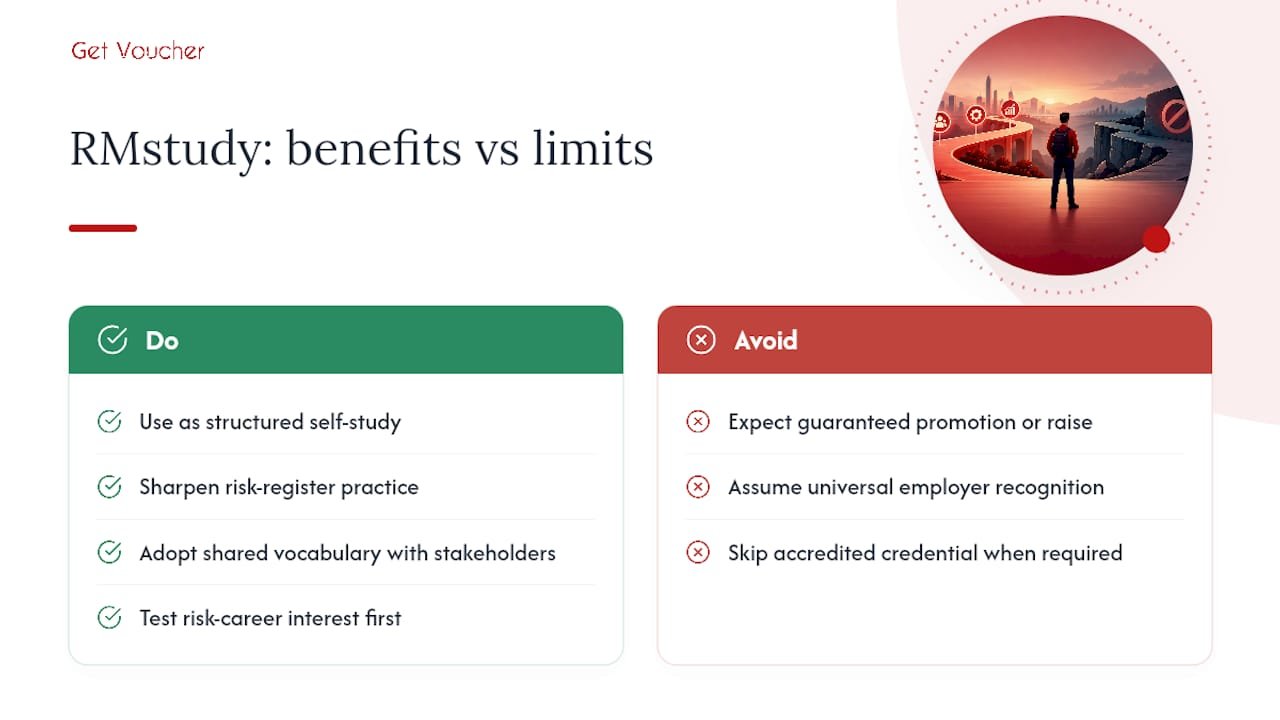
For project managers already handling risk registers informally, the course can sharpen how you structure that work and give you shared vocabulary to use with stakeholders. For career switchers, it offers a lower-commitment way to test interest in risk-focused work before pursuing a more demanding accredited credential.
What it doesn’t do is guarantee a promotion, a salary uplift, or automatic recognition from every employer. Those outcomes depend on your specific organisation, your demonstrated application of the skills, and in some cases whether an accredited credential is separately required for the role. Treat RMstudy as a genuine head start on the fundamentals, not a finish line.
Comparing RMstudy with other risk management credentials
The comparison that matters most isn’t RMstudy against a rival training provider. It’s RMstudy against professional-body credentials like PMI-RMP, because the two operate on fundamentally different models.
Professional-body credentials typically require documented project experience, a formal application review, and a proctored exam set independently of any single training provider. They exist specifically to signal a standardised level of competence recognised across employers and industries. RMstudy’s course-completion certificate, by contrast, confirms you have worked through VMEdu’s specific syllabus and passed its internal assessment, useful evidence of applied learning, but not built to the same independent verification standard.
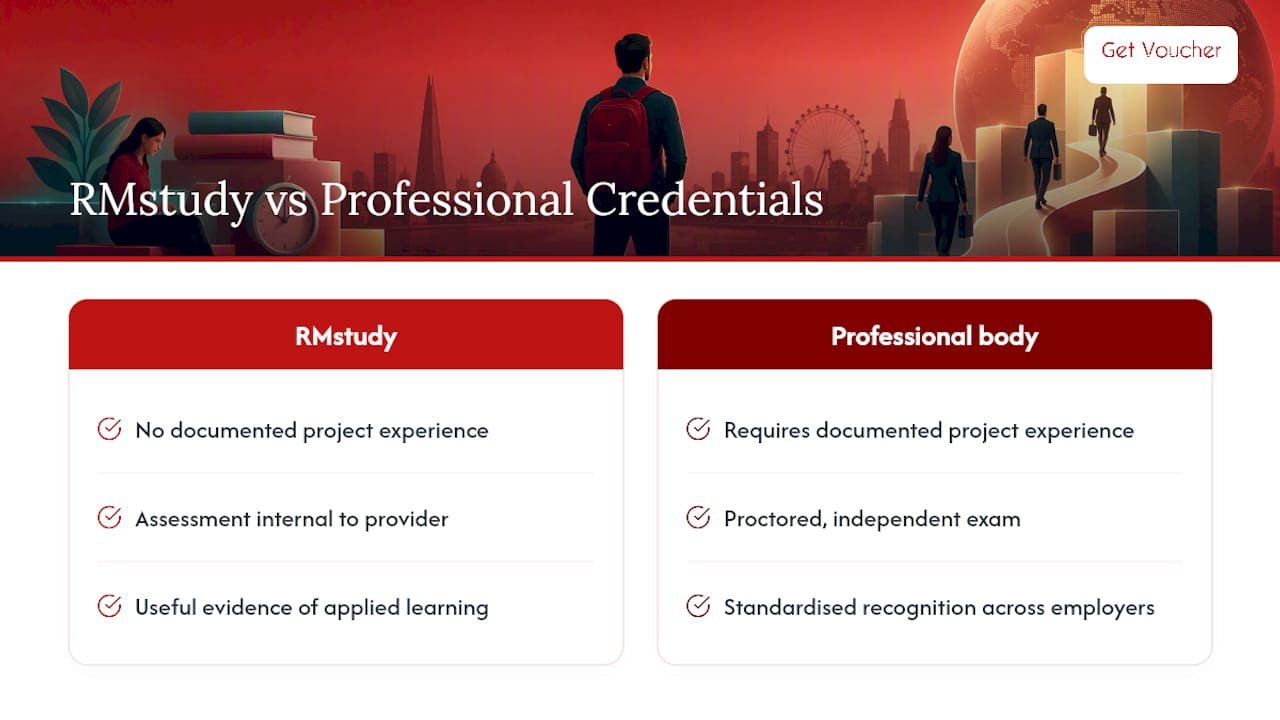
Neither model is inherently better; they answer different questions. If your employer explicitly requires a recognised professional credential for a role, RMstudy alone won’t satisfy that requirement. If you want a structured, practical introduction to risk management concepts before deciding whether to invest in that heavier credential, RMstudy’s format is built for exactly that use case.
Why voucher-based access matters for busy professionals
Flexible, voucher-enabled access solves a real problem for working professionals: fitting structured learning around a job that doesn’t pause for a course timetable. Self-paced formats with simulated tests and downloadable materials let you study in the gaps rather than blocking out a week you don’t have.
GetVoucher’s role is to make that access easier to find and manage across multiple disciplines, not to promise outcomes the course itself doesn’t guarantee. If RMstudy interests you, get in touch with GetVoucher to check current availability and course details.
— Rayan
Get certified with GetVoucher’s course catalogue
GetVoucher doesn’t currently carry RMstudy vouchers, and we won’t pretend otherwise, but the platform is built around exactly the problem this article has been circling: finding structured, voucher-based access to professional certifications without committing to expensive classroom training or hunting across a dozen scattered resources.

If you’re building risk-adjacent skills, GetVoucher’s own Risk Management course is available to purchase now, alongside complementary Agile and process-improvement pathways like Scrum Master Certified (SMC®) at £199 one-off, which pairs well with risk and delivery-focused roles. Browse the full certifications catalogue to see what’s live today. RMstudy is under review for the coming months’ catalogue expansion, so contact GetVoucher directly if you want to be told the moment pricing and availability are confirmed.
Sources
FAQ
Is RMstudy certification a professional credential like PMI-RMP?
No. RMstudy issues a course-completion certificate confirming you finished the training and its internal assessment, which differs from an independent professional credential such as PMI-RMP that involves separate eligibility criteria and examinations.
How much does RMstudy certification cost?
RMstudy’s official pages list pricing of $150 for three months of access, though you should confirm this directly on the RMstudy site before enrolling, as pricing can change.
Can I buy an RMstudy voucher through GetVoucher?
Not currently. GetVoucher does not yet offer RMstudy exam vouchers, though the certification may be added to the catalogue in the coming months, and readers can contact GetVoucher for current availability.
What skills does the RMstudy course actually teach?
The course covers risk identification, assessment, mitigation and monitoring, alongside practical skills like building risk registers and applying risk-response strategies using case-based examples.
Does completing RMstudy guarantee workplace risk management competence?
No. The course-completion certificate demonstrates knowledge of the concepts covered, not guaranteed real-world competence, which still depends on how you apply that learning on actual projects.