




The main recognised credentials are the PMI Risk Management Professional (PMI-RMP) for project risk specialists, the Institute of Risk Management (IRM) Level 4 and Level 5 qualifications for enterprise risk leaders, the NEBOSH/IIRSM Certificate in Managing Risk for health and safety-linked risk roles, RIMS credentials for enterprise risk management, and the RMstudy training course for a focused skills refresh. Full profiles, eligibility rules and logistics for each are set out below.
Table of Contents
- Quick shortlist: main certification routes and study shape
- Profiles: PMI-RMP, IRM, NEBOSH/IIRSM, RIMS and RMstudy
- How to choose the right certification for your role
- Study formats, scheduling and renewal mechanics
- GetVoucher’s role and the RMstudy clarification
- Certification versus experience: a practical view
- Get certification-ready with GetVoucher
- Sources
- FAQ
Quick shortlist: main certification routes and study shape
Before you commit weeks of study to one path, it helps to see how the main routes differ in scope, format and typical audience. Each credential below sits with a different issuing body, and none of these bodies share eligibility rules, exam formats or renewal cycles, so treat each as a separate pathway rather than steps on one ladder.
- PMI-RMP (Project Management Institute): a computer-based exam of 115 questions over 150 minutes, aimed at project risk specialists with documented project risk experience, sourced from the PMI Risk Management Professional (PMI-RMP)® page.
- IRM Level 4/5 qualifications (Institute of Risk Management): blended learning with scheduled assessment windows, aimed at candidates building toward enterprise risk roles, per IRM’s qualifications page.
- NEBOSH/IIRSM Certificate in Managing Risk: cross-sector risk management training with applicability beyond health and safety, suited to practitioners who need a broad risk foundation alongside safety credentials.
- RIMS credentials: enterprise risk management-focused offerings positioned for risk professionals working at organisational level rather than single-project level.
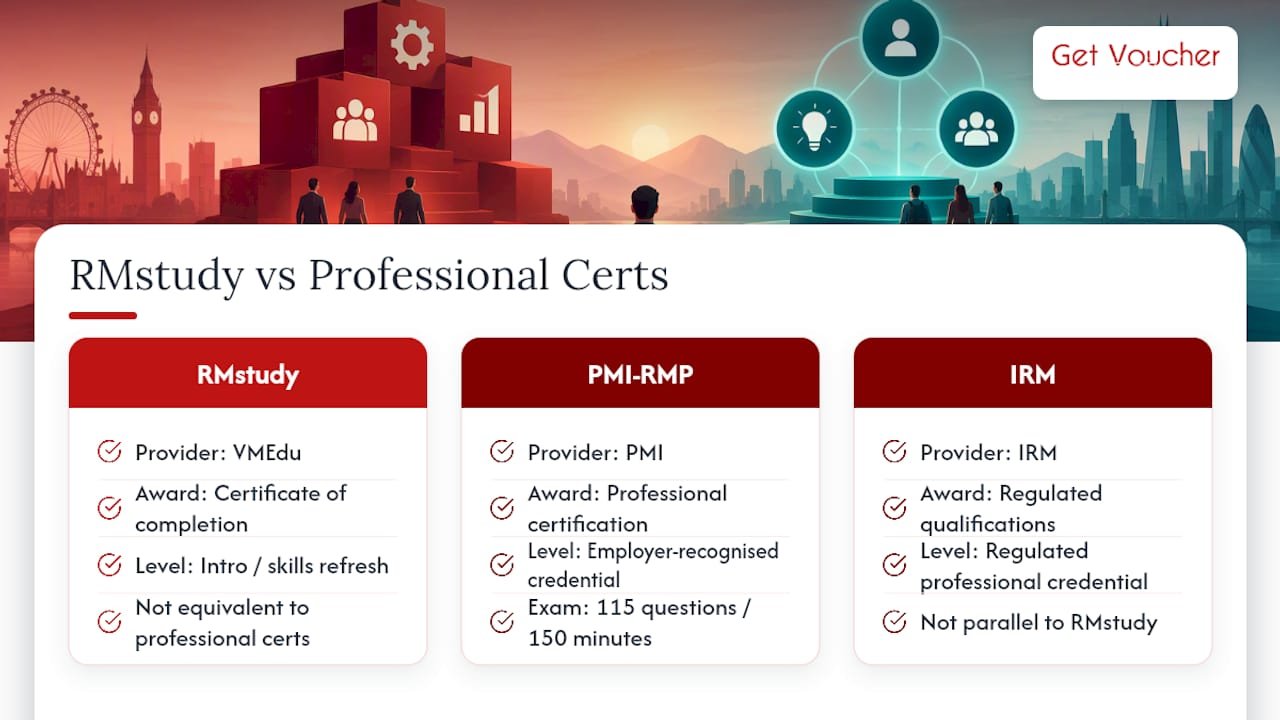
- RMstudy: a training course that issues a certificate of completion, useful as a skills refresh or introduction to risk concepts rather than a professional-level credential.
Employer recognition varies by sector and geography rather than by a single global ranking, so the right choice depends on the industry you work in and the level of responsibility your role carries, a point covered in more detail in the next section.
Profiles: PMI-RMP, IRM, NEBOSH/IIRSM, RIMS and RMstudy
PMI Risk Management Professional (PMI-RMP)
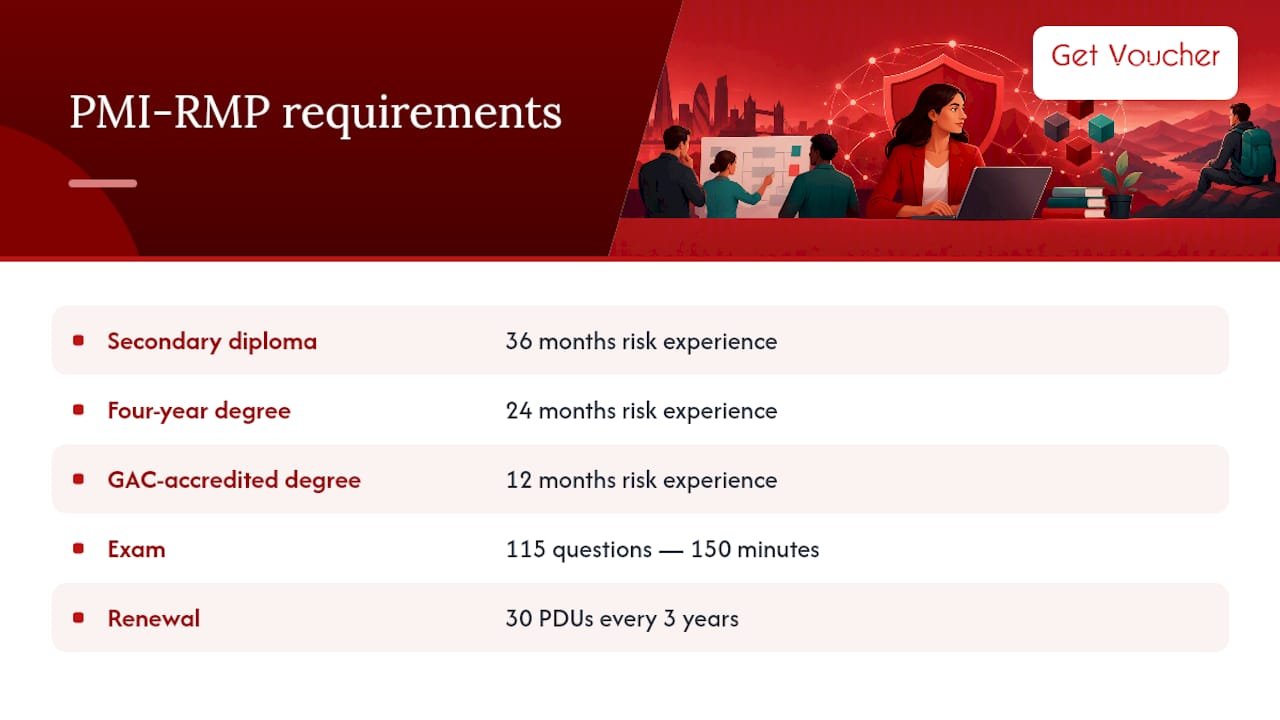
The PMI-RMP is administered by the Project Management Institute and is built around demonstrated project risk experience rather than classroom hours alone. According to the PMI Risk Management Professional (PMI-RMP)® page, eligibility follows one of three paths: 36 months of project risk management experience for candidates with a secondary diploma, 24 months for candidates holding a four-year degree, or 12 months for candidates with a degree from a GAC-accredited programme. The exam itself runs to 115 questions completed within 150 minutes.
Renewal follows PMI’s continuing certification requirements: credential holders earn 30 professional development units (PDUs) across a three-year cycle, as confirmed on PMI’s maintain and renew page. PDUs are logged in one-hour blocks and distributed across PMI’s skill categories, and the PMI-RMP handbook sets out the application process and exam blueprint in detail, underpinned by periodic role delineation studies that keep the exam content aligned with current practice.
Best for: project managers and risk analysts who want a credential focused specifically on identifying and managing risk within project environments, and who already have the experience hours to qualify.
IRM Level 4 and Level 5 qualifications
The Institute of Risk Management offers a distinct family of certificates and diplomas at Level 4 and Level 5, some of which carry Ofqual regulation on the Regulated Qualifications Framework and some of which do not. The IRM qualifications page describes offerings such as the International Certificate in Operational Risk Management and the International Certificate in Enterprise Risk Management, typically with no formal entry requirements recommended and delivered through blended learning.
Assessment is organised around scheduled sessions rather than on-demand testing. The IRM’s course content and FAQ page explains that candidates enrol into a specific assessment cycle and must generally complete all modules attempted within that same session, since enrolment periods and their corresponding assessment sessions are fixed rather than flexible. This scheduling structure means candidates need to plan study pacing around the session dates rather than assuming continuous, self-paced completion. Industry commentary on the Institute of Risk Management analysis published by London Business Matters also flags that checking whether a specific IRM award carries Ofqual regulation is worth doing before enrolling, since regulated and unregulated awards sit under different recognition standards.
Best for: professionals moving into enterprise risk management roles who want a qualification with a defined academic level and, where relevant, UK regulatory recognition.
NEBOSH/IIRSM Certificate in Managing Risk
This certificate combines health and safety grounding with broader risk management principles, making it relevant to practitioners whose roles span safety compliance and wider organisational risk. It is positioned for cross-sector use rather than being confined to a single industry, which suits risk officers who need a foundation that speaks to both safety regulators and general risk stakeholders.
Best for: health and safety professionals expanding into broader risk management responsibilities, or risk officers who need credibility with safety-focused stakeholders.
RIMS enterprise risk credentials
RIMS positions its credentials around enterprise-level risk management rather than project-specific risk work, reflecting the scope of members who often sit in corporate risk, insurance or governance functions. Where PMI-RMP asks for project risk hours and IRM structures learning around regulated academic levels, RIMS credentials are aimed at professionals already operating at an organisational risk oversight level.
Best for: enterprise risk managers and insurance or governance professionals who need a credential recognised within corporate risk circles rather than project delivery teams.
RMstudy training course
RMstudy is a training course, delivered through VMEdu as the provider, that awards a certificate of completion rather than a professional, multi-level certification. It should not be read as parallel or sequential with PMI-RMP’s eligibility rules, exam structure or renewal cycle, nor as equivalent to IRM’s regulated qualifications: RMstudy’s course structure, prerequisites and assessment format are documented separately on its own official course pages, and readers should confirm current details there rather than assuming a hierarchy that mirrors other providers.
Best for: professionals who want a structured introduction to risk management concepts or a skills refresh, rather than a credential intended to meet employer requirements for a recognised professional risk certification.
One in every fact: PMI-RMP’s exam runs to 115 questions across 150 minutes, a fixed format that candidates can plan revision time around with more precision than open-ended study targets allow.
How to choose the right certification for your role
Matching a credential to your career stage and sector cuts down on wasted study time and application fees. Work through these steps in order.
- Identify your career stage. Entry-level practitioners often benefit more from a foundational course, specialists building a project risk track lean toward PMI-RMP, and those aiming at strategic or board-level input tend toward IRM or RIMS credentials.
- Match the credential to your sector. Finance and insurance functions often value RIMS or IRM recognition, safety-adjacent industries respond to NEBOSH/IIRSM, and project-heavy environments favour PMI-RMP.
- Weigh time, cost and recognition together. A credential that costs less but takes longer to complete, or one that is cheaper but less recognised in your sector, is not automatically the better deal.
- Ask training providers direct questions before enrolling: what is the exact assessment method, what does renewal require, and what evidence of experience or prior learning is accepted.
- Watch for red flags: no published handbook, no stated renewal path, or unclear accreditation status are all reasons to dig further before paying.
Pro Tip: Before enrolling, check whether your employer already recognises a specific credential internally, since that can save you from choosing a technically strong qualification that carries no weight in your own promotion or project-assignment decisions.
Study formats, scheduling and renewal mechanics
Delivery formats differ meaningfully between providers, and assuming one provider’s rules apply to another is a common planning mistake. Online proctored exams are monitored remotely through webcam and screen-sharing software, while in-centre tests happen at a physical testing venue with on-site staff, and not every certification body offers both options.
- Some regulated assessments, including IRM qualifications, run on fixed testing schedules rather than on-demand booking, and candidates should confirm scheduling and test-centre availability directly through Pearson VUE’s IRM testing page.
- PMI’s renewal system, the Continuing Certification Requirements programme, asks PMI-RMP holders for 30 PDUs across a three-year cycle, distributed across PMI’s Talent Triangle skill categories, as detailed on the maintain and renew page.
- Missing a renewal deadline typically risks lapsing the credential, so logging PDU activity as you complete it, rather than waiting until the cycle deadline, avoids a last-minute scramble.
- Official fees, exact scheduling windows and any application charges should always be confirmed on the issuing body’s own page rather than assumed from secondary guides, since these details change and vary by region.
GetVoucher’s role and the RMstudy clarification
The platform works with established providers to offer voucher access, structured online study resources and preparation support across various certification pathways. To be clear about scope: RMstudy is currently a training course that issues a certificate of completion, not a multi-level professional certification, and GetVoucher does not currently offer the RMstudy certification exam or voucher.
Where available, the platform may provide course access and preparation support for RMstudy content, and RMstudy certifications may be added to the catalogue in the coming months. If you are interested in RMstudy availability or pricing, you can check with the platform for the latest details.
Certification versus experience: a practical view
Certifications validate a defined body of knowledge, but they do not replace the judgement built from handling actual risk registers, stakeholder disagreements and budget trade-offs under pressure. If you are early in your career, a recognised credential can open doors that experience alone has not yet built. If you already carry years of hands-on risk decisions, the more strategic move is often to pick the credential that formalises what you already do, rather than starting from the most junior available course.
Whichever path you choose, apply for one credential, schedule your assessment, and ask your employer about sponsorship before you second-guess the decision further.
— Rayan
Get certification-ready with GetVoucher
If you are weighing up a risk management path alongside project management, Agile or business analysis skills, GetVoucher’s Risk Management course page gives you a starting point for preparation resources without committing you to classroom training.

- Browse the Risk Management course page for preparation access relevant to this pathway.
- Check the certifications catalogue to see how risk management sits alongside Agile, Scrum and business analysis credentials.
- Contact GetVoucher directly if you want current pricing or availability for RMstudy, since it is not yet part of the standard voucher catalogue.
For readers building a broader delivery skill set, GetVoucher’s Scrum and Agile guide covers related certification roadmaps, and the guidance on maintaining SCRUMstudy certification is a useful reference for how renewal and CPD tracking work in practice. Visit the homepage to see the full course catalogue and current voucher options.
Sources
FAQ
What is the best certification for risk management?
There is no single best certification, since PMI-RMP, IRM’s Level 4/5 qualifications, NEBOSH/IIRSM and RIMS credentials each serve different roles and sectors. The right choice depends on whether you work in project delivery, enterprise risk, safety-linked risk or corporate governance.
Is ERM certification worth it?
Enterprise risk management credentials from bodies such as IRM or RIMS can be worth pursuing if your role involves organisation-wide risk oversight rather than single-project risk work. Their value depends on how your sector and employer recognise the specific credential, so checking employer expectations first is a sensible step.
Is risk management certification worth it?
Certification can demonstrate structured knowledge of risk identification, assessment and response, which is useful for career progression, though its value varies by credential, sector and employer recognition. A project-focused credential like PMI-RMP suits project risk roles specifically, while enterprise-level credentials suit broader governance roles.
How do I become a certified risk manager?
The path depends on which credential you target: PMI-RMP requires documented project risk experience ranging from 12 to 36 months depending on your education level, plus passing a 115-question, 150-minute exam. IRM’s qualifications instead follow a structured, session-based assessment model with no formal entry requirements recommended for most awards.