




Certifications for product managers fall into five main families: dedicated product management programmes, Scrum and Agile Product Owner credentials, business analysis practitioner certificates, project management qualifications, and complementary skills certificates in UX, analytics or Lean Six Sigma. None of these are mandatory routes into the role, and none of them prove you can do the job. What a certification does is demonstrate knowledge of a defined body of practice — use the comparison below to work out which one actually closes a gap you have.
TL;DR:
- Certification options vary in scope, cost, and effort, with dedicated product management certificates suited for beginners and strategic roles.
- Scrum and Agile credentials are mainly relevant for practitioners handling delivery within Scrum teams and do not cover strategic planning.
- Business analysis certificates focus on analytical skills, while project management qualifications are best for large-scale or regulated delivery environments.
- Always identify your specific skill gap before choosing a certification, and verify if the credential is recognized in your industry to ensure value.
- Pairing technical or UX certifications with strategic credentials can demonstrate a well-rounded skill set to employers.
Table of Contents
- Shortlist: the certification types a product manager should consider
- Certification families explained: what each covers and when to choose it
- Comparing certification families by skills, effort and relevance
- How to choose the right certification for your role and experience
- How GetVoucher supports certification access and preparation
- Author perspective: certification as one part of a product career
- Ready to access your next certification voucher?
- Sources
- FAQ
Shortlist: the certification types a product manager should consider
Before comparing details, it helps to see the field at a glance. Each family suits a different stage of a product career, and the cost and time commitment vary sharply between them.
- Dedicated product management certificates — professional certificate series or postgraduate credit programmes covering strategy, discovery and roadmapping. Best for aspiring PMs and career switchers who want structured, PM-specific content. Cost and time: medium to high.
- Scrum/Agile Product Owner and Scrum Master credentials — Scrum-framework specific, focused on backlog management and delivery ceremonies. Best for PMs who also carry Product Owner duties, or practitioners moving into Agile delivery teams. Cost and time: low to medium.
- Business analysis / BCS practitioner certificates — stakeholder management, market analysis and product lifecycle technique. Best for PMs strengthening analytical rigour or business analysts moving towards product roles. Cost and time: high.
- Project management qualifications (PMP, PRINCE2) — planning, governance and delivery frameworks. Best for PMs in regulated or large-scale delivery environments. Cost and time: medium to high.
- Complementary certificates (UX, analytics, Lean Six Sigma) — targeted skill-building rather than role definition. Best for PMs plugging a specific capability gap. Cost and time: low to medium.
Nobody needs all five. The point of this shortlist is to help you rule things out as much as rule them in.
Certification families explained: what each covers and when to choose it
Product management sits at the intersection of strategy, delivery and stakeholder management, and no two certification bodies define its boundaries the same way. That is precisely why understanding scope matters more than collecting credentials.
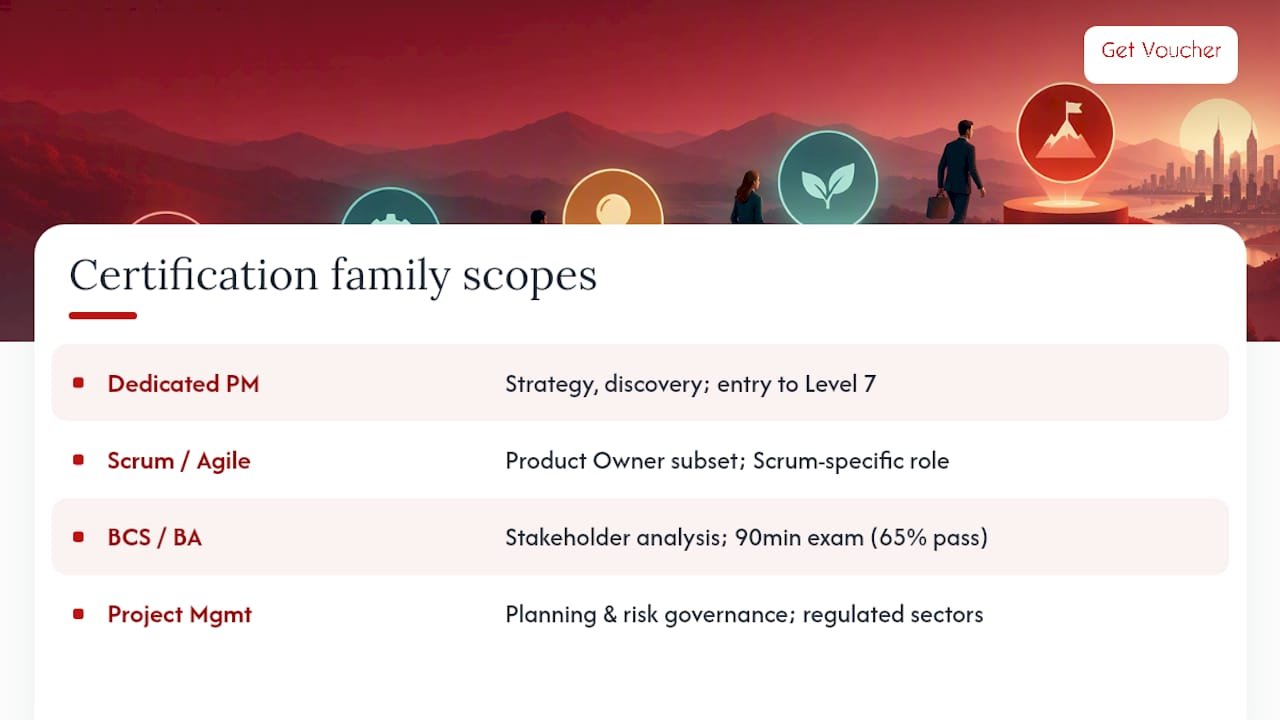
Dedicated product management programmes teach strategy, customer discovery, positioning, metrics and roadmap planning. These range from intensive professional certificate series such as the IBM Product Manager Professional Certificate, delivered as a multi-course pathway aimed at career switchers and early-career professionals, through to academic credit routes like King’s College London’s Product Management Career Accelerator, which can be upgraded to a postgraduate Level 7 certificate and typically demands 12 to 15 hours of study per week. These two examples sit at opposite ends of the depth spectrum: one is a fast, practical entry point, the other an academically credentialed programme built for working professionals with more time to invest.
Scrum/Agile Product Owner and Scrum Master credentials need a clear scope note before anything else. A Product Manager owns strategy end-to-end: market positioning, pricing, roadmap prioritisation and cross-functional alignment. A Product Owner is a Scrum-specific accountability, focused on backlog ordering, sprint goals and working closely with a development team inside a Scrum framework. Conflating the two roles is a common and costly mistake, because Product Owner duties are a subset of what a Product Manager typically does, not an equivalent job title. A credential such as SCRUMstudy’s Scrum Product Owner Certified (SPOC®) is relevant primarily when a Product Manager is also performing hands-on Product Owner responsibilities within Scrum, not as a general-purpose PM credential. If you want to understand this distinction in more depth, our guide on Scrum Master versus Product Owner roles and certification walks through the accountability split in detail, and our breakdown of Product Owner responsibilities covers the day-to-day scope.
BCS and business analysis practitioner certificates focus on stakeholder management, market analysis and product lifecycle technique rather than delivery ceremonies. The BCS Practitioner Certificate in Digital Product Management is structured around a 40-question, 90-minute exam with a 65% pass mark, and course pricing from UK providers commonly runs from £1,395 to £2,250 plus VAT. This sits at the higher end of the cost spectrum, and suits PMs or business analysts who want formal validation of analytical method rather than delivery mechanics.
Project management qualifications such as PMP or PRINCE2 add planning discipline, risk governance and stakeholder reporting structure. They add real value in regulated industries or large delivery programmes, but they say little about product discovery, market fit or pricing strategy, so treat them as a complement to a PM skillset rather than a substitute for one.
Pro Tip: If you already hold a project management or business analysis qualification, look for the gap it doesn’t cover, usually customer discovery or product strategy, before adding another delivery-focused credential to your CV.
Comparing certification families by skills, effort and relevance
Cost figures below are editorial guidance based on publicly listed provider pricing, not fixed quotes, and always worth checking against the provider’s current page before you commit.
- Dedicated PM certificates — skills gained: strategy, discovery, roadmapping; prerequisites: none for entry-level, professional experience preferred for postgraduate routes; exam format: coursework and project-based assessment; effort: roughly 4 to 15 hours a week depending on programme depth; career relevance: best for beginners and career switchers building a PM-specific CV; cost guidance: from around £0 for free introductory content up to roughly £2,000 for postgraduate credit routes.
- Scrum/Agile Product Owner credentials — skills gained: backlog management, sprint planning, Scrum accountabilities; prerequisites: none formally required; exam format: online, unproctored, typically multiple-choice; effort: days to a few weeks of preparation; career relevance: best for Product Owners and PMs performing delivery duties inside Scrum teams; cost guidance: low to medium.
- BCS / business analysis practitioner — skills gained: stakeholder management, market analysis, product lifecycle methods; prerequisites: some providers recommend prior business or analysis experience; exam format: 40 multiple-choice questions, 90 minutes, 65% pass mark; effort: several weeks of structured study; career relevance: best for strategic PMs and analysts formalising analytical rigour; cost guidance: £1,395 to £2,250 plus VAT.
- Project management (PMP/PRINCE2) — skills gained: planning, governance, risk management; prerequisites: PMP typically requires documented project experience; exam format: proctored, multiple-choice, several hours; effort: weeks to months of study; career relevance: best for PMs in regulated or large-scale delivery contexts; cost guidance: medium to high, varies by provider and region.
- Complementary certificates (UX, analytics, Lean Six Sigma) — skills gained: targeted technical or process-improvement skills; prerequisites: usually none; exam format: varies, often online and shorter; effort: days to a few weeks; career relevance: best for PMs closing a specific capability gap rather than defining their core role; cost guidance: low to medium.
How to choose the right certification for your role and experience
Work through this checklist before committing time or money to any programme:
- Define your actual gap. Are you missing PM strategy fundamentals, Scrum delivery mechanics, analytical rigour, or a specific technical skill like UX research?
- Match the credential to your career stage. An aspiring PM benefits most from a product management fundamentals course or a professional certificate series; a Product Owner handling delivery inside Scrum benefits from a Scrum-specific credential; a mid-career PM moving into leadership benefits more from postgraduate or strategic PM certificates plus leadership modules than from another delivery-focused badge.
- Check the time you can realistically commit. Postgraduate routes asking for 12 to 15 hours a week are a different proposition to a self-paced certificate you can finish in a weekend.
- Verify employer recognition. Ask whether the certification is referenced in job specifications in your sector, or whether it functions mainly as a personal development marker.
- Watch for red flags. Be cautious of providers who are vague about exam format, question counts or pass marks, or who make unverifiable claims about salary uplift or guaranteed job outcomes. Ask providers directly for exam duration, question count, proctoring method and renewal requirements before paying.
Pro Tip: Pairing a short technical or UX certificate with a strategic PM credential often demonstrates more rounded capability to hiring managers than stacking multiple credentials from the same family.
How GetVoucher supports certification access and preparation
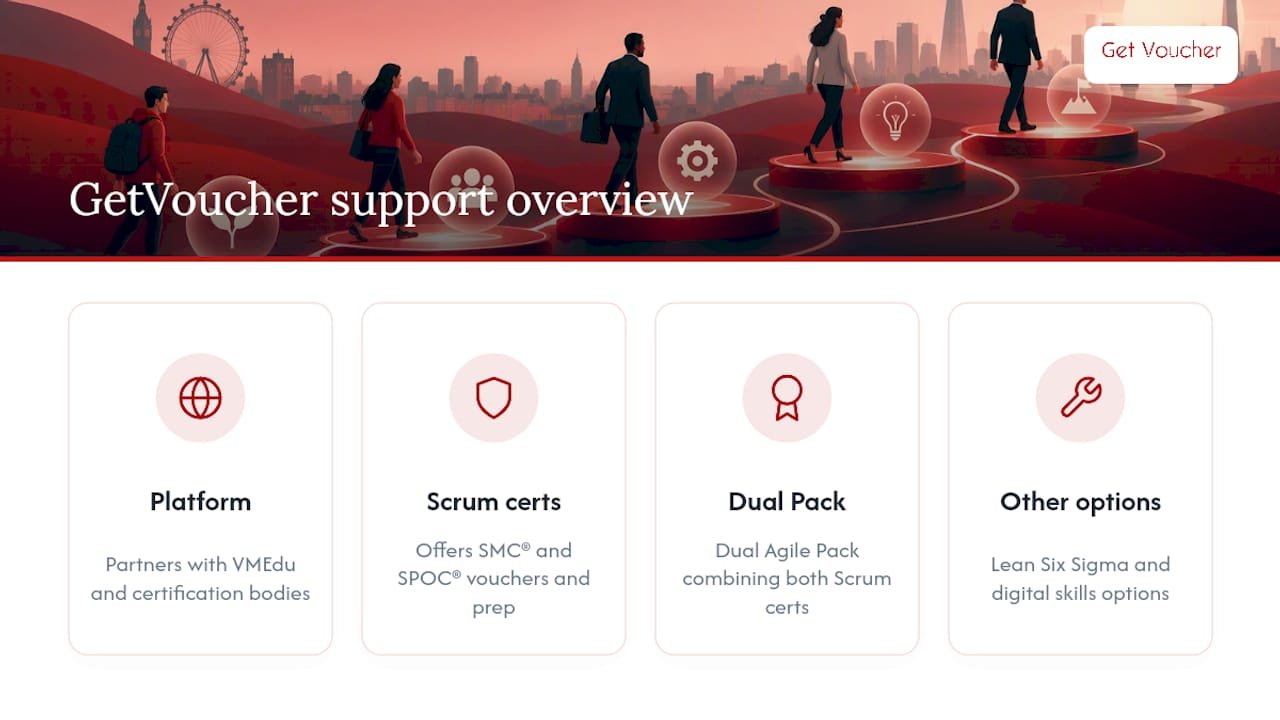
GetVoucher is a voucher platform partnering with established providers such as VMEdu and certification bodies including SCRUMstudy, SMstudy and 6sigmastudy to simplify access to certification vouchers and preparation resources for professionals. For product professionals, that includes Scrum Master Certified (SMC®), Scrum Product Owner Certified (SPOC®), the Dual Agile Pack combining both, and Lean Six Sigma or digital skills options for complementary learning. Always verify exam format, question count, proctoring method and renewal requirements directly on the certification body’s official page before purchase.
Author perspective: certification as one part of a product career
A Product Manager sets strategy end-to-end; a Product Owner runs Scrum delivery. Confuse the two and you will chase the wrong credential. My view: use certification to close a specific, named skill gap, build a portfolio of shipped outcomes alongside it, and favour credentials your industry actually references. Prioritise the gap, not the badge.
— Rayan
Ready to access your next certification voucher?
GetVoucher exists to make the certifications covered above easier to reach, without the cost or scheduling friction of traditional classroom training. If a Scrum/Agile Product Owner credential is your closest gap, you can access Scrum Product Owner Certified (SPOC®) or the combined Dual Agile Pack directly through the platform, alongside Scrum Master Certified (SMC®) if delivery skills are the priority.
Browse the full certifications catalogue to compare what’s currently available across Agile, quality management, negotiation and marketing pathways. If you’re after a certification that isn’t listed yet, including some product management or business analysis specific routes, get in touch with GetVoucher directly to ask about pricing and availability in the coming months. Start by checking the GetVoucher homepage for current voucher options and pricing.
Sources
- BCS Practitioner Certificate in Digital Product Management
- King’s Product Management Career Accelerator (King’s College London)
- Charting the path to product mastery: a competency framework for building product capability
FAQ
Which certification is best for a product manager?
There isn’t a single best certification; it depends on your career stage and the gap you’re trying to close. Aspiring PMs and career switchers often start with a professional certificate series like IBM’s Product Manager programme, while PMs performing Product Owner duties inside Scrum look to a Scrum-specific credential instead.
Is PMP good for product managers?
PMP adds planning discipline, governance and risk management skills that help PMs in regulated or large delivery programmes. It doesn’t cover product strategy, discovery or market positioning, so it works best as a complement to PM-specific learning rather than a replacement for it.
What are the top three skills for a product manager?
Definitions vary across frameworks, but strategic prioritisation, stakeholder communication and customer discovery consistently appear as core PM competencies in industry competency frameworks. These skills sit above delivery mechanics, which is why a pure Scrum credential rarely covers all three on its own.
Do product managers need certifications?
No. Certification is optional and functions as a way to validate competency in a defined area, not a legal or industry requirement to hold the role. Many product managers build careers through portfolio experience and internal promotion, using certification selectively to close specific skill gaps.
Recommended
- Scrum Master vs Product Owner: Which Agile Role and Certification Is Right for You?
- Becoming an Effective Product Owner: Essential Skills and Best Practices
- Product Owner: Roles, Responsibilities, and Real-World Impact
- The Complete Scrum & Agile Guide (2026): Certifications, Frameworks & Career Roadmap