




Six Sigma exam costs rise with each belt level, and the biggest variable is whether you choose exam-only pricing or a bundled package that includes training. Yellow Belt fees sit at the lower end, Green Belt costs more, and Black Belt carries the highest fees of the core levels. Optional extras such as coaching, materials and retakes can add significantly to the total, so always verify current fees directly on the provider’s own site before you commit.
Table of Contents
- Cost breakdown by belt level: Yellow, Green and Black
- What exam fees include (and what they rarely cover)
- Optional and hidden costs: training, materials, retakes, software and travel
- How to compare providers fairly: a simple checklist
- GetVoucher as a practical option: vouchers, bundles and what to verify
- Author perspective: when spending more makes sense
- Practical next step: check GetVoucher voucher packs and available exam access
- FAQ
- Sources
Cost breakdown by belt level: Yellow, Green and Black
Six Sigma certification is structured in tiers, and each one reflects a different depth of knowledge and project responsibility. The exam fee itself typically grows alongside that complexity, though the exact figure depends entirely on which certifying body you choose.
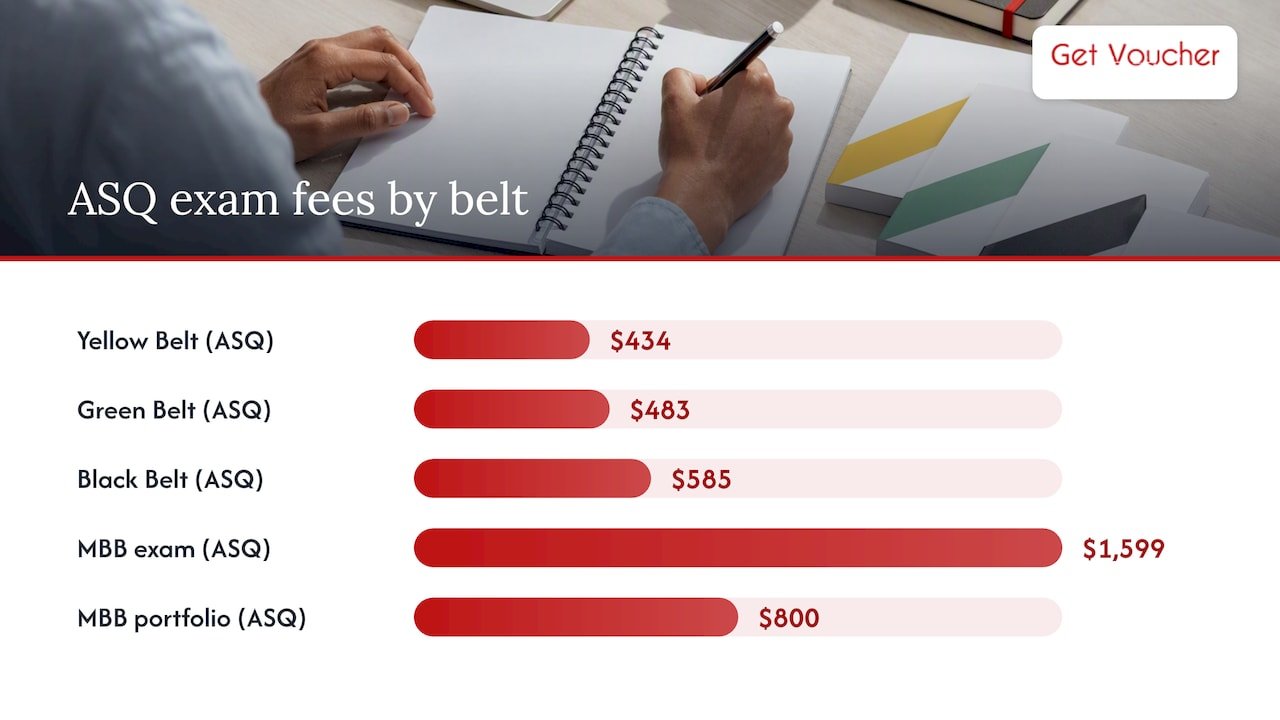
ASQ publishes fixed fees for its own exams: Yellow Belt costs $434, Green Belt costs $483, and Black Belt costs $585. ASQ’s Master Black Belt credential is structured differently again, requiring a separate $800 portfolio review fee in addition to a $1,599 exam fee, so the two charges should never be added together as a single bundled price when you are budgeting.
Other certifying bodies, including 6sigmastudy, publish their own separate fee schedules, which should be checked directly on the provider’s current site rather than assumed from older guidance, since fee tables change without notice.
When you are comparing belts, keep these points in mind:
- Yellow Belt is the entry-level tier and generally carries the lowest exam-only fee of the three core levels.
- Green Belt sits in the middle, reflecting a broader syllabus and often a project or application component.
- Black Belt is the most advanced of the core tiers and carries the highest standard exam fee.
- Retake fees are charged separately from the original exam fee and vary by provider, so they are never included in the headline price.
What exam fees include (and what they rarely cover)
A published exam fee rarely tells the whole story. Before you compare two providers on price alone, it helps to know what that fee is actually buying you.
- Exam registration: the fee generally covers your seat for a single attempt within a defined window.
- Credential record: once you pass, your certifying body typically keeps a record of your status, sometimes with a digital badge or certificate.
- Syllabus access: some providers include access to the body of knowledge or reference material the exam is based on.
What the fee rarely covers is just as important. Live tuition, project mentoring, extended content access after the exam window closes, and specialist software licences such as Minitab are commonly sold as separate, optional extras rather than folded into the base price. Credential validity statements, and whether re-verification or a digital badge is included, also differ by provider, so check the specific terms on the certifying body’s own page rather than assuming they match across brands.
Optional and hidden costs: training, materials, retakes, software and travel
The exam fee is only the starting point. Most of the real variation in total spend comes from optional extras layered on top of it.
- Self-study packs sit at the lower end of optional spend and usually include practice questions or a reference guide.
- Live online courses cost more than self-study and add structured tuition with an instructor.
- Classroom training or one-to-one coaching, sometimes offered through third-party providers such as The Condor Club, sits at the highest end of optional spend.
- Statistical software is sometimes required for project work or coursework; free tools such as JASP cover many Six Sigma statistical needs without a licence fee, which can remove one of the larger optional costs entirely.
- Travel and accommodation apply only where in-person testing at a physical centre is required rather than online proctoring.
- Retake fees are charged per attempt and are never bundled into the original exam price, so repeated attempts can meaningfully raise your total spend.
Pro Tip: Before paying for coaching or classroom time, work out the cost per study hour and compare it against a self-study pack plus free tools like JASP: the gap is often larger than it first appears.
How to compare providers fairly: a simple checklist
Price alone tells you very little unless you know exactly what sits behind it. A fair comparison means isolating the mandatory exam fee from everything sold alongside it.
- Confirm the exam-only fee on the provider’s own current page, not a third-party summary.
- Check the retake policy and its separate cost before you assume one attempt is included.
- List exactly which learning resources, if any, are bundled into the price.
- Note whether the exam is delivered as an online proctored test or an in-person test at a physical centre.
- Check how the credential is verified and whether any re-verification is required.
- Confirm any prerequisites, such as a lower belt or prior project experience.
- Read the refund or transfer policy before paying.
Once you have those answers, decomposing a bundle becomes straightforward: strip out the training, materials and software line items, and what remains is the true exam-only cost.
| Comparison point | Why it matters |
|---|---|
| Exam-only fee | The mandatory baseline cost before any extras |
| Retake policy and cost | Determines total spend if you do not pass first time |
| Bundled inclusions | Shows what training or materials are folded into the price |
| Exam format | Online proctored versus in-person affects travel costs |
| Verification date | Fees change, so note when you checked the provider’s page |
GetVoucher as a practical option: vouchers, bundles and what to verify
GetVoucher operates as a voucher platform rather than a certification body: the credentials themselves are issued by bodies such as VMEdu’s 6sigmastudy brand, and GetVoucher’s role is to give you straightforward access to exam vouchers and bundled learning packs.
On GetVoucher, Six Sigma Yellow Belt access is listed at £0, while a combined Dual 6Sigma Pack covering Green Belt and Lean Six Sigma Green Belt is listed at £290. Prices are set by GetVoucher and should always be checked on the live product page before purchase, since catalogue pricing can change.
Before buying any pack, check:
- Whether it is exam-only access or exam plus training.
- What the retake terms are if you do not pass first time.
- How long the credential or access window remains valid.
Author perspective: when spending more makes sense
Paying for structured coaching or a full classroom course tends to make more sense when your employer is reimbursing the cost, when your role requires a certified project portfolio rather than just an exam pass, or when you have no prior background in statistics and need guided practice rather than a reference pack alone.
For a motivated, self-directed learner with some statistical grounding, a voucher pack paired with free tools and a self-study guide is usually enough to prepare properly without the added cost of live tuition.
— Rayan
Practical next step: check GetVoucher voucher packs and available exam access
Budgeting for a Six Sigma certification gets much simpler once you separate the mandatory exam fee from everything optional sitting around it. GetVoucher brings exam access and bundled learning resources together in one place, which cuts down the time spent comparing separate training providers, materials and software licences one by one.

Visit the GetVoucher certifications catalogue to see current Six Sigma packs, confirm exactly what each one includes, and check the live price before you buy.
FAQ
How much does Six Sigma certification cost?
Costs vary by certifying body and belt level rather than following one fixed figure. ASQ charges $434 for Yellow Belt, $483 for Green Belt, and $585 for Black Belt, with Master Black Belt requiring an $800 portfolio review plus a separate $1,599 exam fee; other bodies set their own fees, so always confirm on the provider’s current page.
Is a Six Sigma certificate worth it?
Whether it is worth it depends on your role, your employer’s requirements and whether the credential maps to work you are already doing. The certification demonstrates knowledge of process improvement methods rather than guaranteeing a particular career outcome, so weigh the cost against your specific goals rather than a general assumption.
Is Six Sigma worth it in 2026?
The value of pursuing Six Sigma certification still comes down to the same factors it always has: your industry, your current role and whether process improvement skills are relevant to your work. No single year makes the credential universally more or less valuable, so judge it against your own situation rather than the calendar.
Is the Six Sigma exam hard?
Difficulty varies by belt level and by how much statistical or process-improvement background you already have. Yellow Belt covers foundational concepts, while Green and Black Belt exams test deeper statistical application, so preparation time should scale with the level you are attempting.
Sources
Fees and procedural details change over time, so always confirm current figures directly with the certifying body or platform before paying.