




Choose your first Agile certification by matching it to your current role and experience, not by chasing whichever credential ranks highest in search results. This guide maps the main beginner pathways, their prerequisites and exam formats, and shows how GetVoucher gives you voucher-backed access to several of them in one place.
Table of Contents
- What is Agile certification and what it validates
- Who should take an entry-level Agile certification?
- How to choose your first certification: a practical decision framework
- Beginner-friendly pathways: prerequisites, exam types, renewal and typical cost ranges
- How to prepare: study plan, timeline and practical resources
- GetVoucher perspective: why a voucher platform helps beginners
- Ready to start: your next steps with GetVoucher
- FAQ
What is Agile certification and what it validates
An Agile certification validates knowledge of a framework, a role-specific skill set or a working mindset. It does not guarantee that you can apply that knowledge flawlessly on a live project, and no credible provider claims otherwise. What it does confirm is that you have studied a defined body of concepts and passed an assessment set by the issuing body.
Beginners typically meet three categories of credential:
- Framework-specific certifications, such as those built around Scrum or Kanban, which teach a named methodology in depth.
- Methodology-neutral fundamentals, such as ICAgile’s accredited courses, which cover Agile principles without committing you to one framework.
- Role-based certifications, aimed at a specific job function such as Scrum Master or Product Owner rather than a general overview.
Assessment formats, recognition and renewal rules vary considerably between providers. Always check the current candidate guide or enrolment handbook published by the issuing body before you commit, rather than assuming one exam format applies across the board.
Who should take an entry-level Agile certification?
Entry-level Agile certification suits several distinct groups, each with a slightly different reason for starting.
Students and graduates use a fundamental credential to show employers they understand Agile terminology before their first job.
- Early-career developers or analysts often add a Scrum-specific certification once they are already working inside a Scrum team.
- Project managers shifting towards Agile delivery tend to look at role-based credentials that map to facilitation or coaching duties.
- Operations staff exploring Agile outside software delivery may prefer a credential built for that context rather than a software-only Scrum course.
If you have no Agile exposure yet, a fundamentals course is the natural starting point. If you already sit in Scrum ceremonies at work, a role-specific credential such as a Scrum Master or Product Owner certification builds on what you already practise.
How to choose your first certification: a practical decision framework
Working through a short framework beats comparing marketing pages, because it forces you to weigh your own situation rather than a provider’s claims.
- Define your role and your 12 month goal. Are you trying to land your first Agile-adjacent job, formalise a role you already do informally, or move from a general project management background into Agile delivery?
- Check eligibility, including every valid pathway. Some certifications offer more than one route in. PMI-ACP, for example, accepts candidates through four separate pathways: two years of general Agile practice, a degree from a PMI Global Accreditation Center institution, a qualifying third-party Agile certification, or an active PMP credential. None of these is the default route; they are equally valid alternatives, so check which one you already satisfy before assuming you need years of prior experience.
- Match the assessment format to how you prefer to be tested. Some credentials use an online unproctored exam you can sit from home at your own pace; others require online proctoring with ID checks and a monitored webcam; ICAgile instead certifies you through an accredited training provider rather than a single central exam.
- Budget both money and time, and read the renewal terms before you pay. A low upfront cost can still carry a continuing education requirement or a renewal fee a few years later.
As you compare options, ask each provider’s candidate guide three direct questions: what exactly is the assessment delivery method, what happens if you fail, and what does renewal cost in both time and money. A vague answer to any of these is a sign to look more closely before enrolling.
Pro Tip: Download the official candidate guide before you register, not after; it is usually free and answers most of these questions in one document.
Beginner-friendly pathways: prerequisites, exam types, renewal and typical cost ranges
Beginner pathways differ enough in structure that a side-by-side look is more useful than a single recommendation.
- Scrum fundamentals and entry Scrum Master routes, such as those built around SCRUMstudy’s model typically have no formal prerequisites and use an online unproctored exam. Renewal cycles and exact costs are set out in each provider’s own candidate guide, so confirm them there before enrolling.
- ICAgile fundamentals run through an accredited learning-provider model: you complete a course with an ICAgile member organisation, and the assessment method is set by that provider rather than by a single universal ICAgile exam. Certifications issued this way do not expire.
- Kanban essentials, such as the Kanban Essentials Certified route, often carry no formal prerequisites and can be completed through a free, unproctored online exam, making them one of the lower-friction starting points for learners on a tight budget.
- PMI-ACP, as noted above, has four distinct eligibility pathways rather than one, so a lack of two years’ Agile experience does not automatically rule you out if you hold a qualifying certification or a PMI-recognised degree.
One certification to notice on cost specifically: the Kanban Essentials Certified course is free to sit and uses an unproctored 40-question online exam with a 60% pass mark, which makes it a genuinely low-barrier way to test whether Kanban suits you before investing in a paid credential.
Treat every cost and timeline figure you read, including the one above, as a snapshot from that provider’s own page at the time you check it. Costs, exam length and renewal rules change, so the candidate guide is always the final word, not a blog summary.
How to prepare: study plan, timeline and practical resources
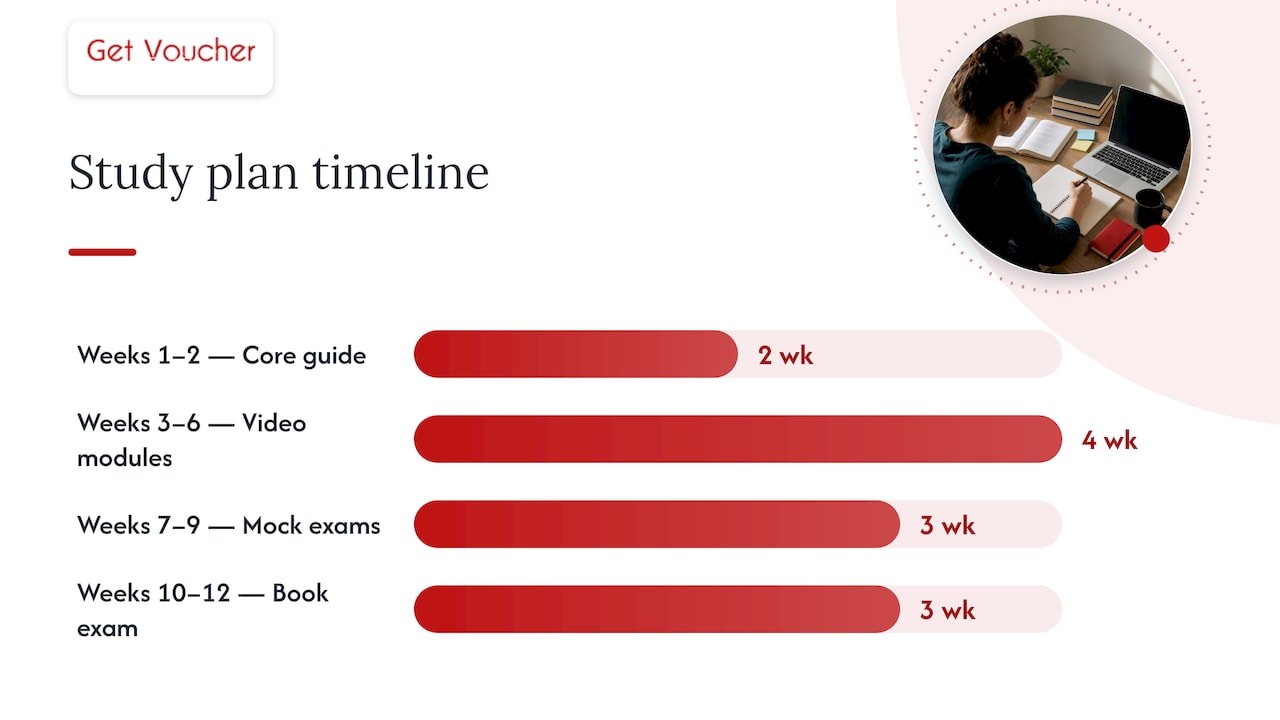
A structured six to twelve week part-time plan works for most beginners juggling a job or studies alongside exam preparation.
- Weeks 1 to 2: read the framework’s core guide (for example the Scrum Guide or the relevant Kanban body of knowledge) and note unfamiliar terms.
- Weeks 3 to 6: work through self-paced video modules, aiming for three to five hours a week, and start a glossary of key roles and artefacts.
- Weeks 7 to 9: sit mock exams or practice question sets to find weak areas, then revisit those sections specifically.
- Weeks 10 to 12: book the real exam, confirm the candidate guide’s technical requirements, and do a short practical task, such as shadowing a sprint ceremony, to connect theory to practice.
On exam day, reread the provider’s candidate guide checklist the night before: valid photo ID, a tested webcam and stable internet for any proctored format, and the exact start-time window given in your confirmation email.
Pro Tip: Treat the mock exam stage as non-negotiable; it reveals gaps a reading list alone will not.
GetVoucher perspective: why a voucher platform helps beginners
The platform works alongside established providers to give learners one place to find a course, buy the voucher and study at their own pace. For a beginner weighing several fundamentals routes at once, that single point of access removes a fair amount of the back-and-forth between separate provider sites, payment pages and study materials.
Bundles such as the Dual Agile Pack suit someone who already knows they want both the Scrum Master and Product Owner foundations rather than one at a time. If a certification you are researching is not yet listed on GetVoucher, it is worth contacting the platform directly to ask about pricing and availability for the coming months.
— Rayan
Ready to start: your next steps with GetVoucher
Starting with a fundamentals voucher costs less, in money and commitment, than booking a full role-based exam before you know whether the framework suits you, and this can be done from one account rather than hunting across several provider sites.
- Browse the Scrum Fundamentals Certified course if you want a free, low-friction starting point.
- Consider the Dual Agile Pack if you already know you want both Scrum Master and Product Owner foundations.
- Check the full certification catalogue for current voucher options, or contact GetVoucher directly if the certification you want is not yet listed.
If you are weighing an Agile credential specifically to break into an IT role, this 2026 IT careers guide is a useful companion while you plan your next twelve months.
FAQ
Is Agile still relevant in 2026?
Agile frameworks continue to be used widely across software and non-software delivery teams, and providers such as SCRUMstudy and ICAgile continue to update and issue new certifications under their current frameworks. Relevance depends on your sector and employer, so check job postings in your target field rather than assuming universal demand.
What is the best certification for Agile?
There is no single best certification: the right starting point depends on your current role, your 12-month goal and which assessment format suits you, whether that is an online unproctored exam, a proctored exam or an accredited-provider model like ICAgile’s. Compare prerequisites and renewal terms directly against each provider’s current candidate guide before choosing.
Can I get Agile certified for free?
Some entry-level options, including GetVoucher’s Scrum Fundamentals Certified course and certain Kanban fundamentals routes, are offered at no cost. Always confirm the current price and any conditions directly on the provider’s enrolment page, since free offerings can change.
Which is better, PRINCE2 or PRINCE2 Agile?
PRINCE2 is a structured project management method, while PRINCE2 Agile layers Agile ways of working, including Scrum and Kanban concepts, onto that same structure. Which suits you depends on whether your organisation needs a traditional governance framework or one that blends governance with Agile delivery practices, so the choice is contextual rather than a simple either/or.
How do I maintain or renew my Agile certification?
Renewal requirements vary by provider: some certifications, such as those issued through ICAgile, do not expire, while others carry a renewal cycle with continuing education requirements. Check the specific provider’s page, such as guidance on maintaining a SCRUMstudy certification, before assuming any single renewal rule applies to your credential.