




Unproctored certification exams let candidates sit an assessment online without a human or camera watching in real time, trading supervision for flexibility. The main benefit is convenient, accessible testing that fits around work and time zones, but the trade-off is a genuine integrity risk that providers and employers still need to manage. Formats vary by provider, so checking current policy before enrolling matters more than ever.
Table of Contents
- What unproctored exams are and how they differ from proctored delivery
- Practical benefits: flexibility, accessibility and global reach
- Credibility, security and AI-related integrity concerns
- Who benefits most and when proctored exams remain preferable
- VMEdu’s shift towards unproctored delivery and what it means
- How to verify exam format and prepare properly
- Is this really a new era, or just a new option?
- How GetVoucher helps you choose the right exam format
- Sources
- FAQ
What unproctored exams are and how they differ from proctored delivery
An unproctored exam is one where no invigilator, human or automated, monitors the candidate while they work. This sits at one end of a spectrum that runs from fully in-person testing centres, through remote invigilation, to fully unsupervised online tests.
Remote invigilation, sometimes called remote proctoring, is different again. According to Gov, it involves monitoring candidates at a separate location to ensure assessments are completed under controlled conditions, and regulators are clear it must not undermine assessment validity.
Common unproctored formats include:
- Timed online multiple-choice tests with no live monitoring.
- Take-home assignments submitted within a set window.
- Machine-marked assessments where scoring is automated and instant.
Knowing which category a certification falls into helps you interpret what “online exam” actually means before you book one.
Practical benefits: flexibility, accessibility and global reach
Unproctored delivery removes several practical barriers that put people off certification altogether. A candidate working night shifts, caring for a relative, or based several time zones from a testing centre can sit an exam when it actually suits them, rather than booking around a fixed slot.
Benefits typically include:
- Lower costs, since there is no venue, invigilator or travel expense to cover.
- Flexible scheduling across time zones, useful for distributed teams and remote workers.
- Faster result delivery, often immediate for machine-marked formats.
- Reduced administrative overhead for providers running high volumes of low-stakes tests.
Pro Tip: Book an unproctored exam window during your normal working hours rather than late at night, since fatigue affects performance regardless of who, or what, is watching.
For providers, scalability is the operational upside: an unproctored model can serve far more candidates simultaneously than a testing centre with fixed capacity. That scalability is precisely why the format suits CPD-style and entry-level credentials better than licensing exams, a distinction the next section covers in more depth.
Credibility, security and AI-related integrity concerns
The honest case against unproctored exams rests on detection, not intention. A study that injected AI-written submissions into a live university examinations system found that the majority went undetected by standard marking workflows, a finding reported in a PLOS ONE case study on artificial intelligence and exam integrity.
AI-generated submissions in this study were frequently undetected by markers, which raises real questions about how unsupervised assessments cope with generative tools.
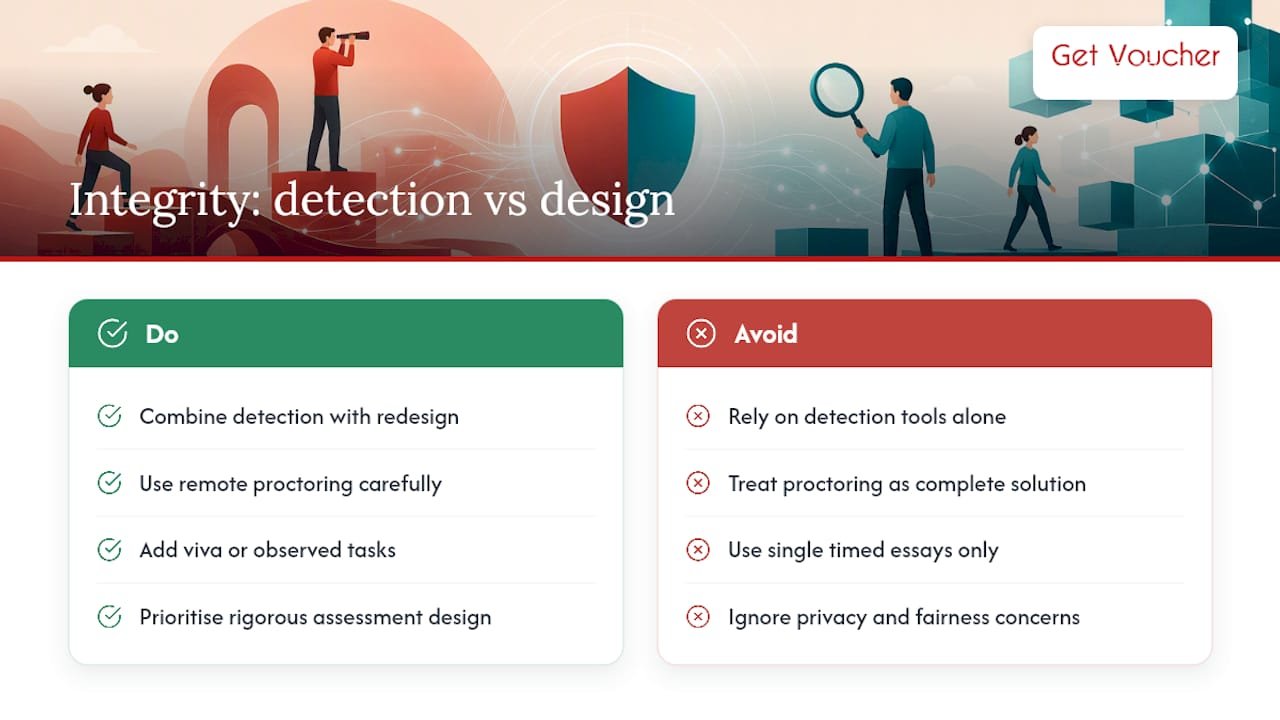
That does not mean unproctored testing is inherently unsafe, but it does mean detection tools alone are not a complete answer. Ofqual’s review of on-screen assessments found that stakeholders recognise the benefits of on-screen and remote approaches but raise consistent concerns about fairness, technical reliability, and security. The regulator recommends careful use alongside further work on assessment technology.
Remote proctoring tools exist to close this gap, using webcam monitoring, browser lockdowns or keystroke analysis, but a systematic review of online exam cheating found that these measures can reduce some forms of dishonesty while raising separate concerns about privacy, fairness and false positives. In other words, no current technology solves the problem outright.
Assessment design changes that reduce reliance on a single unsupervised, time-constrained essay, such as adding a viva, an observed task, or process evidence, materially reduce susceptibility to AI misuse.
This is the more durable insight: redesigning what an exam asks for often does more for integrity than any single detection tool. Employer recognition tends to follow the same logic. A credential body’s reputation for rigorous assessment design matters at least as much as whether the exam happened to be proctored.
Who benefits most and when proctored exams remain preferable
Unproctored formats suit certain candidates and contexts far better than others, and matching the format to the stakes involved is the practical skill here.
- Working professionals and career switchers gain the most from unproctored, low- to medium-stakes exams, since flexible scheduling fits around existing jobs and caring responsibilities.
- CPD and foundational credentials are well suited to unproctored delivery, where the goal is broad access and knowledge validation rather than gatekeeping a licence.
- High-stakes, regulated or safety-critical roles still tend to require proctored or invigilated exams. Professional credentials such as ISC2’s CISSP commonly require proctored testing, sometimes alongside verified work experience.
- Employers and awarding bodies deciding on format should ask: what happens if this credential is misused, does the role carry safety or legal exposure, and does the certifying body’s own policy specify a delivery mode.
Where the consequences of a wrongly awarded credential are serious, supervision still earns its cost.
VMEdu’s shift towards unproctored delivery and what it means
VMEdu, working through certification bodies such as SCRUMstudy, has moved parts of its exam delivery towards unproctored online formats for suitable credentials, reflecting a broader industry shift in how exam delivery is structured. This is best read as an operational evolution rather than a universal replacement for supervised testing.
Some points worth holding onto:
- Formats vary by certification and can change, so a rule that applied last year may not apply today.
- Foundational or entry-level credentials are more likely to use unproctored delivery than advanced or specialist ones.
- Candidates should always check the specific certification’s current exam policy rather than assuming based on a related credential.
GetVoucher operates as a voucher platform, not a certification body, and works alongside providers including VMEdu to help candidates find the right certification pathway and confirm delivery format before they buy. That distinction matters: GetVoucher distributes access and study resources, while VMEdu and its brands, including SCRUMstudy, set and administer the exam itself.
How to verify exam format and prepare properly
Before enrolling in any certification, a short verification routine saves confusion later.
- Check the certifying body’s own policy page for the exact delivery format, not a general FAQ.
- Read the voucher or enrolment terms for accepted ID and any software requirements.
- Look for sample papers or exam guides to confirm question style and time limits.
- Confirm revalidation or CPD requirements, since renewal rules differ by credential.
Pro Tip: Test your device, camera and internet connection at least a day before an online exam, proctored or not, since technical failures during a timed test are rarely recoverable.
If a role or employer expects an invigilated result, book that option specifically rather than assuming an unproctored pass will be treated the same way. GetVoucher’s course pages typically note the exam format alongside voucher details, so checking there before purchase is worth the extra minute.
Is this really a new era, or just a new option?
The framing of unproctored exams as a wholesale “new era” oversells what is really a widening of options. Convenience has genuinely improved for candidates who were previously locked out by geography or schedule, and that is worth taking seriously. But the integrity question has not been solved, only redistributed, from the exam hall to assessment design and employer judgement.
GetVoucher’s stance is practical rather than promotional: enable access to the format that suits a candidate’s certification, while pushing readers to verify current requirements rather than assume. Evidence-based adoption, certification by certification, beats treating unproctored delivery as a blanket upgrade.
— Rayan
How GetVoucher helps you choose the right exam format
This certification voucher platform helps you find the right credential, confirm its exam format and get studying without unnecessary extra costs.

Across Agile and Scrum, digital marketing, quality management, negotiation and sales, the platform offers vouchers bundled with structured, self-paced learning resources.
- Browse certification categories by discipline before committing to a specific credential.
- Check each course page for current exam format and voucher terms.
- Start with a free foundational certification, such as Scrum Fundamentals Certified, before progressing to a paid credential.
Certifications not yet listed on the platform, including some KANBANstudy, RMstudy and BAlearning credentials, are planned for coming months. Contact the platform for current pricing and availability. Visit the GetVoucher certification catalogue to compare options and confirm exam delivery before you enrol.
Sources
Guidance on remote invigilation and on-screen assessments comes from gov.uk and Ofqual. Industry delivery practices are documented by Pearson VUE.
- Gov
- A real-world test of artificial intelligence infiltration of a university examinations system: a ‘Turing Test’ case study — PLOS ONE
FAQ
Which certifications never expire?
Expiry and revalidation rules differ by certifying body rather than following one universal pattern. Some credentials require periodic revalidation or continuing professional development, as outlined in gov.uk guidance on revalidating a certificate of competency, while others do not specify renewal at all, so always check the issuing body’s own policy.
What is a proctored and unproctored exam?
A proctored exam is monitored, either in person or remotely, to confirm the candidate is working under controlled conditions. An unproctored exam has no live supervision during the test itself, which increases flexibility but relies more heavily on assessment design and result review to protect integrity.
What is a non-proctored assessment?
A non-proctored assessment is another term for an unproctored exam: one completed without a human or automated invigilator watching in real time. It is commonly used for lower-stakes, foundational or CPD-style credentials rather than licensing exams.
Do cyber security certifications expire?
Renewal requirements vary by certifying body and credential level. Some professional cyber security credentials, including advanced ones referenced by providers such as ISC2, require ongoing continuing education to remain valid, so checking the specific body’s policy is the only reliable approach.