




The best-supported approach combines structured retrieval practice, challenging catastrophic thoughts, and a few brief calming actions before and during the exam. A 2019 meta-analysis of psychological and educational interventions and NHS guidance on exam preparation both point the same way. Below, you will find what the evidence actually supports, a practical revision plan, in-exam fixes, and where to get help.
Table of Contents
- Understanding exam anxiety: causes, signs and why it matters
- What the research shows: interventions that reduce anxiety and those that improve performance
- Concrete revision plan and exam-day routines that reduce anxiety through preparedness
- Short in-exam techniques for panic or going blank
- Developing academic buoyancy and longer-term coping skills
- When exam anxiety needs professional support and where to go
- Time management and study organisation to reduce anxiety
- The role of relaxation techniques such as progressive muscle relaxation and deep breathing
- How mindset and motivation shape exam anxiety
- Common myths and misconceptions about exam anxiety
- Author perspective: what this means for learners and certification pathways
- Turn exam habits into a certification plan with GetVoucher
- Sources
- FAQ
Understanding exam anxiety: causes, signs and why it matters
Exam anxiety, sometimes called test anxiety, is a specific form of performance anxiety that shows up before or during assessments. It sits on a spectrum: a small amount of nervous energy can sharpen focus, but high, persistent anxiety tends to feel disabling rather than motivating.
Students experiencing it commonly report:
- Physical signs: a racing heart, sweating, nausea or shaking hands.
- Cognitive signs: racing thoughts, difficulty concentrating, or going blank mid-answer.
- Behavioural signs: avoiding revision, procrastinating, or skipping the exam altogether.
The distinction between “useful nerves” and “debilitating anxiety” usually comes down to function: does the feeling sharpen your attention, or does it crowd out your ability to retrieve what you know? Anxiety can interfere with attention and working memory during recall, which is why many of the strategies below focus on reducing the mental noise that competes with what you actually studied, rather than promising a direct lift in your grade.
What the research shows: interventions that reduce anxiety and those that improve performance
It helps to separate two different questions: what reduces the anxiety itself, and what improves exam performance. They are not the same thing, and the evidence for each is not identical.
A 2019 meta-analysis of randomised controlled trials involving 2,209 university students found that psychological and educational interventions reduced test anxiety with a large effect (g = -0.76) and also improved academic performance, though with a smaller effect (g = 0.37), measured at post-treatment. That performance gain is real but modest next to the anxiety reduction, and it should not be read as a guarantee for any individual student.
Practice testing shows a similar pattern. A 2023 meta-analytic review covering 3,374 participants reported that practice testing, repeatedly retrieving information under test-like conditions, is linked to a medium reduction in test anxiety (Hedges’ g = -0.52), with 88% of included studies showing some anxiety reduction after practice tests.
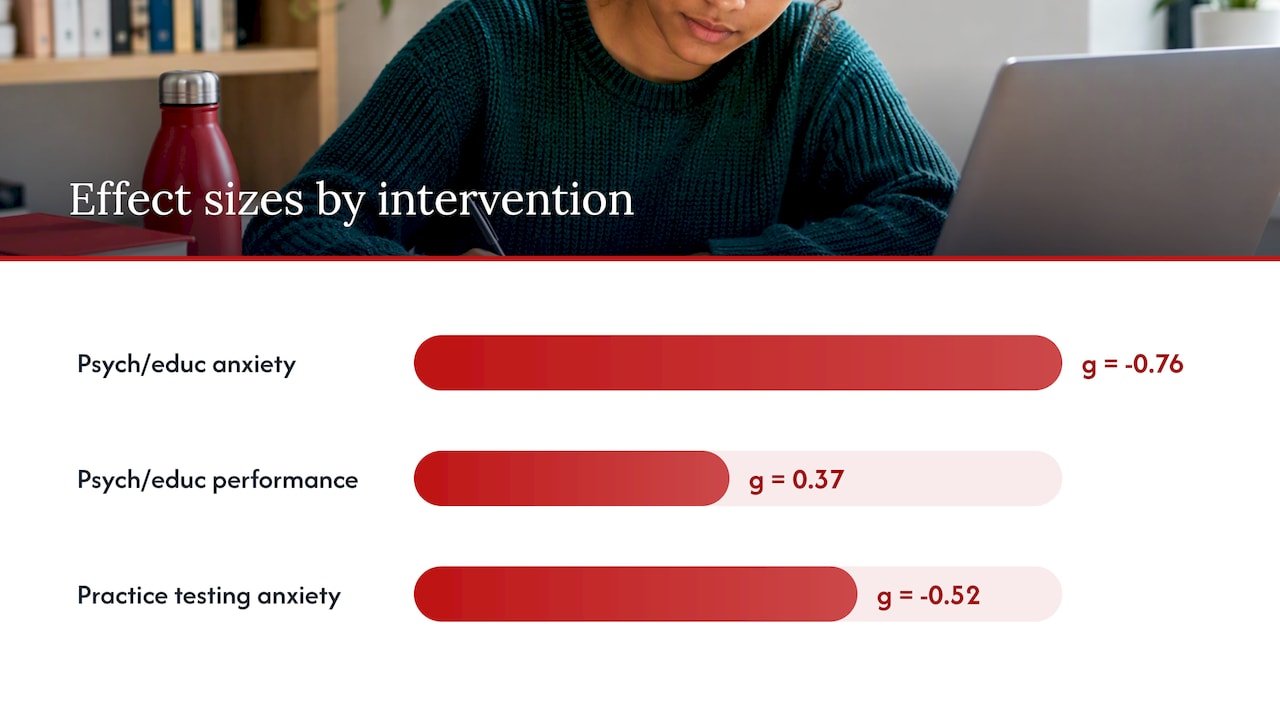
Statistic callout: A 2019 meta-analysis of 44 RCTs found psychological and educational interventions produced a large reduction in test anxiety (g = -0.76) alongside a smaller gain in academic performance (g = 0.37), a reminder that calmer students do not automatically become higher-scoring ones.
Interventions with the clearest research backing include:
- Retrieval practice and past papers: linked to reduced anxiety in the 2023 meta-analysis above, with plausible but smaller performance links.
- CBT-style cognitive restructuring: challenging catastrophic predictions about failure, supported within the broader intervention category in the 2019 meta-analysis.
- Relaxation training and systematic desensitisation: some educational systematic reviews report meaningful anxiety reductions in children and adolescents, though evidence for performance gains specifically is thinner.
- Multimodal school-based programmes: combining CBT, relaxation and study skills, which a 2020 international systematic review found to be effective and low-cost to deliver.
Concrete revision plan and exam-day routines that reduce anxiety through preparedness
Preparedness does not eliminate anxiety, but it changes what you are anxious about. A revision plan with structure gives your brain less to catastrophise over.
- Spread your sessions: work in short, spaced blocks across several weeks rather than cramming, mixing subjects within a session where possible to support retention and reduce anxiety.
- Prioritise retrieval over rereading: test yourself from memory, using flashcards, past papers or practice questions, rather than simply re-reading notes.
- Use timed past papers: practising under realistic time pressure, as recommended in NHS exam preparation guidance, builds familiarity with the format and reduces the sense of threat on the day. A practical guide to timed practice tests walks through how to structure a realistic mock session.
- Protect sleep, movement and meals: the NHS lists regular sleep, a balanced diet and physical activity as supportive foundations rather than guaranteed fixes.
- Build a day-of checklist: pack your stationery, ID and water the night before, and plan a simple pre-exam routine so decisions are not left to a stressed morning.
Pro Tip: Run at least one full past paper under exact exam timing before the real thing, so the clock itself stops being a source of surprise.
Short in-exam techniques for panic or going blank
If panic hits mid-exam, a short sequence of actions may help you regain enough control to keep working, although these are supportive coping steps rather than proven ways to improve exam scores.
- Pause and reset your posture: put your pen down, sit back, and try to slow your breathing; some students find this comforting, though no specific breathing pattern has strong evidence for improving exam performance.
- Move to a different question: skip the one that triggered the panic and return to it once you feel more composed.
- Use a memory cue: imagine the page, lecture, or mnemonic related to the topic to help retrieve information.
- Tell an invigilator if you need to: taking a supervised short break can be better than leaving the exam early.
Developing academic buoyancy and longer-term coping skills
Academic buoyancy, the everyday resilience that helps students handle routine setbacks like a disappointing mock result, is described in a DfE literature review as a protective factor against test anxiety, alongside mastery-oriented goals and a stable academic self-concept. The same review notes that problem-focused coping, actually tackling the source of stress, correlates with lower anxiety, while avoidance correlates with higher anxiety.
Ways to build this over time include:
- Set mastery goals over outcome goals: aim to understand a topic rather than only to beat a target grade.
- Challenge unhelpful beliefs directly: when you think “I always fail under pressure”, ask what evidence actually supports that, a CBT-style technique referenced in the 2019 meta-analysis above.
- Involve teachers and parents constructively: GOV.UK guidance highlights the role of teachers and parents in creating a lower-threat assessment environment, rather than adding pressure through fear-based messaging.
When exam anxiety needs professional support and where to go
Seek support if anxiety is stopping you from studying, sleeping, eating normally or attending school. Speak to a teacher, school counsellor or GP, who can also advise on exam adjustments. NHS and school support routes are confidential, and asking early is better than waiting until exam week.
Time management and study organisation to reduce anxiety
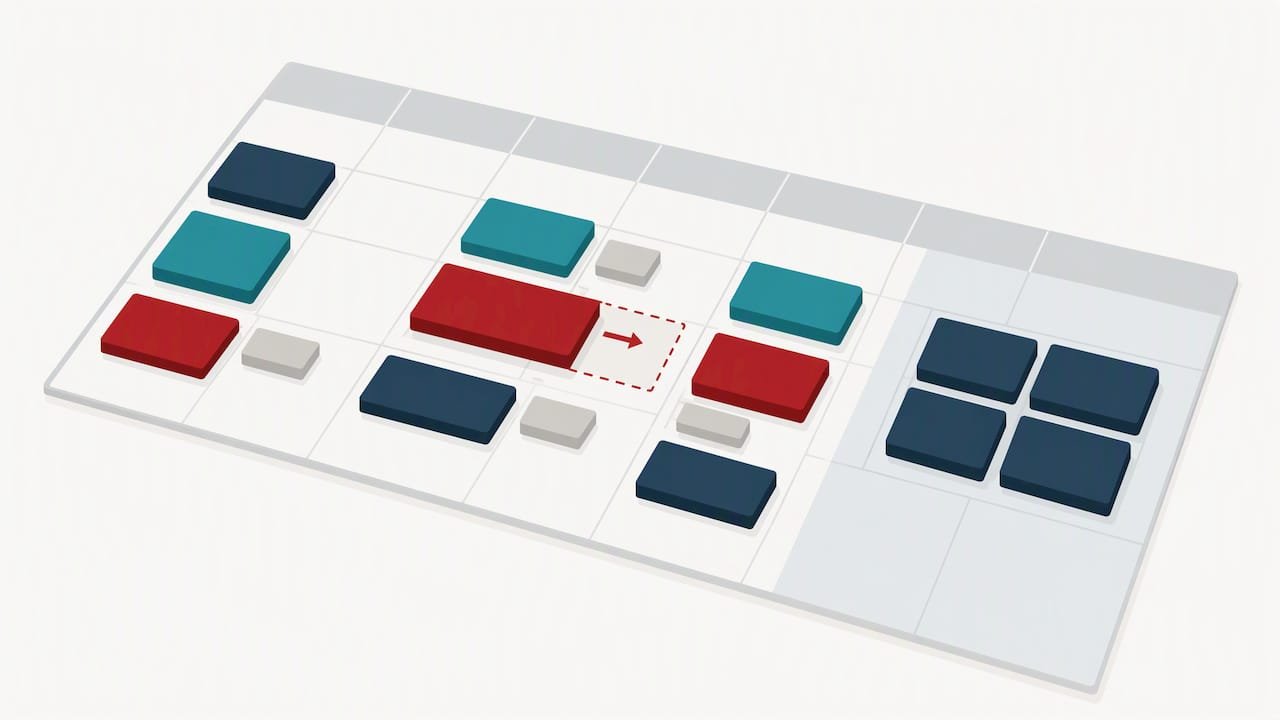
Disorganised revision is its own source of anxiety, because uncertainty about whether you have covered enough tends to feel worse than the workload itself. A written revision timetable, broken into subject blocks with realistic daily targets, replaces that uncertainty with a visible plan.
Breaking large topics into smaller, specific tasks, rather than vague entries like “revise biology”, makes progress easier to track and gives you a concrete sense of what is actually done. A structured revision plan for a specific subject shows how this looks in practice: topics sequenced by priority, with built-in time for past papers near the end.
Building in deliberate rest between sessions matters as much as the sessions themselves. The NHS recommends regular breaks as part of exam preparation, not as an optional extra, because sustained study without pauses tends to reduce both concentration and motivation over time.
Reviewing your plan weekly, rather than fixing it at the start of term, lets you adjust for topics that are taking longer than expected. This flexibility reduces the anxiety that comes from falling behind a rigid schedule you set weeks earlier under different assumptions.
The role of relaxation techniques such as progressive muscle relaxation and deep breathing
Relaxation techniques, including progressive muscle relaxation and breathing exercises, appear across several of the intervention categories included in the broader 2019 meta-analysis of psychological and educational approaches. The NHS also lists breathing exercises as a supportive component of a wider wellbeing approach that includes sleep, diet and activity, rather than a standalone fix.
It is worth being precise about what this evidence does and does not say. Relaxation techniques can support how calm you feel in the moment, and some students find them useful before or during an exam. No specific breathing pattern or timing protocol has been shown in peer-reviewed research to reliably improve exam performance on its own. Treat relaxation as one supportive tool inside a wider plan that also includes retrieval practice and cognitive work, not as a substitute for either.
Progressive muscle relaxation, which involves tensing and releasing muscle groups in sequence, is included in some educational systematic reviews alongside CBT and systematic desensitisation as part of effective anxiety-reduction programmes for children and adolescents, generally delivered as part of a structured course rather than a one-off exercise.
How mindset and motivation shape exam anxiety
The goals you set for yourself change how exam stress feels. Mastery-oriented goals, where the aim is understanding a subject, are associated with lower test anxiety than purely outcome-focused goals fixed on a grade, according to the DfE literature review on anxiety and educational assessment.
A growth mindset, broadly understood as the belief that ability develops through effort rather than being fixed, fits naturally with mastery goals. Practically, this means treating a poor mock result as information about what to revise next, rather than as evidence of a fixed limitation. The same review links problem-focused coping, actively working on the source of stress, with lower anxiety, while avoidance coping correlates with higher anxiety.
Motivation and anxiety also interact in both directions. Low motivation can make revision feel pointless, which increases last-minute cramming and the anxiety that comes with it, while some anxiety can sharpen focus when it does not tip into overwhelm. The aim is not to eliminate nerves entirely but to keep them in the range where they support rather than disrupt your recall.
Common myths and misconceptions about exam anxiety
A few persistent myths are worth clearing up directly.
“Calm students always score higher.” The 2019 meta-analysis found interventions reduced anxiety with a large effect but improved performance with a notably smaller one, so reducing anxiety is not the same as guaranteeing a better mark.
“Breathing exercises fix exam nerves.” Breathing techniques can feel supportive in the moment, but no specific pattern has strong peer-reviewed evidence for improving exam outcomes, so treat them as one small part of a wider plan rather than a fix on their own.
“Avoiding the subject reduces stress.” Avoidance coping correlates with higher, not lower, anxiety in the DfE review cited above, which suggests facing the material directly tends to serve students better than putting it off.
“Some people just have test anxiety and cannot change it.” Academic buoyancy and mastery-oriented goals are both described as protective factors that can be developed, rather than fixed traits.
Author perspective: what this means for learners and certification pathways
The revision habits that reduce exam anxiety, retrieval practice, structured planning, challenging unhelpful thoughts, carry over directly into adult life, including professional certification exams. There are structured learning pathways and vouchers available for professional certifications, which can be a practical way to apply the same preparation discipline later in your career.
— Rayan
Turn exam habits into a certification plan with GetVoucher
The routines that get you through school and university exams, spaced practice, past papers, a clear revision structure, apply just as well to professional certification later on. The platform provides access to certification vouchers and structured online learning across Agile and Scrum, digital marketing, quality management and negotiation, so you do not have to piece together separate courses, documents and videos from different sources.
If you want a low-stakes way to start, Scrum Fundamentals Certified is available at no cost, a useful first step before committing to a paid credential such as the Scrum Master Certified (SMC®) at £199. For some certifications still being added to the catalogue, further additions are planned in the coming months; it is recommended to contact the provider directly for pricing and availability. Browse the full certifications catalogue to see which pathway matches where you want to go next.
This article is general information, not a substitute for advice from a qualified doctor. Consult a qualified healthcare professional about your own circumstances before acting on anything here.
Sources
- Meta-analysis of psychological and educational interventions for test anxiety (Liverpool repository)
- Meta-analytic review: practice testing and test anxiety (Yang et al., 2023)
- Tips on preparing for exams — NHS
FAQ
How do I stop a panic attack during an exam?
Pause, put your pen down and sit back, and some students find slower breathing or a brief grounding pause supportive in the moment, though no single technique is proven to guarantee relief. Move to a different question if you have gone blank, and tell an invigilator if you need a short supervised break rather than leaving the exam.
What is the 3-3-3 rule for anxiety?
The 3-3-3 rule is a popular grounding technique that asks you to name three things you can see, three sounds you can hear, and move three parts of your body. It is a general anxiety-management tip rather than a peer-reviewed exam-specific intervention, so treat it as one possible calming step rather than a guaranteed fix.
How can I relieve exam stress?
The strongest evidence points to structured retrieval practice and challenging unhelpful thoughts, which a 2019 meta-analysis linked to a large reduction in test anxiety. Supportive habits like sleep, regular breaks and relaxation exercises, as recommended by the NHS, add further support without being a standalone solution.
How do I overcome fear of failing exams?
Challenging catastrophic predictions about failure, a CBT-style technique included in the broader interventions studied in the 2019 meta-analysis, is one of the better-supported approaches. Pairing this with mastery-oriented goals and problem-focused coping, rather than avoidance, is linked to lower anxiety in educational research on the topic.