




If you need employer-recognised proof for a management or consultancy role, a project-based university Green Belt or an ISO 18404/RSS-aligned route is the stronger choice. If you need fast, exam-based evidence of competence for an operational role, a provider certification such as Lean Six Sigma Green Belt through GetVoucher gets you there quicker and at lower cost.
Table of Contents
- Which certification type to choose: university, ISO/RSS, provider or free
- What each belt level means: from White to Master Black
- University programmes vs industry certifications: what actually differs
- What to expect: time, cost and project requirements
- How to choose the best lean certification for you
- GetVoucher: how our voucher routes and packs make certification accessible
- What the certification market gets wrong about “recognition”
- GetVoucher: voucher packs to start your Lean/Six Sigma path
- Sources
- FAQ
Which certification type to choose: university, ISO/RSS, provider or free
Lean and Six Sigma credentials fall into four broad categories, and picking the right one starts with knowing what each is built for.
University programmes, run through business schools or executive education units, combine classroom teaching with a mandatory workplace project. They suit people who need a credential their employer or a regulator will treat as rigorous, particularly in the public sector or engineering.
ISO 18404 and RSS 18404-aligned pathways are not courses in themselves. They are a competency framework that some universities, consultancies and employers use to benchmark Green Belt, Black Belt and Master Black Belt skills against a shared standard, which matters when a role specifies “ISO 18404 aligned” as a requirement.
Industry and provider certifications, such as those built on the SCRUMstudy and 6sigmastudy catalogues, focus on exam-based assessment of Lean and Six Sigma theory. They suit professionals who want a fast, affordable credential to demonstrate baseline knowledge, particularly for a first move into process improvement or as a complement to a project management role.
Free introductory courses, including Six Sigma Yellow Belt options, exist to test interest before committing money or time to a full Green Belt.
- University routes suit management and consultancy roles where a workplace project and formal assessment are expected.
- ISO/RSS-aligned pathways suit readers whose employer or sector specifies a recognised competency standard.
- Provider exams suit operational practitioners who need a quick, budget-friendly credential.
- Free introductory courses suit anyone testing whether Lean Six Sigma is worth pursuing further.
What each belt level means: from White to Master Black
Belt names describe a progression of responsibility, not just difficulty. Each level expects a different kind of evidence from the person holding it.
- White Belt: an introduction to Lean and Six Sigma vocabulary, typically assessed by a short quiz with no project requirement.
- Yellow Belt: covers foundational tools such as process mapping and basic data collection, usually assessed by an online exam alone.
- Green Belt: expected to run or contribute to a real improvement project alongside passing an exam, and often the entry point for a formal “Improvement Practitioner” type role.
- Black Belt: leads complex, cross-functional projects and typically needs documented project evidence plus a more demanding exam or portfolio review.
- Master Black Belt: coaches Black and Green Belts, sets improvement strategy, and is usually reached through experience and demonstrated coaching or teaching rather than an exam alone.
In the UK, these belt levels sit alongside vocational routes such as the Improvement Specialist apprenticeship standard, which formalises Lean/Six Sigma capability into Improvement Technician, Specialist and Leader job titles. Whether a given belt maps neatly onto one of those titles depends on the employer and sector, so it is worth checking a specific job description rather than assuming the belt name alone will translate.
University programmes vs industry certifications: what actually differs
The two routes differ in three practical ways: how you learn, how you are assessed, and how much employers weigh the result.
University Green Belt courses, such as those from Napier University, typically run 3 to 6 days of classroom or virtual classroom teaching combined with distance learning, and expect a workplace improvement project as part of the assessment. This structure suits readers whose employer will fund training and give them time to complete a project, and it produces a credential with a documented, verifiable outcome.
Industry and provider certifications, including those on the 6sigmastudy catalogue, are built around online modules and a single proctored or online exam, with no mandatory project. This route suits someone studying around a full-time job who needs a result within weeks rather than months.
- University routes offer classroom or blended delivery, mandatory project evidence, and higher fees, and generally carry stronger weight in sectors that value formal assessment.
- Provider routes offer self-paced online modules, exam-only assessment, and lower fees, and generally suit faster, budget-conscious study.
- Assessment format matters to employers differently: a verified workplace project signals applied capability, while a proctored exam signals theoretical grounding.
Neither route is universally “better”. A hiring manager assessing a candidate for a factory-floor improvement role may value project evidence more than a manager hiring someone to support a wider Agile transformation, where a faster, broader credential can matter more.
What to expect: time, cost and project requirements
Budgeting realistically means separating university fees from provider fees, since the gap is significant.
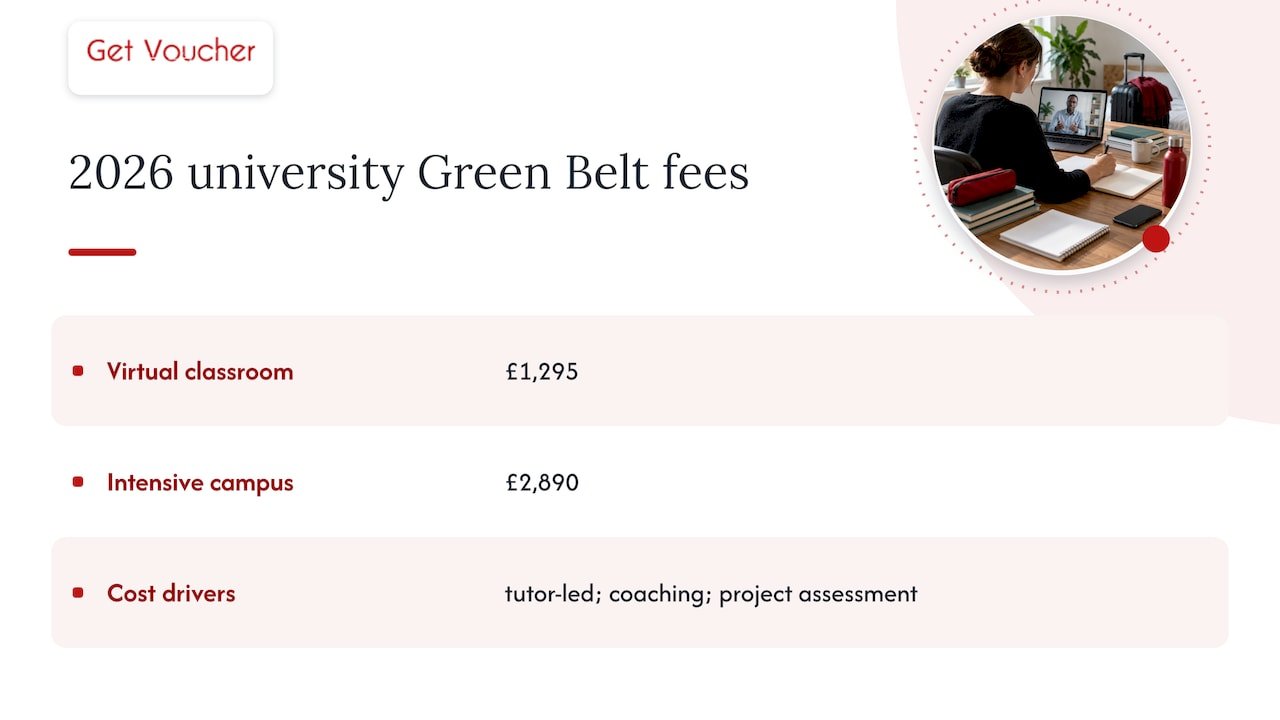
University Green Belt fees in 2026 range from around £1,295 for virtual classroom delivery to roughly £2,890 for intensive campus-based short courses, depending on format and duration. That range reflects the cost of tutor-led teaching, coaching support and the assessment overhead of reviewing a real project, not just course content.
Delivery format affects the time commitment as much as it affects cost. Oxford Lifelong Learning’s Green Belt structures a typical programme as five days of classroom simulation work plus a self-paced analytical module, splitting the practical, team-based learning from the statistical content so each can be paced differently.
Where a workplace project is required, university providers such as the University of Bedfordshire recommend choosing a project that delivers high impact for relatively low effort, since assessors are checking that you can apply the methodology to a real problem within the course timeframe, not that you have solved the hardest problem in your organisation. Coaching from a Master Black Belt is commonly built into these programmes to support that project through to completion.
Providers vary on whether a credential needs maintaining. Some issuing bodies expect no formal renewal once you hold a Green or Black Belt, while others attach continuing education or recertification expectations. Check the specific issuing body’s policy before assuming your certificate is valid indefinitely.
How to choose the best lean certification for you
Work through these steps in order rather than picking a certification by name recognition alone.
- Identify your target role first: operational practitioner, project lead, manager or consultant, since each favours a different belt and route.
- Check whether your employer or sector references ISO 18404 or the RSS 18404 sector scheme as a requirement.
- Decide whether you can commit time to a workplace project, which rules university-style Green Belt routes in or out.
- Compare exam format: proctored online exam versus in-person testing centre, and confirm which your schedule allows.
- Weigh cost against timeline: provider exams are typically faster and cheaper; university routes take longer and cost more but produce project evidence.
Before committing, ask a provider or your HR team these five questions: does this credential require a verified project, is the exam proctored or self-certified, is the certifying body referenced by any recognised standard, what is the total cost including retake fees, and how is the credential viewed by employers in your specific sector.
Watch for marketing language that implies universal recognition or guaranteed pass rates. No credible provider can promise a specific career outcome, and claims of blanket “industry recognition” are worth verifying against the issuing body’s own materials rather than a course marketing page.
Pro Tip: When a project is required, pick one tied to a metric your manager already tracks, such as cycle time or defect rate, so the result is easy to verify and easy to talk about in an interview.
GetVoucher: how our voucher routes and packs make certification accessible
A voucher is simply your access code to a provider’s training platform and exam booking system, bought once and redeemed when you are ready to start. GetVoucher issues vouchers for certifications from bodies such as 6sigmastudy, working through VMEdu as the training provider behind the credential.
On Lean and Six Sigma specifically, GetVoucher lists Lean Six Sigma Green Belt (LSSGB™), Six Sigma Green Belt (SSGB™), a free Six Sigma Yellow Belt (SSYB™) for readers testing the waters, and a dual pack combining Six Sigma Green Belt and Lean Six Sigma Green Belt for those who want both credentials in one purchase.
- After buying a voucher, check the exam format (proctored online or testing centre) directly with the issuing body.
- Confirm whether a workplace project is required for your specific certification before you schedule study time.
- Build a study plan around the self-paced material included with your voucher rather than sourcing separate resources.
Other Lean/Six Sigma credentials not yet listed on GetVoucher are planned for coming months; readers can contact GetVoucher directly for pricing and availability.
What the certification market gets wrong about “recognition”
The received wisdom treats certification recognition as binary: either a credential is “recognised” or it is not. That framing does not hold up. Recognition is contextual, tied to sector, employer and even the specific hiring manager reviewing your CV, and a Black Belt that opens doors in manufacturing may mean little to a marketing director.
What gets underweighted is project evidence. A credential backed by a documented, verifiable improvement project tends to carry more weight in interviews than the belt colour itself, because it gives an employer something concrete to ask about. Readers chasing the “best” certification often spend more energy comparing brand names than thinking about what they can point to afterwards.
Prioritise fit over prestige: match the assessment style and route to the role you actually want next, then treat the certificate as evidence to discuss, not a credential to display.
— Rayan
GetVoucher: voucher packs to start your Lean/Six Sigma path

Choosing between a university project route and a faster exam-based credential does not need to mean paying agency-level coaching fees or piecing together study materials from a dozen sources. GetVoucher gives you direct access to the voucher, the provider’s self-paced training and the exam booking, in one purchase, so you can move from decision to study without extra admin.
- Lean Six Sigma Green Belt (LSSGB™) is priced at £290 one-off.
- The Dual 6Sigma Pack combines Six Sigma Green Belt and Lean Six Sigma Green Belt in a single purchase.
- Browse the full range on the GetVoucher certifications page.
Before you buy, confirm the exam format and any project requirement with the issuing body, then head to GetVoucher to secure your voucher and start studying.
Sources
- Six Sigma Green Belt — Napier University short courses
- RSS 18404 sector scheme (Royal Statistical Society)
- Lean Six Sigma Green Belt — University of Bedfordshire
FAQ
What is the most recognised lean certification?
Recognition depends on sector and employer rather than one universal answer. University Green Belt programmes that include a verified workplace project, or credentials aligned to the RSS 18404 sector scheme, tend to carry more weight where formal assessment matters, such as manufacturing or the public sector.
Is Lean Six Sigma or PMP better?
They cover different skills: Lean Six Sigma focuses on process improvement and waste reduction, while PMP focuses on project management delivery and governance. Choosing between them depends on whether your target role centres on improving how work gets done or on managing projects to completion.
Is Lean Six Sigma still relevant in 2026?
Lean Six Sigma principles continue to underpin improvement roles referenced in frameworks such as the Improvement Specialist apprenticeship standard, which formalises these skills into recognised job titles. Its relevance depends on your sector, with manufacturing, healthcare and operations roles showing the clearest ongoing demand.
Is Lean certification worth it?
It depends on whether the credential matches what your target role actually expects. A Green Belt with verified project evidence can demonstrate applied capability to an employer, while a lower-cost exam-only certification such as Six Sigma Yellow Belt is a reasonable way to test interest before committing to a fuller programme.