



The best project management certifications depend on where you stand right now, not on a single universal ranking. For beginners, APM PFQ or PMI CAPM build the fundamentals without demanding years of experience. Mid-career professionals typically look at PRINCE2 Practitioner, APM PMQ or PMI PMP, while agile delivery roles often point towards Certified ScrumMaster or AgilePM. The comparison below breaks down prerequisites, exam format and study time so you can match a credential to your next move.
Table of Contents
- Shortlisted certifications for project managers at every level
- Comparing the shortlist side by side
- How to choose the right certification for your role and budget
- GetVoucher’s role in preparing for certification
- Building a credential path without overcollecting
- Start your certification pathway with GetVoucher
- FAQ
- Sources
Shortlisted certifications for project managers at every level
Each certification below covers a different slice of the profession, from entry-level fundamentals to chartered-level recognition. Treat this as a menu rather than a ladder: your sector, employer and current role matter more than any single credential’s reputation.
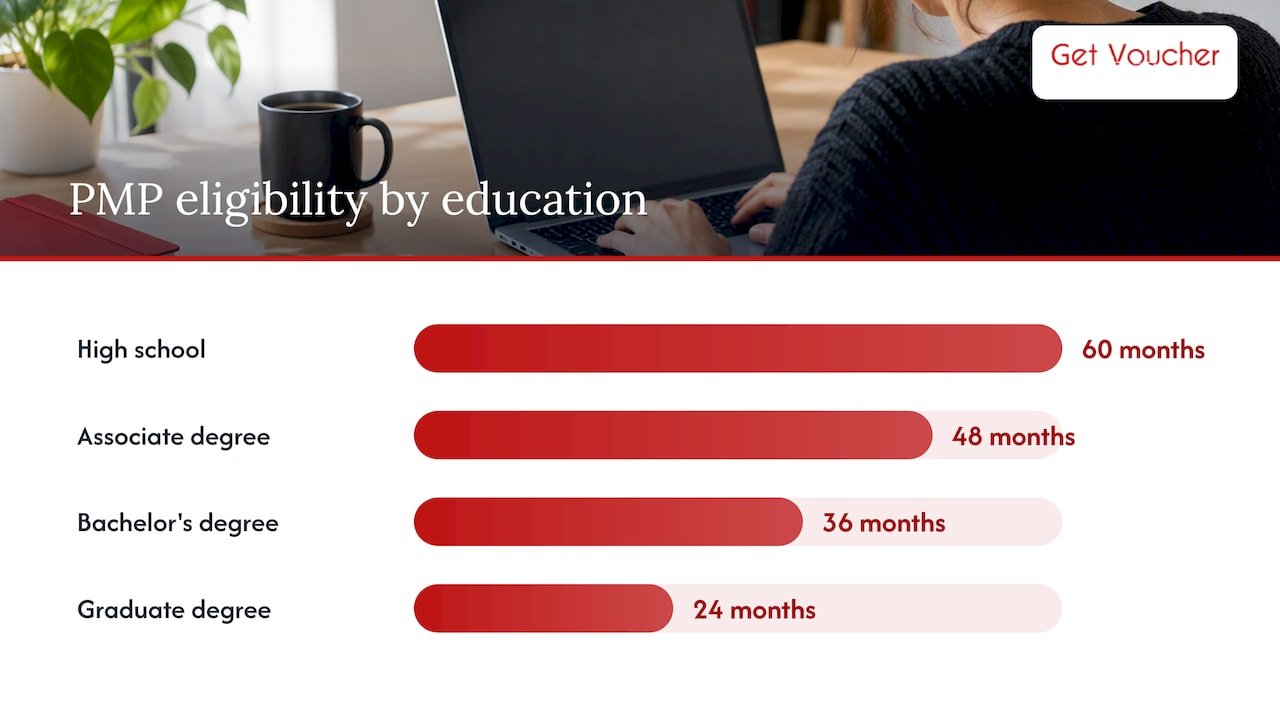
PMI PMP (Project Management Professional) suits experienced practitioners who manage full project lifecycles. As of 2026, eligibility runs through four education-based pathways: 60 months of project management experience with a high school diploma, 48 months with an associate degree, 36 months with a bachelor’s degree, or 24 months with a graduate degree, all accrued within the past 10 years, plus 35 hours of project management training. The exam is a 180-question, 240-minute computer-based test covering predictive, agile and hybrid approaches, with a July 2026 exam specification update in effect. Renewal requires ongoing professional development units within a three-year cycle.
PMI CAPM (Certified Associate in Project Management) is a standalone entry-level credential rather than a mandatory stepping stone to PMP. It requires a secondary degree plus 23 hours of project management education, with no prior project experience needed. The exam runs 150 questions over 180 minutes and covers fundamentals, predictive methods, agile approaches and business analysis. It suits early-career professionals and career switchers who want a recognised credential independent of their work history.
APM PFQ (Project Fundamentals Qualification) is an entry-level, multiple-choice exam aligned to the APM Body of Knowledge, sat online or in person with no prior experience required. APM’s own qualification page describes it as suitable for complete beginners, and uptake among younger professionals has been growing according to APM’s 2025 salary and market trends survey.
APM PMQ (Project Management Qualification) sits at a broader, intermediate level for practising project professionals. APM describes PMQ as assessable through accredited training providers or as a self-study online exam, making it flexible for people balancing study with a current role.
APM ChPP (Chartered Project Professional) is the chartered-level credential for senior practitioners who can demonstrate sustained competence against the APM’s professional standard. It sits above PFQ and PMQ and is built for those already operating at a senior or principal level.
PRINCE2 Foundation introduces the PRINCE2 method’s principles, themes and processes and is typically the first step for anyone working within PRINCE2-run environments. PRINCE2 Practitioner builds on Foundation and tests the ability to apply and tailor the method to real projects, usually via a computer-based or online proctored exam depending on the training provider. PRINCE2 Agile combines PRINCE2’s governance structure with agile delivery techniques, suited to project managers working in blended predictive-agile environments rather than purely public-sector or UK-only settings. Adoption varies by organisation and sector rather than by geography alone.
Certified ScrumMaster (CSM), issued through Scrum Alliance, is an entry-level agile credential focused on the Scrum Master role. Scrum Alliance’s own guidance contrasts CSM with alternative entry routes such as PSM, noting that renewal rules and preparation emphasis differ between issuing bodies. CSM suits people stepping into Scrum team facilitation rather than broader project management.
AgilePM (Foundation and Practitioner) certifies agile project management specifically, distinct from Scrum team-level roles, and suits those managing agile projects within a wider governance framework.
CompTIA Project+ is a vendor-neutral, entry-to-intermediate credential aimed at generalist IT and business professionals who need broad project management knowledge without heavy prerequisites.
SAFe Agilist certifies readiness to lead agile practices at scale across multiple teams or a programme, aimed at leaders coordinating agile delivery beyond a single team.
IAPM Certified Project Manager and PPM (Professional in Project Management) offer alternative routes to recognised project management credentials, often with more flexible entry requirements than PMI or APM pathways, useful for professionals outside PMI or APM’s typical geographic reach.
Six Sigma qualifications (Yellow Belt, Green Belt and Lean Six Sigma variants) focus on process improvement and quality management rather than general project delivery, making them a complementary credential for project managers working in manufacturing, operations or continuous improvement roles.
BCS project management qualifications, IPMA, PM2, Half Double, Praxis, Project Canvas, P3O and MSP each serve more specific contexts: BCS and IPMA offer alternative professional body routes, PM2 is used within EU institutional projects, Half Double focuses on impact and speed in delivery, Praxis offers an integrated framework and body of knowledge, Project Canvas supports early-stage project scoping, and P3O and MSP address portfolio, programme and project office structures and programme management respectively rather than individual project delivery.
GetVoucher does not issue a certification itself. It operates as a voucher platform working with providers including VMEdu brands such as SCRUMstudy and SMstudy, giving professionals a way to access certification pathways, self-paced study materials and exam scheduling support without committing to classroom-based training. Its role in this list is practical rather than technical: it is where you go to access the voucher once you have decided which credential fits.
- CAPM requires a secondary degree and 23 hours of project management education, with no project-experience requirement.
- PMP’s four 2026 pathways run from 24 to 60 months of experience depending on education level, plus 35 hours of training.
- PRINCE2 Agile and AgilePM both blend agile technique with structured governance, but serve different starting points (PRINCE2 users versus dedicated agile project managers).
- CSM and PSM are both entry-level Scrum credentials from different issuing bodies with different renewal approaches.
Comparing the shortlist side by side
The table below lines up the shortlist on the dimensions that actually drive a decision: entry requirements, exam format and how much time you will need to set aside.
| Certification | Level | Best for | Prerequisites | Exam format and duration | Renewal/CPD |
|---|---|---|---|---|---|
| PMI PMP | Expert | Experienced project managers across predictive, agile and hybrid delivery | 24 to 60 months of experience depending on education, plus 35 hours of training | 180 questions, 240 minutes, computer-based | 3-year cycle with professional development units |
| PMI CAPM | Entry | Early-career professionals and career switchers | Secondary degree plus 23 hours of project management education | 150 questions, 180 minutes | Renewal cycle set by PMI |
| APM PFQ | Entry | Beginners with no prior project experience | None | Multiple-choice, online or in-person | Not applicable at entry level |
| APM PMQ | Intermediate | Practising project professionals building broader competence | Varies by training provider | Accredited course assessment or self-study online exam | CPD through APM membership |
| APM ChPP | Expert/chartered | Senior practitioners seeking chartered recognition | Demonstrated sustained professional competence | Portfolio and panel assessment | Ongoing CPD required |
| PRINCE2 Foundation | Entry | First step into PRINCE2-run environments | None | Multiple-choice, online or classroom | Not applicable at Foundation level |
| PRINCE2 Practitioner | Intermediate | Applying and tailoring PRINCE2 to real projects | PRINCE2 Foundation | Objective testing, online proctored or in-person | Re-registration within set cycle |
| PRINCE2 Agile | Intermediate | Blended predictive-agile delivery environments | PRINCE2 Foundation | Combined exam covering PRINCE2 and agile practices | Re-registration within set cycle |
| Certified ScrumMaster (CSM) | Entry | Scrum team facilitation roles | Course attendance through Scrum Alliance | Online assessment | Renewal required, differs from other agile bodies |
| AgilePM Foundation/Practitioner | Entry to intermediate | Agile project managers within governed frameworks | None for Foundation | Multiple-choice and scenario-based exams | Practitioner-level renewal applies |
| CompTIA Project+ | Entry to intermediate | Generalist IT and business professionals | None mandatory | Computer-based test | Renewal through CompTIA’s continuing education programme |
| SAFe Agilist | Intermediate to expert | Leaders scaling agile across programmes | Familiarity with agile concepts recommended | Online exam following course attendance | Annual renewal |
| GetVoucher | Entry to intermediate (access platform) | Professionals wanting flexible voucher access to SCRUMstudy, SMstudy and related certifications | None, varies by chosen certification | Determined by the issuing body, not GetVoucher | Determined by the issuing body |
A handful of patterns stand out once the entries sit next to each other. Entry-level routes such as APM PFQ and PMI CAPM genuinely require no prior project experience, which makes them a realistic starting point for career switchers rather than a consolation prize before “the real certification”. That matters because APM’s workforce research found that 54% of project professionals worry about having the right skills to deliver projects, which argues for picking a credential that closes a specific gap rather than chasing the most recognisable name on a CV.
Mid-career credentials diverge by delivery style rather than by prestige. PRINCE2 Practitioner and APM PMQ both assume some working exposure to project environments, but PRINCE2 leans on its own structured method while PMQ assesses broader competence against the APM Body of Knowledge. Agile-specific routes, including PRINCE2 Agile, AgilePM and CSM, matter most when your organisation already runs agile or hybrid delivery, since the practical skills they test rarely transfer cleanly into a purely predictive environment.
APM’s 2025 salary and market trends survey also recorded growing uptake of PFQ and a correlation between APM qualifications and higher reported earnings within the surveyed sample, a useful signal for anyone weighing whether an entry-level credential is worth the time, though the finding reflects that specific survey population rather than the whole profession.
How to choose the right certification for your role and budget
Picking a certification works best as a short sequence of decisions rather than a single leap. Run through these in order before you commit time or money.
- Assess your current experience and role. If you have little or no formal project experience, entry credentials such as APM PFQ, PMI CAPM or CompTIA Project+ are built for that starting point.
- Check what your sector or employer actually uses. Government and infrastructure projects often run on PRINCE2; agile software teams lean towards CSM or AgilePM; process-heavy manufacturing environments frequently value Six Sigma alongside a core PM credential.
- Confirm prerequisites before you register. PMP’s experience thresholds (24 to 60 months depending on education) and CAPM’s 23-hour education requirement are fixed by PMI, so check these against your own record first.
- Choose a study route that matches your schedule. Self-study paired with a voucher suits people fitting preparation around a job; classroom or accredited-provider routes suit those who want structured contact time.
- Book the exam through the right channel. PRINCE2 and PMP exams are typically sat as a computer-based test at an approved centre or via online proctoring through the training provider or Pearson VUE, depending on the certification body’s current arrangement, so confirm the exact booking method with the issuing body before scheduling.
Self-study with a voucher tends to be the lowest-friction route for working professionals, since it removes the need to coordinate classroom attendance around a job. Accredited classroom providers still suit people who prefer live instruction and peer discussion, and some partner routes, such as self-paced property management certificate courses, show how flexible, vocational study formats have become common well beyond the PMI and APM ecosystem.
Pro Tip: Build credentials in a sequence that matches your actual project exposure, for example PFQ or CAPM first, then a mid-career credential once you have led real projects, rather than collecting multiple entry-level certificates in parallel.
GetVoucher’s role in preparing for certification
Voucher platforms do not replace the issuing bodies above. They connect professionals to certification pathways from providers including VMEdu brands such as SCRUMstudy and SMstudy, alongside Six Sigma and negotiation credentials. For certifications still being added to their catalogue, readers are invited to get in touch directly for current pricing and availability rather than relying on unconfirmed details.
- GetVoucher lists Scrum Master Certified (SMC®) and Scrum Product Owner Certified (SPOC®) at £199 each as one-off purchases.
- Several SMstudy® marketing credentials, including Digital Marketing Professional, sit at £199, with Certified Email Marketing Professional priced at £299.
- Lean Six Sigma Green Belt (LSSGB™) is listed at £290, and several entry credentials, including Scrum Fundamentals Certified and Six Sigma Yellow Belt (SSYB™), are available at no cost.
- The certifications catalogue shows which pathways currently have vouchers available for self-paced study and exam scheduling support.
For a reader comparing PRINCE2 against PMP or weighing CSM against AgilePM, the practical question is often less about the credential itself and more about how to prepare without expensive coaching, and that is the specific gap a voucher platform like this is built to close.
Building a credential path without overcollecting
The honest advice here is to resist treating certifications as a checklist to complete. A realistic progression for most readers starts with an entry credential, PFQ or CAPM being the two most accessible, moves into a role-specific mid-career credential once you have actually delivered projects (PRINCE2 Practitioner, APM PMQ or an agile route depending on your environment), and only later considers a chartered-level credential such as APM ChPP once your experience genuinely supports it. Certification hoarding, collecting several entry-level credentials without applying any of them, rarely moves a career forward as much as one well-chosen credential backed by real project work.
— Rayan
Start your certification pathway with GetVoucher
Once you know which certification fits your career stage, the next hurdle is usually cost and scheduling friction rather than content. GetVoucher addresses that directly by selling vouchers for certification courses and exams from providers including SCRUMstudy and SMstudy, with self-paced video training and downloadable study materials included for applicable pathways, so you are not piecing together separate tools and providers yourself. Entry-level options such as Scrum Fundamentals Certified, Six Sigma Yellow Belt (SSYB™) and NGstudy™ Certified Negotiation Associate are listed at no cost, giving you a way to test a pathway before paying for a fuller credential such as Scrum Master Certified (SMC®) at £199. Browse the current certifications catalogue to see what is available now, and if a certification you need is not yet listed, contact GetVoucher directly for pricing and availability.
FAQ
What are the top 5 project management certifications?
There is no single official top five, since the right certification depends on your experience and sector. Commonly considered leading options include PMI PMP, PMI CAPM, PRINCE2 Practitioner, APM PMQ and Certified ScrumMaster (CSM), each suited to a different career stage or delivery style.
Is PMP or PRINCE2 better?
Neither is universally better: PMP suits experienced practitioners managing projects across predictive, agile and hybrid approaches, with eligibility requiring 24 to 60 months of experience depending on education level. PRINCE2 Practitioner tests the ability to apply a specific structured method and is widely used in environments that already run PRINCE2 governance, so the right choice depends on what your employer or sector uses.
What is the most prestigious certification for project management?
Prestige depends on sector and region rather than a fixed hierarchy. APM ChPP represents chartered-level recognition within the APM framework for senior practitioners, while PMI PMP carries strong recognition in organisations that follow PMI’s body of knowledge, so the more relevant question is which one matches your industry’s expectations.
Is PRINCE2 or APM better?
PRINCE2 is a specific method with its own certification track (Foundation, Practitioner, Agile), while APM is a professional body offering a broader qualification ladder (PFQ, PMQ, ChPP) alongside membership and CPD. Many professionals hold credentials from both, since PRINCE2 teaches a delivery method and APM assesses wider project management competence.
Best Agile Certifications: Project Manager Picks, Free to £299
[…] Project management certifications for every career stage, from £0 […]