




The quickest route depends on your role and experience: White or Yellow Belt suits someone new to process improvement, Green Belt may be a suitable entry point for professionals who lead projects part-time, and Black Belt suits those working full-time in improvement roles or with established project experience. Before you enrol anywhere, check the awarding body and how the credential is assessed, since recognition and rigour vary widely between providers.
Table of Contents
- Certification families and formats: university, provider and industry body
- Belt levels explained: White, Yellow, Green and Black
- Accreditation, assessment and recognition: what to verify before enrolling
- Costs and study time: realistic ranges to plan around
- Choosing the right certification: a decision checklist
- How GetVoucher supports access to Lean and Six Sigma pathways
- What actually signals value in a Lean credential
- FAQ
- Sources
Certification families and formats: university, provider and industry body
Lean and Six Sigma credentials come from three broad sources, and knowing the difference matters more than most learners realise. University-awarded programmes tend to sit inside a business school or engineering department, wrapping Lean tools into a wider academic framework. They often take longer to complete and carry a higher price tag, but they suit learners who want the subject taught alongside broader operations management theory.
Industry and provider certifications work differently. These are typically organised around belt levels, standalone courses built for working professionals rather than full-time students, and the better-known examples set out a defined scope and syllabus before you start. According to SimplicityHub’s guide to Lean Six Sigma certification, belts are typically awarded at White, Yellow, Green and Black levels, each confirming a different depth of understanding of DMAIC, Lean principles and statistical tools.
Delivery format is a separate decision from which belt to pick. You will generally find:
- Self-paced online: video modules and reading you work through on your own schedule, often the cheapest route.
- Instructor-led online: live sessions with a trainer, useful if you want structured deadlines without travel.
- Classroom-based: in-person training, usually the most expensive format and best suited to those who learn through group exercises.
- Voucher plus proctored exam: you study independently, then sit a monitored online or in-person test to gain the credential.
University routes suit someone building a long-term academic credential alongside Lean knowledge, perhaps as part of an MBA or engineering degree. Provider and industry-body routes suit the professional who needs a recognised credential within months rather than years, and who is comparing cost and flexibility against a fixed syllabus. Course aggregators such as Coursera’s Lean Six Sigma listings show how many formats and belt levels now sit side by side, which makes the format decision as important as the belt decision itself.
Belt levels explained: White, Yellow, Green and Black
Belt names are borrowed from martial arts, but the curriculum behind each belt varies by provider. It’s important to check the specific syllabus rather than assume two “Green Belts” cover the same content.
- White Belt: an introduction to Lean vocabulary and basic waste-reduction concepts, usually a short course aimed at team members who need awareness rather than leadership skills.
- Yellow Belt: builds on White Belt with a first look at process mapping and team-level participation in improvement projects, still light on statistics.
- Green Belt: covers the full DMAIC cycle (Define, Measure, Analyse, Improve, Control) along with basic statistical analysis, and is aimed at those who lead or support improvement projects part-time alongside their main role.
- Black Belt: adds advanced statistical methods, project mentoring responsibilities and leadership expectations, often requiring a submitted project as evidence of applied work.
SimplicityHub notes that assessment formats vary across this belt structure, from exam-only tests at the lower levels to combined exam-and-project requirements at Black Belt with some providers. That project component acts as a practical proxy for applied learning: a Black Belt earned through a submitted workplace project carries different weight than one earned purely through a multiple-choice exam, particularly for employers hiring into project-led roles.
Prerequisites also vary by provider rather than following a single industry rule. Some Green Belt courses assume no prior Lean knowledge, while others expect a completed Yellow Belt or equivalent experience first. Black Belt programmes more often require a prior Green Belt or demonstrable project history, though the exact requirement depends entirely on which body is issuing the credential. This is also where Lean and Six Sigma terminology can blur. Lean focuses on waste reduction and flow, Six Sigma focuses on reducing variation through statistical control, and Lean Six Sigma blends the two: always check which framework a specific belt is actually teaching rather than assuming “Green Belt” means the same curriculum everywhere.
Accreditation, assessment and recognition: what to verify before enrolling
Not every Lean or Six Sigma certificate carries the same standing, and the only reliable way to judge one is to check who issues it and how it is assessed. Several named bodies operate in this space, each with its own structure: ASQ (American Society for Quality) runs its own certification scheme with periodic recertification requirements, IASSC (International Association for Six Sigma Certification) focuses on standardised exam-based testing, and CSSC (Council for Six Sigma Certification) operates its own separate assessment model. Provider-specific bodies, including those behind individual belt courses, set their own prerequisites and exam formats, so a credential from one is not automatically interchangeable with another.
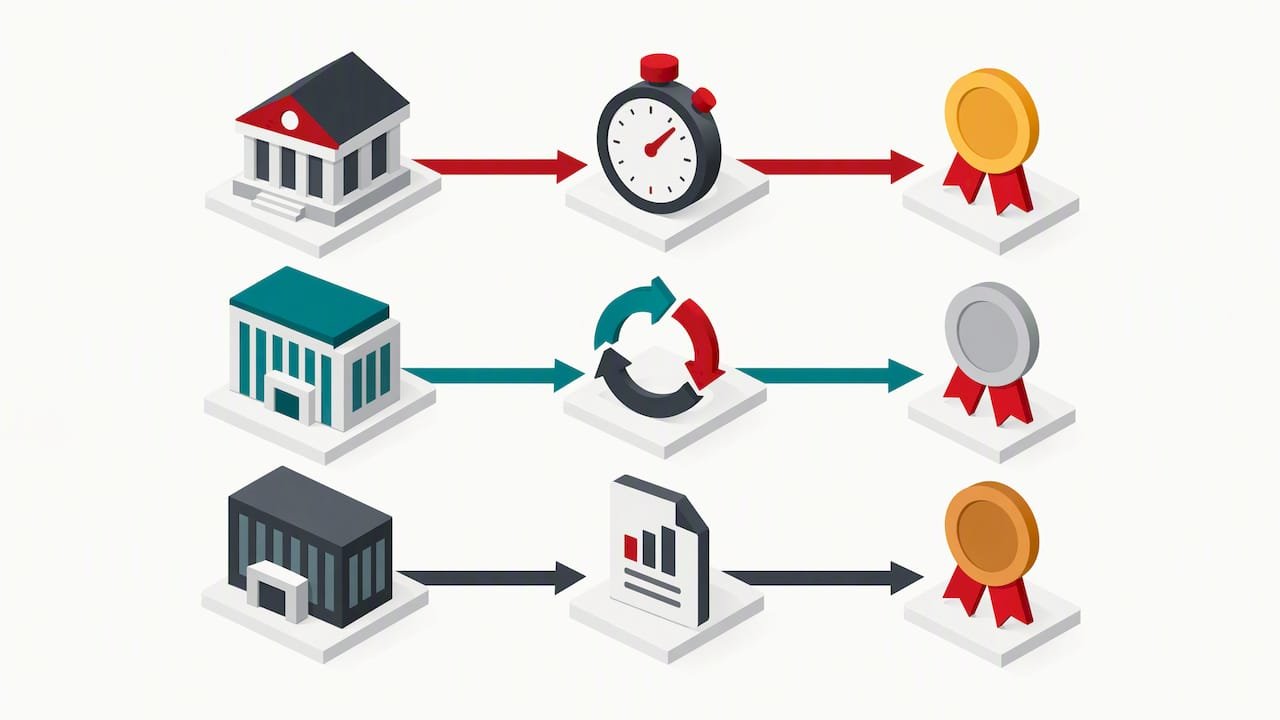
In the United Kingdom, the Improvement Practitioner apprenticeship standard from Skills England gives a useful reference point: apprentices are expected to use a blend of Lean and Six Sigma methods, including DMAIC and 8D problem-solving, across a range of sectors, and must hold level 2 English and maths before their end-point assessment. This shows that recognition in formal UK pathways tends to rest on demonstrated practical method use and literacy and numeracy prerequisites, rather than on any single belt name.
Before enrolling, check these points directly with the provider:
- Assessing body: is there a named, identifiable organisation behind the credential, or just the training company itself?
- Assessment type: exam-only, exam plus project submission, or a proctored online test?
- Recertification rules: does the credential expire, as with some ASQ certifications, or remain valid indefinitely?
- Sector guidance: does an apprenticeship standard, employer framework or industry body reference this credential or method?
Pro Tip: Search the awarding body’s own site for the credential name before you pay; a legitimate body will list its syllabus, assessment method and any recertification requirement in full.
Costs and study time: realistic ranges to plan around
Study time and cost depend heavily on format, depth and whether a project submission is required, so treat any figure you see as an editorial range rather than a fixed rule. Shorter belts such as White and Yellow typically involve a few hours of self-paced study, while Green Belt content covering full DMAIC and basic statistics takes considerably longer to work through properly. Black Belt, with its added statistical depth and project component, represents the longest commitment of the belt structure.
Several factors push cost upward regardless of belt level:
- Classroom delivery: in-person training and venue costs add to the price compared with self-paced online formats.
- Project mentoring: one-to-one guidance on a submitted improvement project costs more than an exam-only assessment.
- University affiliation: academic credit and institutional branding typically carry a premium over provider-issued belts.
- Accreditation fees: some assessing bodies charge separately for exam registration or recertification.
Course aggregators such as Class Central list Lean Six Sigma options across universities and independent providers side by side, and comparing several listings before committing is one of the simplest ways to see how price tracks with format and depth.
To reduce cost without cutting corners on the credential itself, look at voucher-based access, which separates the exam fee from expensive bundled coaching, check whether your employer has a training or professional development budget that covers certification, and prioritise self-paced formats if you are comfortable studying independently rather than in a scheduled class.
Choosing the right certification: a decision checklist
Work through these points in order before you commit to a specific belt or provider.
- Match the belt to your actual role: are you participating in projects occasionally, or leading and mentoring improvement work full-time?
- Check the assessing body: is there a named organisation behind the credential with a published syllabus and assessment method?
- Look at the assessment format: exam-only, exam plus project, or proctored online test, each signals a different depth of verification.
- Decide on delivery format: self-paced, instructor-led, or classroom, based on how you learn best and the time you can commit.
- Compare total cost: include exam fees, any mentoring charges and recertification costs where they apply.
- Confirm prerequisites: some Green and Black Belt courses require a prior belt or demonstrable project experience.
- Check recertification rules: find out whether the credential expires and what renewal involves before you pay.
Prioritise employer recognition when the credential needs to support a specific job application or internal promotion, prioritise project-based assessment when you want evidence of applied skill rather than just theory, and prioritise convenience and cost when you are building foundational knowledge rather than a formal qualification.
Pro Tip: Treat an “attendance-only” certificate, one with no named assessing body, or vague wording about how the exam works as a red flag: ask the provider directly for the assessment format before you pay.
How GetVoucher supports access to Lean and Six Sigma pathways
GetVoucher works as a voucher platform alongside VMEdu as the training provider and 6sigmastudy as the certification body behind its Lean Six Sigma listings, which means you are booking access to an established provider’s syllabus and exam rather than a GetVoucher-authored course. 
The current catalogue includes the Lean Six Sigma Green Belt (LSSGB™) at £290 one-off, and the Six Sigma Yellow Belt (SSYB™), which is free, giving you a lower-commitment way to start before paying for a Green Belt voucher. Black Belt is not currently listed in the GetVoucher catalogue; if that is your target, contact GetVoucher for information on pricing and availability.
For professionals who want both Green Belt variants in one step, the Dual 6Sigma Pack bundles the Six Sigma Green Belt and Lean Six Sigma Green Belt together. Benefits worth noting:
- Simplified booking: one checkout for voucher access rather than separate arrangements with multiple providers.
- Fixed, published pricing: the amount you pay is listed upfront rather than quoted after enquiry.
- Flexible study access: self-paced materials sit alongside the voucher rather than requiring a fixed class schedule.
Visit the certifications catalogue to see the full current range before deciding which belt fits your plan.
What actually signals value in a Lean credential
A certification demonstrates knowledge of DMAIC and core Lean tools, and it certifies understanding of a defined syllabus, but it does not, by itself, guarantee that the holder will perform well in a live improvement project. Employers and experienced practitioners tend to look past the certificate name itself and ask what was actually produced: a documented project, a measurable process change, a worked example of statistical analysis applied to a real dataset.
That is why the apprenticeship standard referenced earlier leans so heavily on practical method use, DMAIC, 8D and problem-solving applied across sectors, rather than naming a single preferred belt. Pairing a certification with genuine project evidence, and with complementary skills such as basic data analysis or change management, tells a far more convincing story than the credential alone. Treat the belt as proof you understand the framework, not as proof you can run a factory floor or a hospital ward through it; tools like those covered in AI-assisted process improvement are increasingly part of that complementary skill set too.
— Rayan
FAQ
What is the most recognised Lean certification?
There is no single universally recognised Lean certification, since recognition depends on the assessing body, sector and employer. Credentials tied to named bodies such as ASQ, IASSC or CSSC, or referenced in formal pathways like the UK’s Improvement Practitioner apprenticeship standard, tend to carry clearer, checkable standing than generic provider certificates.
Is Lean Six Sigma or PMP better?
Lean Six Sigma and PMP serve different purposes rather than competing directly: Lean Six Sigma focuses on process improvement and reducing waste or variation, while PMP centres on project management methodology and governance. The better choice depends on whether your work is primarily about improving existing processes or managing projects end to end.
Is Lean Six Sigma still relevant in 2026?
Lean Six Sigma methods, including DMAIC and practical problem-solving tools, continue to feature in formal improvement pathways such as the Improvement Practitioner apprenticeship standard, which spans multiple sectors. Its relevance depends on your industry and role rather than being a fixed, universal answer.
Is Lean certification worth it?
A Lean certification demonstrates knowledge of waste-reduction tools and certifies understanding of a defined syllabus, which can support a CV or internal case for taking on improvement work. Its practical worth increases considerably when paired with documented project experience rather than treated as a credential on its own.