




Whether you can “schedule” a Scrum exam depends entirely on the provider. Some Scrum exams have no appointment at all: you receive access and sit the test when you are ready. Others, such as Scrum Council’s CASM, send you a scheduling link for a remotely proctored sitting. This guide walks through what happens at each stage for the main providers, what to check before you start, and what to do if you miss a slot or need another attempt.
One point first. Booking, proctoring, retakes and validity are set by each certification body, never by Scrum as a framework. Treat every rule below as belonging to the provider named next to it.
Table of Contents
- Scheduling a Scrum exam: the short version
- Scrum Alliance CSM: no booking, but a strict sequence
- Scrum.org PSM I: a password, not an appointment
- Scrum Council CASM: the one with a scheduling link
- SCRUMstudy exams: online and unproctored
- Unproctored or proctored: what it changes for scheduling
- Before exam day: a practical checklist
- Rescheduling and missed exams
- How costs differ, and why an exam-only voucher is not always the cheapest route
- Our perspective: the date is rarely the hard part
- Where to start with GetVoucher
- Frequently asked questions
- Sources
Scheduling a Scrum exam: the short version
| Provider and credential | Do you book a time slot? | What you need first |
|---|---|---|
| Scrum Alliance, CSM® | No fixed slot: you take the online, non-proctored test from your dashboard | An approved 16-hour course with a Certified Scrum Trainer |
| Scrum.org, PSM I | No fixed slot: you use an assessment password | No prerequisite course |
| Scrum Council, CASM | Yes: a scheduling link arrives after approval and payment | Approved application and academic background |
| SCRUMstudy, SMC® and SAMC™ | No proctored appointment: online, unproctored exam | Provider-specific, see below |
The table is a map, not a substitute for the provider’s own page. Rules change, so confirm them on the official site before you pay.
Scrum Alliance CSM: no booking, but a strict sequence
The Certified ScrumMaster® test is not something you book with a testing centre. Scrum Alliance requires you to complete a course with a Certified Scrum Trainer first. After the course, you receive a welcome email with a link to activate your account, and you take the test from your candidate dashboard.
The course itself is an approved 16-hour course taught by a Certified Scrum Trainer, and the same page describes the test as online and non-proctored. So the “scheduling” you do is with the trainer: you pick a course date, and the test becomes available afterwards.
What the CSM test looks like
The CSM test has 50 questions and must be completed in one hour without pausing. The pass mark is 74%. Because you cannot pause, choose a moment when you will not be interrupted, even though there is no appointment.
If the welcome email does not arrive
Scrum Alliance suggests checking your spam folder, using the Forgot Password feature, or contacting support with your trainer’s name and course date. Have those details to hand before you write.
Retakes
For the CSM, you get two free attempts within 90 days. After two failures, or once the 90 days are up, each further attempt costs USD 25. That is the retake rule for this credential only.
Scrum.org PSM I: a password, not an appointment
The Professional Scrum Master™ I assessment works differently. Scrum.org lets individuals earn the certification by passing an assessment, with no prerequisite course. You purchase an assessment password and use it when you are ready.
Two details matter for planning. PSM I passwords do not expire and are valid for one attempt only, so there is no deadline pressure, but you cannot treat one password as a second chance. The assessment has 80 questions, a 60-minute limit and a passing score of 85%.
Official PSM I pricing is set by Scrum.org, and the credential has lifetime validity with no renewal fees. Check the current figure on their page rather than relying on a third-party listing.
Scrum Council CASM: the one with a scheduling link
If your question is literally “how do I pick a date and time”, the CASM is the closest match among these. Scrum Council’s CASM requires an approved application and payment before you receive an email link to schedule a fully online, remotely proctored exam.
Before you reach that stage:
- You submit your academic background. Scrum Council’s stated requirement is a secondary school diploma, higher secondary certificate or equivalent.
- Your name must match the government-issued photo ID you will show on exam day, so check how your name appears on your account.
- You can attempt the exam up to three times within a 12-month period.
The page we used does not set out a rescheduling policy in the detail you would want. If you may need to move your slot, ask Scrum Council’s support before booking, and ask three things: how much notice is required, whether a fee applies, and whether a missed slot uses up one of your three attempts.
SCRUMstudy exams: online and unproctored
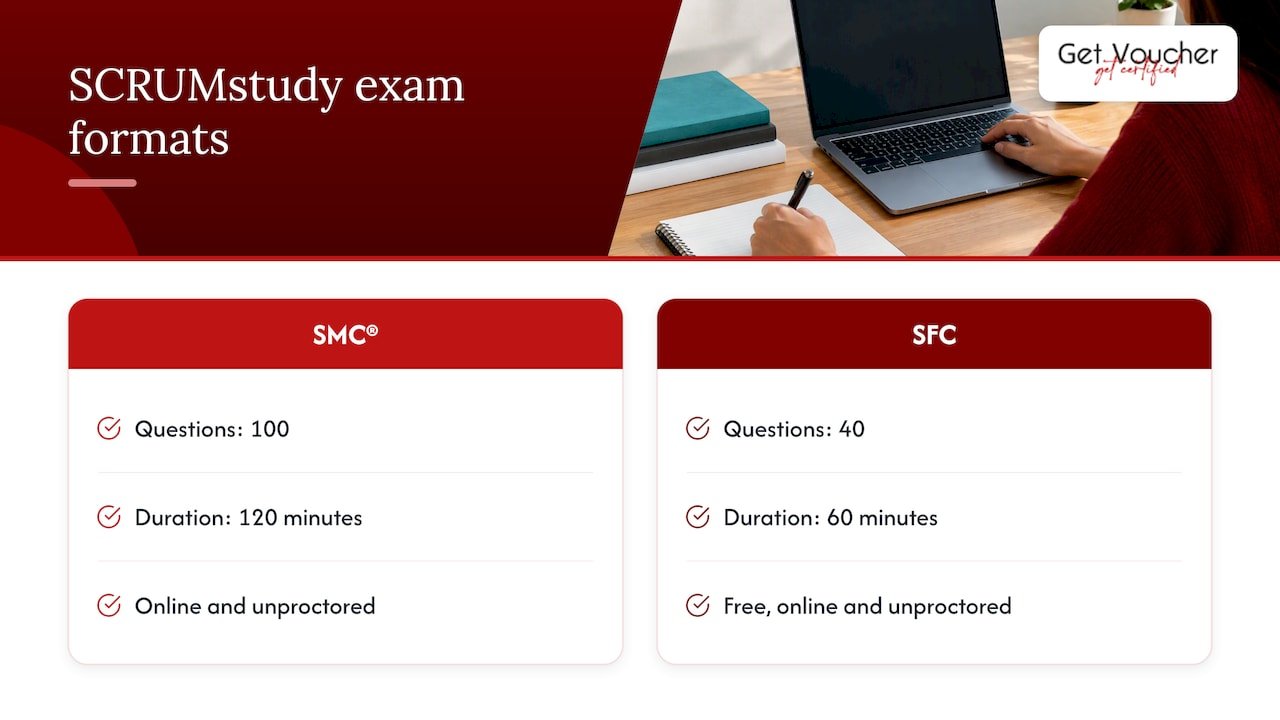
SCRUMstudy certifications work on a different model again. The SMC® and SAMC™ exams are online and unproctored, not generic proctored assessments. In practice you are not waiting for an exam centre to offer a slot. The SMC® exam has 100 questions in 120 minutes. The free Scrum Fundamentals Certified (SFC) exam has 40 questions in 60 minutes, also online and unproctored. Our exam format guide sets these side by side with the other providers.
What each GetVoucher purchase includes (study materials, access to the provider platform, support with exam arrangements) varies by product, so read the individual page before buying. Start with the pages for Scrum Master Certified (SMC®) and SCRUM Agile Master Certified (SAMC™). We sell SCRUMstudy credentials. We do not sell Scrum Alliance or Scrum.org credentials, and nothing here should be read as a claim that one provider’s exam is better than another’s.
Validity and renewal are also provider-specific. For SCRUMstudy, see how to maintain your SCRUMstudy certification.
Unproctored or proctored: what it changes for scheduling
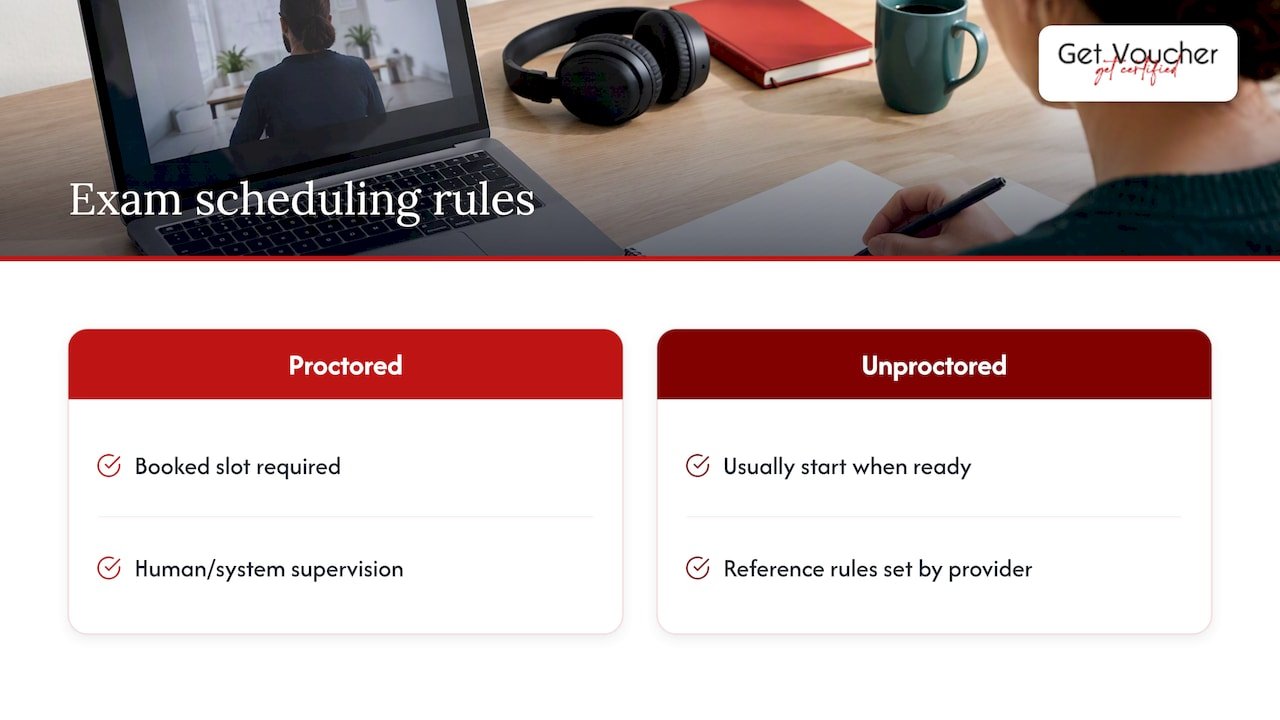
Proctoring decides whether you need an appointment. A remotely proctored exam, like CASM, needs a booked slot because a human or system supervises you. An unproctored online exam can usually be started when you are ready. That is a logistics difference only. A proctored exam is not inherently more credible than an unproctored one, and an unproctored one should not be assumed to be open-book. Each provider sets its own rules on reference materials, so read them before you start.
Before exam day: a practical checklist
Most failed sittings come down to avoidable setup problems. Scrum Alliance’s guidance for the CSM test is specific: use Safari, Firefox, Chrome or Microsoft Edge, disable pop-up blockers, use one computer and one browser, and avoid the browser navigation buttons. The same habits are sensible for any online exam.
- Confirm the format. Questions, minutes and pass mark differ by provider. Write them down.
- Block the time. Allow the full exam length plus a buffer, even if no slot is booked.
- Test your connection and browser on the machine you will use.
- Check your ID and name. Essential for proctored exams, and a good habit for account activation everywhere.
- Read the Scrum Guide again. Provider questions are written around it, though each provider has its own style and emphasis.
- Keep a note of your credentials and trainer or order details in case you need support.
Rescheduling and missed exams
Rescheduling only exists where a slot exists. That gives you three situations:
- No slot (CSM, PSM I, SCRUMstudy): nothing to reschedule. You start when ready, within any access window. For the CSM that is the 90-day free-attempt window. PSM I passwords do not expire.
- A booked slot (CASM): contact the provider as early as possible, using the questions above.
- A failed attempt: the question becomes retakes. CSM allows two free attempts in 90 days, then USD 25 each. CASM allows three attempts in 12 months. PSM I passwords cover one attempt only, so a retake needs a new one.
We have not found a single published reschedule rule shared across Scrum providers, and you should not assume one. Fees, notice periods and deadlines belong to the provider, so confirm them in writing before paying.
How costs differ, and why an exam-only voucher is not always the cheapest route
The route you pick changes both scheduling and cost. The CSM includes a mandatory 16-hour course, where the trainer sets the price. PSM I has no required course, but you pay for the assessment and any preparation you choose. CASM has an application stage and payment before scheduling. For SCRUMstudy credentials through us, SMC® costs £249 and SAMC™ costs £349, and the free Scrum Fundamentals Certified costs £0. Whether that is cheaper than another route depends on whether you need the course, materials and retakes of that provider. Our Scrum Master certification cost breakdown separates exam fees, mandatory training, optional preparation, retakes and renewal.
Our perspective: the date is rarely the hard part
We talk to a lot of people who ask us how to book a Scrum exam, and the question usually hides a different one: which exam, and in what order? The date is rarely the difficult bit. Most Scrum exams are taken online on your own timeline, so the real planning is about preparation, format and fit.
Our advice is to choose the credential first and the day second. Look at the exam format, the prerequisites and what you will do with the credential. A certification shows you studied a body of knowledge and passed a test. It does not prove real-world performance, and we would not tell you it guarantees a job, salary or promotion.
If you are new to Scrum, starting with a free introductory exam costs nothing and shows you what an online Scrum exam feels like. Then decide how much further to go. If you are weighing several providers, compare them honestly on format, cost and renewal, not on which one has the loudest marketing.
— Rayan
Where to start with GetVoucher
If SCRUMstudy credentials fit your plan, our Scrum and Agile certifications include Scrum Master Certified (SMC®) at £249, Scrum Product Owner Certified (SPOC®) at £299 and a dual pack for £519. Prefer a no-cost first step? Scrum Fundamentals Certified is £0. Not sure which role-based certification suits you? Our Scrum certification guide by role will help.
Frequently asked questions
Can I choose the date and time of my Scrum exam?
Only with some providers. Scrum Council’s CASM sends a scheduling link after approval and payment. The CSM, PSM I and SCRUMstudy exams do not use a booked slot, so you take them when you are ready within the provider’s rules.
How do I book a Scrum Master exam?
It depends on the credential. For the CSM, you book the 16-hour course with a Certified Scrum Trainer, and the test follows through your dashboard. For PSM I, you buy an assessment password. For CASM, you apply, pay and then use the scheduling link.
Can I reschedule a Scrum exam?
Only where you have a booked slot, such as CASM, and the terms are the provider’s. Ask for notice period, fees and attempt rules before booking. For exams with no slot, there is nothing to reschedule.
What happens if I fail the exam?
Retake rules are provider-specific. The CSM allows two free attempts within 90 days, then USD 25 per attempt. CASM allows up to three attempts in 12 months. A PSM I password is valid for one attempt only.
Sources
- How to take the Certified ScrumMaster® (CSM®) test, Scrum Alliance
- What to expect from the Certified ScrumMaster® (CSM®) test, Scrum Alliance
- Professional Scrum Master™ I Certification, Scrum.org
- Certified Agile Scrum Master (CASM)® Certification, Scrum Council