




If you want to become a practising Scrum Master, a Scrum Master certification is the direct route. If product leadership is the goal, look at product owner credentials. Delivery and programme managers tend to benefit more from AgilePM or PRINCE2 Agile, while scaled-agile leadership points towards SAFe or Disciplined Agile. Voucher-backed preparation is available for several of these pathways, which can shorten the time between deciding and starting.
Table of Contents
- Top Agile certifications and what each one validates
- How to choose the right certification for your role
- Exam formats, prerequisites and how to prepare
- What employers and assurance reviewers actually look for
- Certification levels and what they mean for career progress
- Industry recognition and how it varies by certification type
- Costs and fees you can expect across certification routes
- Who issues these certifications and how credibility is assessed
- Sequencing certificates with real capability
- How GetVoucher helps you prepare for the right certification
- FAQ
- Sources
Top Agile certifications and what each one validates
The Agile certification landscape covers several distinct jobs to be done, and conflating them is the most common mistake candidates make. Below are the credential families you will meet most often, what they test, and who they tend to suit.
Professional Scrum Master (PSM) and Professional Scrum Product Owner (PSPO) sit under Scrum.org’s umbrella. PSM validates understanding of the Scrum Master’s facilitation and servant-leadership role, while PSPO focuses on backlog management, stakeholder alignment and value delivery. Both are assessed through timed online exams rather than coursework, which makes them attractive to self-taught candidates with some Scrum exposure already.
Certified ScrumMaster (CSM) and Certified Scrum Product Owner (CSPO), issued through the Scrum Alliance ecosystem, cover similar ground to PSM and PSPO but require attendance at an accredited course before the assessment. That structure suits people who want a guided introduction rather than independent study, and it is one reason CSM remains a frequent first certification for people moving into Scrum Master roles.
PMI Agile Certified Practitioner (PMI-ACP) is broader than any single framework. It tests knowledge across Scrum, Kanban, Lean and XP, and it suits practitioners who already hold some project experience and want a credential that signals cross-framework fluency rather than depth in one methodology. PMI sets experience prerequisites alongside the exam, which distinguishes it from entry-level Scrum credentials.
AgilePM (APMG) is a standalone agile project management framework rather than an add-on to an existing method. According to the Agile Business Consortium’s comparison of the two frameworks, AgilePM suits organisations that are building agile delivery capability from the ground up, with its own governance, roles and lifecycle built in. It has a visible presence in UK public-sector training, including through government project delivery learning routes.
PRINCE2 Agile takes the opposite approach. Rather than replacing a governance framework, it overlays agile behaviours and techniques onto an existing PRINCE2 structure. The Agile Business Consortium notes this makes PRINCE2 Agile a better fit where PRINCE2 governance is already embedded in an organisation, while AgilePM is usually the more direct route when no such baseline exists.
SAFe Agilist (SA) addresses scaled Agile across multiple teams and programmes. It is aimed at people working in, or moving into, enterprise coordination roles, such as release train engineers or programme-level leads, and it assumes familiarity with team-level Agile before tackling the scaled layer.
Disciplined Agile (DAC/CDA) certifications, now part of PMI’s portfolio, take a choose-your-approach stance: rather than prescribing one method, Disciplined Agile trains practitioners to select and blend practices for a given context. It suits people who already have exposure to more than one framework and want a credential reflecting that flexibility.
Certified Agile Coach / Certified Enterprise Coach (CEC) credentials sit at the top of the ladder. They are built for people who facilitate change across teams and organisations rather than deliver within a single team, and they typically expect significant prior coaching experience as a precondition, not a starting point.
A few practical distinctions are worth holding onto as you compare these:
- Entry-level credentials (Scrum Fundamentals, CSM, PSM I) assume little or no prior Agile experience.
- Role-specific credentials (PSPO, CSPO) assume you already understand Scrum mechanics and want to specialise in product work.
- Scaled and coaching credentials (SAFe Agilist, CEC) generally expect team-level experience first, since they build on rather than replace it.
None of these displaces the others outright. They answer different questions about what you do day to day, which is why the next section focuses on matching the credential to the role rather than ranking them against each other.
How to choose the right certification for your role
Picking a certification works best as a structured decision rather than a reaction to whatever course is being advertised. Run through this checklist before committing time or money.
- Map your current experience. If you have never worked on an Agile team, an entry-level credential such as Scrum Fundamentals Certified gives you vocabulary and context before you commit to a role-specific exam.
- Identify the target role, not just the framework. A Scrum Master certification signals facilitation and process ownership; a product owner credential signals prioritisation and stakeholder management. These are different jobs even within the same team.
- Weigh team size and structure. Credentials built for single-team delivery (PSM, CSM, PSPO, CSPO) rarely prepare you for the coordination problems that scaled frameworks like SAFe are designed to address.
- Assess how governance-heavy the environment is. Organisations with established PRINCE2 governance tend to value PRINCE2 Agile; organisations building agile delivery capability from scratch often get more direct value from AgilePM, a distinction the Agile Business Consortium sets out clearly.
- Factor in budget and time before framework prestige. A credential you can realistically prepare for and pass is worth more than an aspirational one left half-studied.
Role-based quick picks follow from that checklist. Entry-level practitioners usually start with Scrum Fundamentals or PSM I. Practising Scrum Masters look at PSM or CSM depending on whether they prefer self-paced online assessment or guided coursework. Product owners look at PSPO or CSPO on the same logic. Delivery and programme managers in governance-heavy settings lean towards AgilePM or PRINCE2 Agile, while those coordinating several Agile teams at once look at SAFe Agilist or Disciplined Agile. Coaches move towards CEC-level credentials only once they already have facilitation experience behind them.
The most common mismatch is choosing a credential for the framework’s reputation rather than the role you actually do. A delivery manager in a governance-heavy public programme who picks a pure Scrum Master credential may find it answers the wrong question, since it was built for team facilitation, not programme-level governance. Sequencing matters too: jumping straight to a scaled or coaching credential without team-level experience tends to leave gaps that the exam itself will not reveal until you are on the job.
Pro Tip: Pair every certification with at least one real sprint cycle or delivery period of hands-on practice before moving to the next credential; the sequence matters more than the speed.
Exam formats, prerequisites and how to prepare
Exam formats vary by certification body, and the terminology matters because it affects how you book and sit the exam. Many Scrum.org and Scrum Alliance exams run as online proctored assessments, meaning a remote invigilator monitors you through your webcam during a timed, computer-based test you can take from home. Others, including some PMI and APMG assessments, may be delivered as computer-based tests at an accredited testing centre, which involves booking a physical slot rather than sitting the exam remotely. Always check the specific provider’s current exam delivery method before scheduling, since formats do change.
Prerequisites differ by family. Entry-level credentials like Scrum Fundamentals typically have no formal prerequisite. PMI-ACP sets documented project and Agile experience requirements. CEC-level coaching credentials expect a substantial track record of coaching work, which rules them out as a first certification for most readers.
On study time, treat any figure as editorial guidance rather than a fixed rule, since it depends on your starting point. Some UK Skills Bootcamp listings for AgilePM training describe around 60 hours of combined pre-course study and taught modules, which gives a rough sense of scale for a framework-level qualification rather than a universal benchmark.
Your main preparation routes are:
- Self-study, using official provider materials and practice questions, best suited to candidates with some existing Agile exposure.
- Instructor-led courses, useful where attendance is a prerequisite, as with CSM and CSPO.
- Short bootcamps, often used for framework-level credentials like AgilePM.
- Voucher-backed bundles, which pair exam access with structured self-paced video training, reducing time spent hunting for separate study materials.
GetVoucher’s course pages, including Scrum Fundamentals Certified and the Dual Agile Pack covering Scrum Master and Product Owner certification, bundle exam vouchers with self-paced training, which can cut the time spent assembling study resources from scratch.
What employers and assurance reviewers actually look for
Government guidance on digital delivery assurance is instructive here, because it treats certificates as one input rather than the deciding factor, as explained by Digital Fractal Technologies Inc. The GOV.UK guide on assurance for agile delivery of digital services recommends that at least one assurance reviewer has practical agile delivery experience, and that reviewers observe team activities such as stand-ups and show-and-tells rather than relying only on documentation. The service manual’s training guidance similarly treats Agile as an umbrella term, encouraging exposure to several methods rather than strict adherence to one textbook approach.
Practitioner commentary from government points the same way for coaching roles specifically.
Effective agile coaching depends on facilitation, systems thinking and organisational change capability rather than certificates alone.
That view, set out by Jill Wright of the Ministry of Justice in a government blog on agile coaching, reinforces that employers and reviewers want demonstrable delivery evidence alongside any credential, not instead of it.
Certification levels and what they mean for career progress
Agile credentials broadly split into three levels: foundation, practitioner and advanced or coaching-level. Foundation credentials, such as Scrum Fundamentals or PSM I, demonstrate familiarity with terms, roles and ceremonies, and they open doors to junior delivery or Scrum support roles. Practitioner-level credentials, including PSPO, CSPO, PMI-ACP and AgilePM Practitioner, validate the ability to run a role or a workstream, and they tend to matter most when moving from a support position into ownership of a team’s process or backlog.
Advanced and coaching-level credentials, such as CEC or SAFe Program Consultant routes, assume you already operate at practitioner level and are seeking to influence multiple teams or an organisation’s delivery model. Progression between these tiers is rarely automatic: moving from practitioner to coaching level is a function of accumulated delivery and facilitation experience, not simply passing another exam. Treat each tier as a signal of scope rather than a guaranteed promotion trigger, since career advancement also depends on the organisation’s own structure and the demand for that particular skill set at the time.
Industry recognition and how it varies by certification type
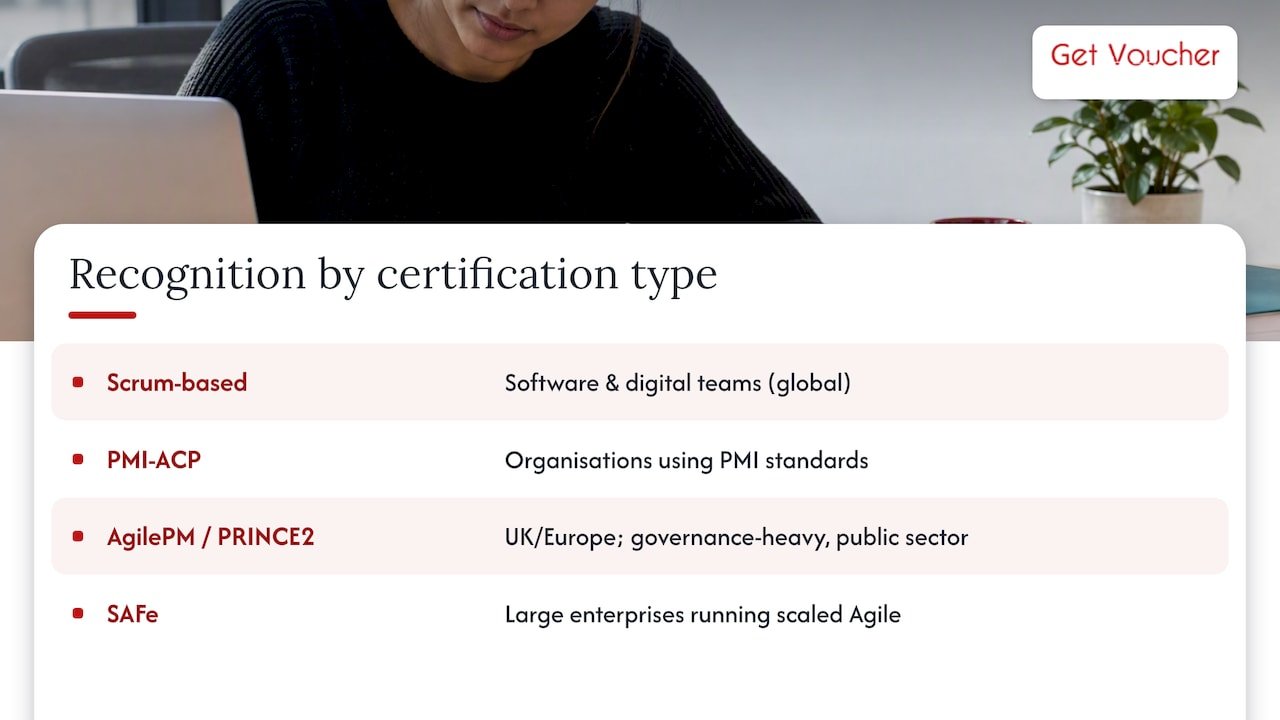
Recognition is not uniform across the Agile certification landscape, and it tends to track adoption in the sector you work in rather than any single ranking. Scrum-based credentials (PSM, CSM, PSPO, CSPO) have wide recognition across software and digital product teams globally, largely because Scrum itself is the most commonly adopted framework in those settings. PMI-ACP carries particular weight in organisations that already use PMI’s project management standards, since it sits inside a credentialing family many programme offices already recognise.
AgilePM and PRINCE2 Agile have a stronger footprint in UK and Europe-based governance-heavy environments, including public-sector programmes, reflecting PRINCE2’s established role there rather than a global default. SAFe credentials are recognised specifically where scaled-framework adoption exists, typically larger enterprises running multiple Agile teams in parallel; they carry less weight in smaller, single-team organisations simply because the problem they solve does not arise there. None of these differences make one certification universally superior. They reflect which sectors and geographies have adopted which frameworks, so the right choice depends on where you work or intend to work, not on a single global recognition score.
Costs and fees you can expect across certification routes
Fees vary by certifying body, exam attempts and whether training is bundled in, and no single figure applies across the whole Agile certification landscape. Rather than quoting borrowed figures from other providers, it is worth checking each certifying body’s own published fee schedule before budgeting, since prices and renewal terms change.
Within GetVoucher’s own catalogue, voucher-backed routes include Scrum Master Certified (SMC®) at £199 one-off and Scrum Product Owner Certified (SPOC®) at £199 one-off, both including exam access as part of the voucher. The Scrum Fundamentals Certified route is free, making it a low-friction way to test interest in Agile before paying for a role-specific credential. Renewal and maintenance requirements differ by certifying body too, and GetVoucher’s guidance on maintaining your SCRUMstudy certification covers what that looks like for SCRUMstudy-issued credentials specifically. Always treat a certifying body’s own fee page as the final word, since training costs, exam retake fees and renewal charges are set independently by each provider.
Who issues these certifications and how credibility is assessed
Agile certifications come from several distinct organisations, each with its own assessment model and scope, and credibility is best judged by what the body actually evaluates rather than by name recognition alone. Scrum.org issues PSM and PSPO through independent online exams. The Scrum Alliance issues CSM and CSPO through accredited trainer-led courses followed by assessment. PMI, best known for project management credentialing, issues PMI-ACP with documented experience prerequisites alongside the exam. Scaled Agile Inc administers SAFe certifications tied to its own scaled framework. ICAgile offers a track-based model covering multiple Agile disciplines through accredited training providers. SCRUMstudy and other VMEdu-affiliated brands issue Scrum and Agile credentials assessed through their own proctored exams, with GetVoucher providing voucher access into that pathway.
Each body sets its own syllabus, exam format and renewal policy, so credibility is best judged certification by certification rather than by assuming one issuing organisation outranks another across every credential it offers.
Sequencing certificates with real capability
My own view: certificates earn their value when paired with practice, not when stacked on their own. Start with a foundation credential to learn the vocabulary, apply it in a real sprint or delivery cycle, then specialise once you know which role actually suits you. A credential sitting ahead of experience signals less than the same credential following it.
— Rayan
How GetVoucher helps you prepare for the right certification
Certification courses and exam vouchers across Scrum, Agile and related professional skills are available, pairing exam access with self-paced video training so you are not hunting across separate sites for materials. 
- Dual Agile Pack: Scrum Master & Product Owner Certification, a bundled route if you are weighing both roles.
- Scrum Fundamentals Certified, a free starting point for readers new to Agile.
- The full certifications catalogue for Scrum Master, Product Owner and related vouchers.
For credentials not yet listed, readers are invited to contact the platform directly for pricing and availability as the catalogue expands.
FAQ
Which Agile certification is most recognised?
Recognition depends on the sector and region rather than one universal ranking. Scrum-based credentials such as PSM and CSM have broad recognition in software and product teams, while AgilePM and PRINCE2 Agile carry more weight in UK governance-heavy public-sector programmes, as the Agile Business Consortium notes.
Is PRINCE2 Agile better than PRINCE2?
They are not direct competitors: PRINCE2 Agile is an overlay that adds agile behaviours to an existing PRINCE2 governance structure rather than a replacement for it. According to the Agile Business Consortium, the better choice depends on whether your organisation already runs PRINCE2 governance or is building agile delivery capability from scratch, which points more towards AgilePM.
Is Agile still relevant in 2026?
Government service manual guidance continues to treat Agile as a core delivery approach, recommending teams learn multiple frameworks such as Scrum and Kanban rather than relying on a single rigid method, according to GOV.UK’s agile training guidance. Assurance practices built around agile delivery, including reviewer experience and team observation, remain active government policy as of August 2026.
Is CSM or PMP better?
They answer different questions: CSM validates Scrum-specific facilitation skills for a single team, while PMP (and its agile-focused counterpart, PMI-ACP) covers broader project management and cross-framework knowledge. The right choice depends on whether your role centres on Scrum team facilitation or wider project and programme management responsibilities.
Sources
- AgilePM® vs PRINCE2 Agile®: Which Should You Choose? – Agile Business Consortium
- Guide on assurance for agile delivery of digital services (August 2026) – GOV.UK
- Gov
- Cddo