




Digital marketing is the broader discipline. Content marketing is one focused approach inside it. Digital marketing covers every online route to a customer: websites, search engines, social media, email and mobile apps. Content marketing is the part that creates and distributes useful, relevant material for a defined audience, such as articles, videos, podcasts and guides.
So the question “which is better?” usually has the wrong shape. You rarely choose one over the other. You decide how much of your effort goes into explaining and building trust, and how much into reach, activation and conversion. This guide sets out the differences, shows them side by side, and gives you a practical sequence for a small team.
Table of Contents
- How the two relate
- Six differences at a glance
- What makes content marketing different from advertising
- The channels that carry content
- When to lean on content and when to lean on the wider mix
- A practical sequence for a small business
- Our view: treat content as the operating system, not the rival
- Building the skills: the SMstudy route we sell
- Common mistakes to avoid
- FAQ
- Sources
How the two relate
Think of digital marketing as the whole programme and content marketing as one operating method within it. The UK government’s business guidance defines digital marketing as the use of digital traffic channels to make people aware of your brand and products. A blog post is not a channel. It is an asset that needs channels to reach anyone: search, social, email or paid promotion.
That is why a single article often needs several things before it contributes to a commercial result:
- search optimisation, so people can find it;
- social or community distribution;
- an email send to people who already know you;
- sometimes paid amplification;
- analytics, so you know what happened afterwards.
All of these are digital marketing. The article itself is content marketing. Neither works well alone.
Some practitioners go further. One UK digital culture resource notes the argument that there is only marketing, not digital marketing, though it concludes the term is still useful as a specialism. For a reader deciding what to learn or budget for, the distinction remains practical.
Six differences at a glance
The table below covers scope, activities, examples, time horizon and measurement, which are the five points readers most often confuse. Treat the entries as common patterns, not rules: any business can mix them.
| Point of comparison | Content marketing | Digital marketing (wider mix) |
|---|---|---|
| Scope | A focused approach: creating and sharing useful content for a defined audience | The whole discipline: every digital channel used to promote or communicate with customers |
| Main activities | Audience research, editorial planning, writing, filming, editing, publishing, updating | SEO, paid search and display, social media, email, landing pages, conversion testing, analytics |
| Typical examples | A how-to guide, a webinar recording, a podcast episode, an infographic, a customer explainer | A paid search campaign, a welcome email sequence, a retargeting advert, a social campaign that promotes the guide |
| Primary goal | Educate, build trust, support discovery | Awareness, traffic, leads and sales, depending on the objective set |
| Time horizon | Often longer: trust and search visibility build over time | Mixed: a paid campaign can produce an immediate opportunity, while brand growth takes longer |
| Measurement | Usefulness, engagement, search visibility, returning visitors, assisted conversions | All of the content measures plus paid reach, email response, lead quality, conversion and commercial performance |
1. Scope
Content marketing is a subset. Every content marketing activity is digital marketing when it is delivered online, but plenty of digital marketing involves no content strategy at all, such as a straightforward paid advert pointing at a product page.
2. Activities
Content teams spend their time on what the audience needs to know. The wider digital team spends time on how that material, or an offer, reaches people and what they do next.
3. Examples
A useful test: if the thing is valuable to the reader even without a sales message, it is probably content. If it exists mainly to deliver a message or prompt an action, it is probably campaign activity.
4. Intent
UK government guidance suggests starting by deciding whether the aim is brand growth or an immediate sale. Content usually serves the first aim well. Campaign tactics are often better suited to the second, though good content can shorten the path to a sale too.
5. Time horizon
The same guidance distinguishes a one-off digital campaign, which can create an immediate opportunity, from brand growth, which depends on trust and can take longer. This is why you should not judge a guide and a paid campaign by the same short-term metric.
6. Measurement
Content is usually judged on usefulness signals. The broader programme is also judged on commercial outcomes. No single metric proves effectiveness. Benchmark first, then change one variable at a time.
What makes content marketing different from advertising
Research from Manchester Metropolitan University on business-to-business digital content marketing describes it as an inbound technique that depends on content that is useful, relevant, compelling and timely. The researchers’ marketers point to a publishing mindset: understand the audience’s information needs and how long they take to reach a purchase decision, and shift from selling towards helping.
That has practical consequences:
- Start from the question, not the product. What does your buyer need to understand before they can choose?
- Expect a slower build. Content compounds, but you should plan for months, not days.
- Maintain it. A guide that is out of date quietly damages trust.
This also answers a frequent query about inbound marketing. Inbound marketing is generally described as attracting people with helpful material rather than interrupting them. Content is its engine, and it still sits within digital marketing alongside search, social and email.
The channels that carry content
Digital marketing channels include your website, search engines, social media, email, mobile apps, paid search and display advertising. Content formats include articles, videos, podcasts, images, infographics and social posts, as listed by the Good Growth Hub.
The common implementation failure is producing one generic asset for every platform. GOV.UK’s social media guidance stresses that user needs and platform specifications differ, so content should be adapted to the channel, to accessibility requirements and to the intended journey. The same guidance treats content as a governed communication activity. Branded or sponsored material can resemble editorial content, so label it transparently.
A short mapping helps:
| Channel | What it does best | Content that fits |
|---|---|---|
| Organic search | Captures people who are already looking | Guides, comparisons, explainers |
| Activates people who know you | Digests, onboarding sequences, updates | |
| Social media | Starts conversations and extends reach | Short clips, visual summaries, commentary |
| Paid search and display | Buys reach quickly | Landing pages, focused offers |
When to lean on content and when to lean on the wider mix
Use this as a rough decision aid.
Lean on content marketing when:
- your product needs explaining before anyone will consider it;
- buyers research for weeks before deciding;
- you want to be found for the questions your customers ask;
- you have more expertise than advertising budget.
Lean on the wider digital mix when:
- you have a time-limited offer or launch;
- you need to reach people who do not know you yet;
- you already have good content and want it seen by more of the right people;
- you need to test messages and landing pages quickly.
Most businesses need both, in proportions that depend on their market. Nothing here guarantees a result: effectiveness depends on audience, offer and execution.
A practical sequence for a small business
The UK government’s guidance recommends clear objectives, audience research, a budget, testing and analytics. Turning that into a working order:
- Define the business objective. Brand growth or an immediate sale? Write down a target.
- Pick a narrow audience and name its main information need.
- Choose one format and one main channel you can sustain.
- Publish one accessible core asset, such as a thorough guide.
- Distribute it through owned channels (site, email), earned ones (mentions, shares) and, if useful, paid ones.
- Measure against a baseline, then test one change at a time, such as a headline, a call to action or a send time.
Keep the first cycle small. One strong asset, well distributed and measured, teaches you more than ten thin ones.
Our view: treat content as the operating system, not the rival
We see readers arrive at this topic from two directions. Some are small business owners asking where to put a limited budget. Others are career switchers or marketing beginners asking what to learn first. Our view is the same for both: do not set content against the rest of digital marketing. Learn the whole map first, then specialise.
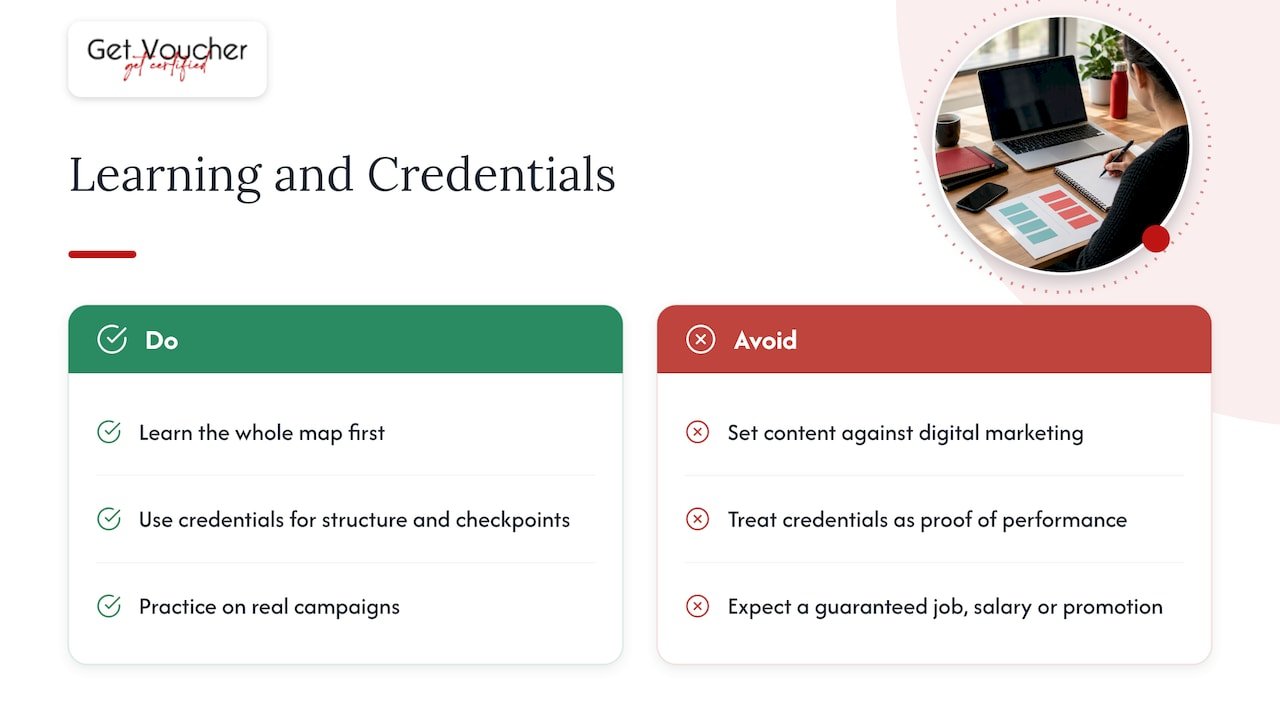
That is also how we think about certification. A credential shows you have studied a body of knowledge to a provider’s standard. It does not prove real-world performance, and it does not guarantee a job, salary or promotion. What it can do is give your learning a structure and a checkpoint, which matters when you are teaching yourself across channels. It is also worth keeping apart three things people mix up: certifications from a recognised provider, completion certificates from a single course, and platform-specific training for one tool. They carry different scopes, and none replaces practice on real campaigns.
If your interest is content specifically, we have separate guides on content marketing courses and whether free skills or formal credit suit you and a 90 day plan for busy marketers. A dedicated content marketing course and a broader digital marketing certification are different products, and you may reasonably want one, the other or both.
— Rayan
Building the skills: the SMstudy route we sell
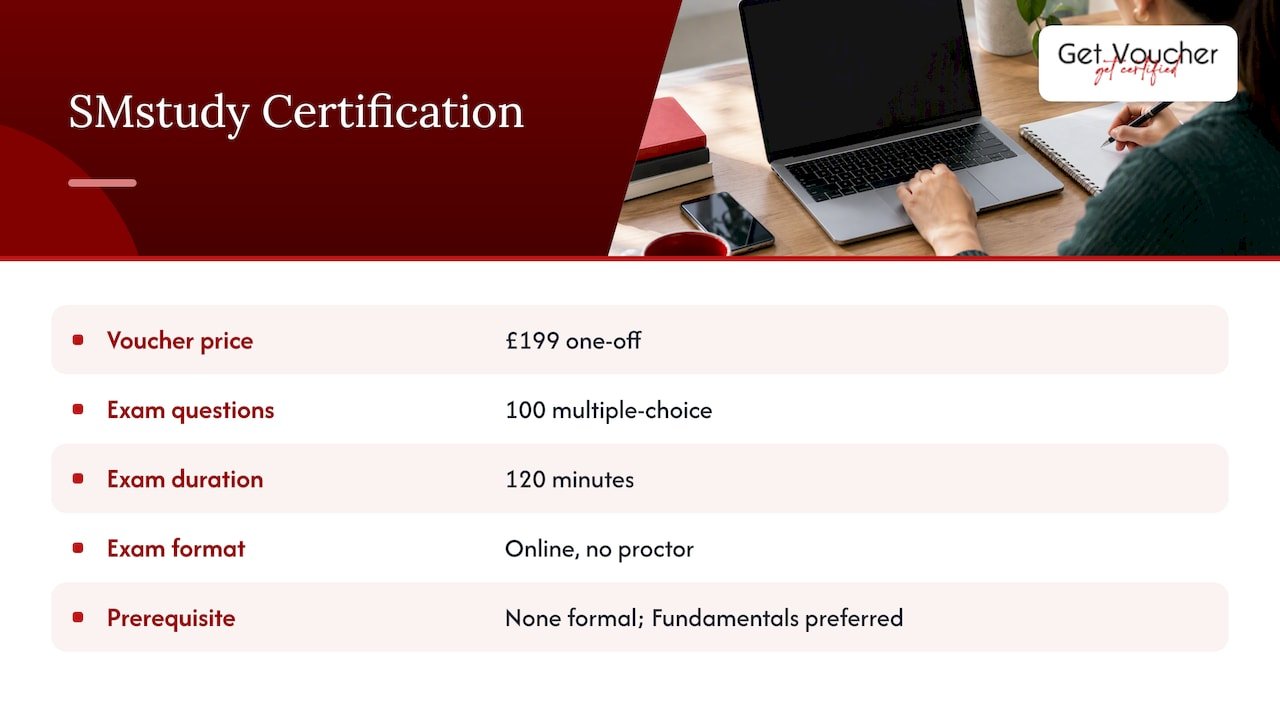
If you want a structured route into the wider discipline, we sell vouchers for SMstudy® certifications. The SMstudy® Certified Digital Marketing Professional voucher costs £199 one-off. According to the provider’s certification page, there is no formal prerequisite, though completing the Fundamentals certification first is preferable. The exam has 100 multiple-choice questions, lasts 120 minutes and is taken online without a proctor. It is not a project-based assessment.
You can start with Digital Marketing Fundamentals and see the full range in our digital marketing category. Our other digital marketing vouchers, such as Search Marketing, Email Marketing and Marketing Strategy, are each £199 one-off. Inclusions such as training access, study materials or scheduling support vary by product, so check the product page before you buy. For a timed plan, see our guide for career switchers. To compare everything we offer, visit our certifications page.
If you want the same argument in our own words, our blog version of this comparison covers the topic from the learner’s side.
Common mistakes to avoid
- Publishing without a distribution plan. Content that no one is sent to rarely finds an audience on its own.
- Using one asset everywhere unchanged. Adapt format and wording to each platform.
- Judging content by last-click sales alone. Look at assisted conversions, returning visitors and search visibility too.
- Changing five things at once. You will not know what worked.
- Skipping the baseline. Without a starting figure, improvement is guesswork.
- Hiding the sponsor. Disclose branded or paid content clearly.
FAQ
Is content marketing part of digital marketing?
Yes, when it is delivered online, which is nearly always the case today. It is one approach within a wider set of digital channels and tactics. Content marketing also exists offline, for example in printed magazines, but the comparison readers care about is with the online mix.
What is the key difference between the two?
Scope and aim. Digital marketing covers every online route to your audience, including paid advertising, email and search. Content marketing concentrates on creating useful material that educates and builds trust, usually over a longer period.
Which should a small business start with?
Start with your objective and audience, not the label. If customers need explaining to, one strong guide plus an email list is a sensible first step. If you have a time-limited offer, a small paid test with a clear landing page may suit better. Measure either against a baseline.
How is inbound marketing different from digital marketing?
Inbound marketing is an approach built on attracting people with helpful content rather than interrupting them. Digital marketing is the broader field of online channels, and inbound methods are used within it. The two terms overlap far more than they compete.
Sources
- How to create a digital marketing strategy, business.gov.uk
- Social media playbook, GOV.UK
- Business to business digital content marketing: marketers’ perceptions of best practice, Manchester Metropolitan University
- Digital Content, Communications and Marketing, Good Growth Hub
- Introduction to Digital Marketing, Digital Culture Network
- SMstudy Certified Digital Marketing Professional