




A workable digital marketing study plan has three parts: a fixed syllabus taken from the certification you are sitting, a weekly rhythm you can keep up alongside a job, and timed practice before exam day. Below is an eight-week plan built around the SMstudy® Certified Digital Marketing Professional route, which has no formal prerequisites. It is written for professionals, career switchers and small business owners who want to learn digital marketing and have the knowledge validated. You can stretch or compress it to suit your own week. At GetVoucher, the Digital Marketing Professional voucher costs £199 one-off, and the Fundamentals level is listed at £0.
The plan is not a promise that eight weeks suits everyone. Your starting point, your hours and the exam you choose all change the timeline. Treat the schedule as a template, and treat the syllabus of your chosen provider as the authority.
Table of Contents
- Start with the syllabus, not the calendar
- Know the exam before you plan around it
- The 8-week digital marketing study plan
- How to adjust the plan to your situation
- Study habits that hold up
- How to tell you are ready
- Where GetVoucher fits
- Our view on studying for a certification
- FAQ
- Sources
Start with the syllabus, not the calendar
Most failed study plans begin with a calendar and a pile of random videos. Start the other way round: decide which credential you are preparing for, then build the plan from its official outline.
That matters because “digital marketing” covers a wide area. Prospects says a degree is not essential for the field. It lists branding, campaign planning, content and creative strategy, analytics, SEO and PPC (pay-per-click advertising) as typical areas of study. It also names tools such as GA4, Search Console, email platforms and ad managers. No single course covers every tool, so a plan needs a boundary.
A certification gives you that boundary. You study what the body of knowledge covers, and you can measure yourself against an exam format. Three questions fix the boundary:
- What is the goal? A career switch, a promotion, a better understanding of your own business’s marketing, or a credential for your CV.
- What is your starting level? If you have never run a campaign, begin at the Fundamentals level. If you already work in marketing, you can go straight to the professional level.
- How many hours a week can you protect? Be honest. Four steady hours beat ten hours you will abandon in week three.
Know the exam before you plan around it
Exam formats are provider-specific, so do not carry assumptions over from one certification to another. For the SMstudy® route, these are the formats published by the provider:
| Level | Questions | Time | Delivery | Notes |
|---|---|---|---|---|
| Digital Marketing Fundamentals | 40 | 60 minutes | Online, unproctored | 30 correct answers needed to pass |
| Digital Marketing Professional | 100 | 120 minutes | Online, unproctored | Multiple choice, no negative marking |
The Digital Marketing Professional exam is a multiple-choice knowledge test, not a project-based assessment. Unproctored means no invigilator watches you, which says nothing about how hard the questions are. Fundamentals is a preferred starting point for the professional level, not a requirement.
How hard is it? Difficulty depends on your background, how closely you study the syllabus and how much timed practice you do. A 100-question paper in 120 minutes gives you roughly 72 seconds per question. That makes pacing a skill you should rehearse. You will not be able to treat it as an open-ended essay task.
The 8-week digital marketing study plan
The plan assumes around four to six hours a week. If you have less time, spread each week over two, and expect the whole plan to take longer. Each week has one main topic, one practical task and one short recall check.
| Week | Focus | Practical task | Recall check |
|---|---|---|---|
| 1 | Foundations: marketing basics, the customer journey, how channels fit together | Map the channels a brand you know actually uses | Explain the funnel to a friend without notes |
| 2 | Strategy and planning: objectives, audience, budget | Draft a one-page plan for a small, real or imaginary business | List three measurable objectives and how you would track each |
| 3 | Search: SEO and paid search | Review the title and description of five pages on your own or a chosen site | Define SEO, PPC, keyword intent and quality score in your own words |
| 4 | Content, social and email | Sketch a four-week content calendar | Name one metric per channel |
| 5 | Analytics and measurement | Explore a demo analytics account and write down five metrics you would report | Say what each metric does and does not tell you |
| 6 | Display, affiliate and other channels, plus conversion thinking | Write a short test hypothesis for a landing page | Match each channel to a typical objective |
| 7 | Full revision | Make a one-page summary of the whole syllabus | Take a timed set of chapter tests |
| 8 | Mock exam and booking | Sit a full-length practice under real timing | Review every wrong answer, then sit the exam |
Weeks 1 and 2: build the map
Read or watch for understanding first. The aim is to see how the pieces connect: audience, message, channel, measurement. Many beginners jump straight to tools and never learn why a campaign exists. The week 2 planning task is the most useful one in the plan, because it forces you to apply the vocabulary.
If your reader profile is a small business owner, use your own business for the planning exercise. You will remember the material better, and you will finish with something usable.
Weeks 3 and 4: the channels
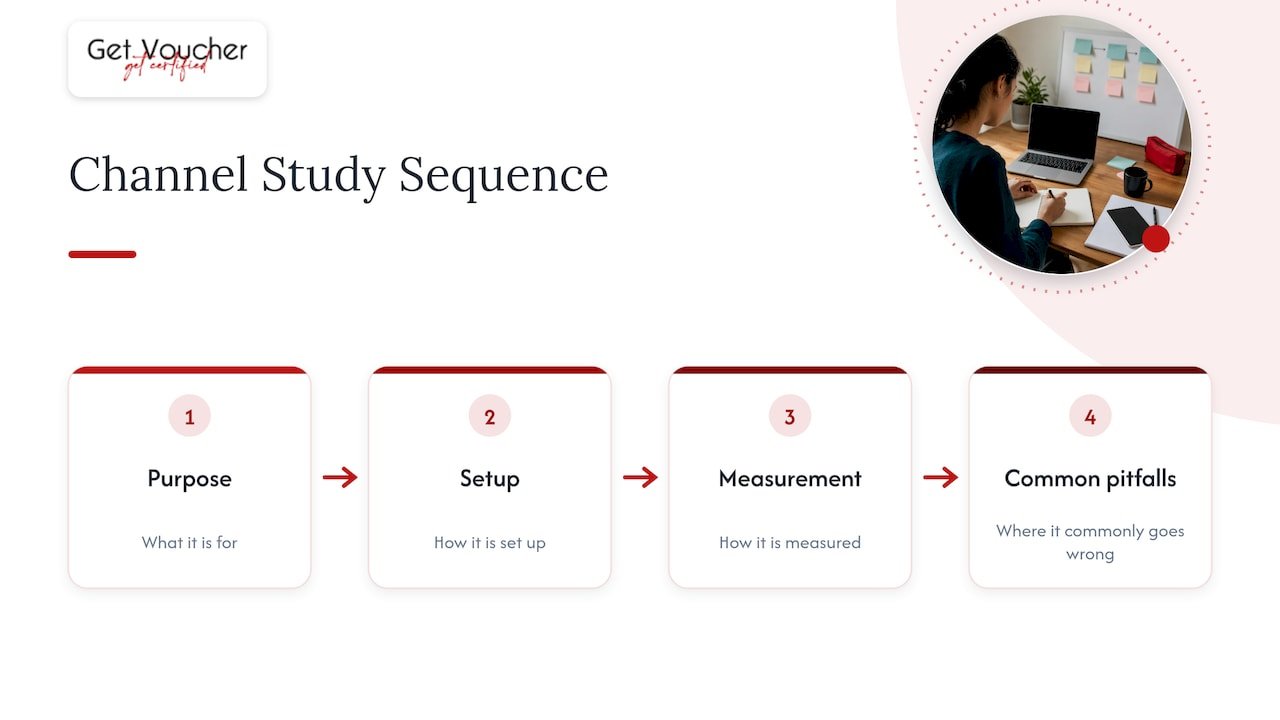
Search, content, social and email make up most day-to-day digital marketing work. Study each in the same order: what it is for, how it is set up, how it is measured, and where it commonly goes wrong.
Two cautions keep your notes accurate. First, do not confuse a discipline with the whole field: content marketing is one part of the wider digital mix, which we compare in content marketing vs digital marketing. Second, keep platform-specific training apart from a general certification. Learning one ad manager’s buttons is not the same as learning marketing principles, and a course-completion certificate is not the same as an exam-based certification.
When you reach email, include the rules around consent and personal data. A short guide to data protection rules for email marketing shows the kind of obligations marketers work under, even though the detail differs by country. For UK campaigns, check the current UK requirements before you apply anything.
Weeks 5 and 6: measure and refine
Analytics is where many candidates feel least confident, so give it a full week. You do not need to master every report. You need to understand what a metric means, what drives it and which decision it supports. A bounce rate or a conversion rate is only useful when you know what question it answers.
In week 6, add the remaining channels and start thinking in tests. A good habit is to write each idea as a hypothesis: if we change X for audience Y, we expect Z, and we will measure it with W. Avoid rigid assumptions about speed or conversion behaviour, because results vary by audience, product and market.
Weeks 7 and 8: practise under exam conditions
Revision is not rereading. Use the chapter tests that come with the course, then take a full timed paper. After each one, sort your mistakes into three groups: did not know, misread the question, ran out of time. Each group needs a different fix.
On the final week, do one mock under real timing, review it, rest and then sit the exam. Do not cram new topics in the last two days.
How to adjust the plan to your situation
The same eight weeks do not fit everyone. Use this guide to adapt.
- Complete beginner or student: start with Fundamentals and add a week at the start for vocabulary. The Fundamentals exam is a 40-question paper, so it gives you a low-stakes read on whether you are ready to continue.
- Career switcher: keep the plan, and add the practical work as optional portfolio material. A portfolio can help you talk about your skills, but it is not an official requirement of this certification. Our guide for career switchers choosing digital marketing courses goes deeper.
- Working marketer: compress weeks 1 and 2 into one, and spend the saved time on analytics and the weakest channel.
- Small business owner: spend more time on planning, search and email, because that is where most small-business marketing budgets are decided.
A certification shows that you have met a provider’s knowledge standard. It does not prove that you will perform in a role, and no plan can promise a job, salary or promotion.
Study habits that hold up
A few routines make the difference between finishing and drifting.
- Fix two or three study slots a week and put them in your diary like meetings.
- Keep one notes page per week, ending with five questions you could be asked.
- Test yourself before you reread. Retrieval from memory beats passive review.
- Apply every topic once. Even a rough plan, a headline test or a metrics list fixes the idea.
- Track weak areas in a single list and revisit it every Sunday.
If you fall behind, drop a practical task before you drop a recall check. The checks are what the exam measures.
How to tell you are ready
Readiness is not a feeling. Use evidence: you can score comfortably on timed chapter tests, you can explain each channel’s purpose and metric without notes, and you finish a full mock inside the time limit with minutes to spare. Setting your own pass line above the official one gives you a margin for nerves.
Because the exam is online and unproctored, plan the practical side too. Pick a quiet slot, check your connection and keep your account details to hand. Rules on scheduling and verification are provider-specific, so read the instructions that come with your voucher rather than assuming they match another exam you have taken.
Where GetVoucher fits
GetVoucher sells vouchers for SMstudy® certifications, and we have a commercial relationship with providers such as VMEdu, so you should know that when you read our recommendations. Inclusions differ by product, so check the product page for exactly what each voucher covers.
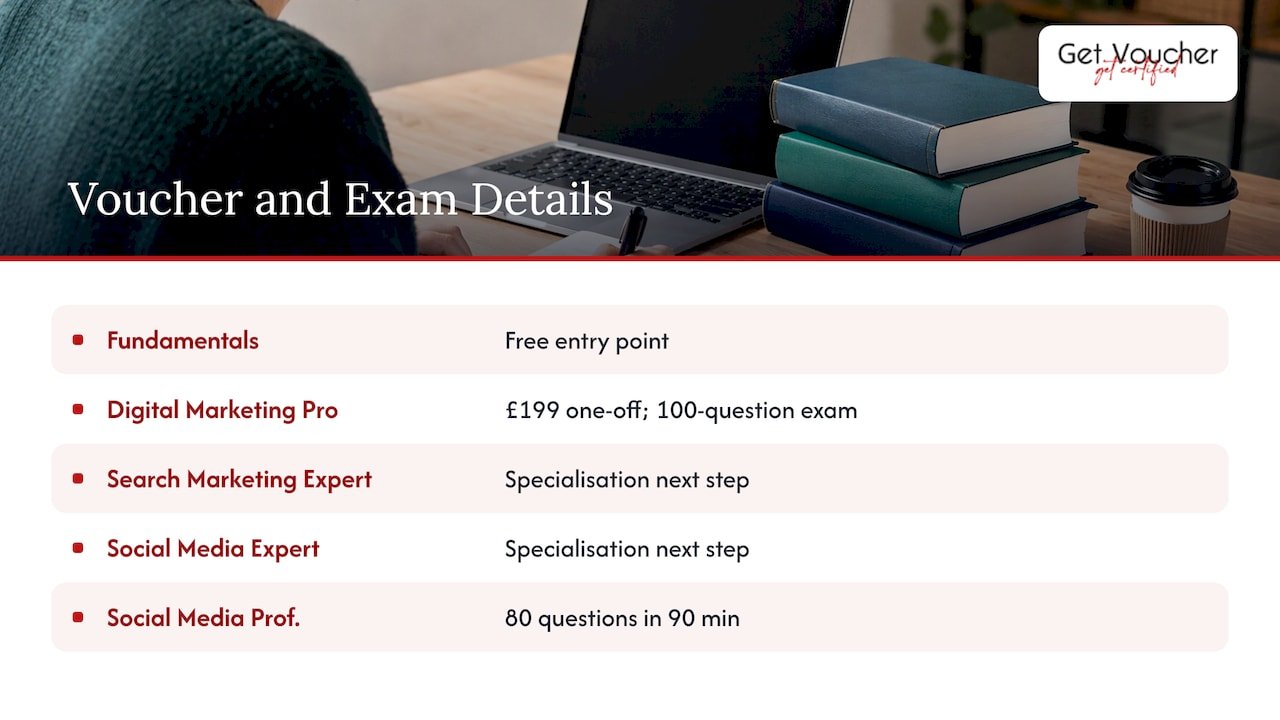
For this plan, the Digital Marketing Fundamentals voucher is the free entry point, and the Digital Marketing Professional voucher, at £199 one-off, takes you to the 100-question professional exam. If you want to specialise afterwards, the Search Marketing Expert and Social Media Marketing Expert pages show the next steps. The Social Media Marketing Professional focuses on social-media strategy, not on producing short-form content, and it requires the Digital Marketing Professional credential first. Its exam is 80 questions in 90 minutes, online and unproctored.
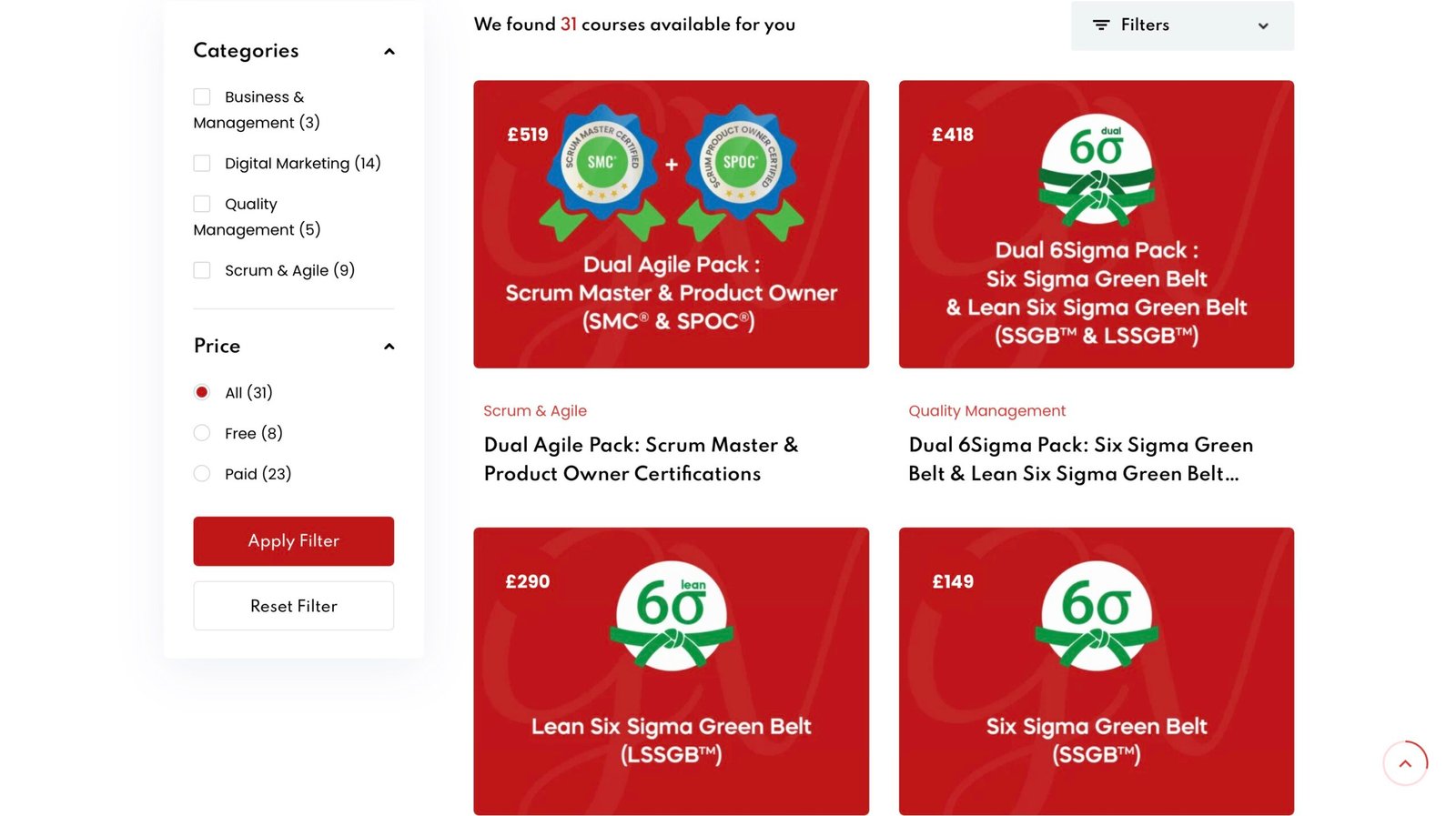
You can see the whole range on the Digital Marketing category page.
Our view on studying for a certification
Most people we speak to about certification do not lack motivation. They lack a boundary. Digital marketing is so wide that studying “everything” turns into studying nothing, and a fixed syllabus with a clear exam format fixes that.
That is why we think the order matters: start at Fundamentals, move to the professional level when the vocabulary feels natural, and add a specialism such as search or social media afterwards. Each step has a defined exam, so your progress is something you can see.
We also want you to keep certification in proportion. It is a structured way to learn and to validate what you know. It does not replace practice, and we would rather you ran one small real campaign alongside the course than collected credentials without applying them.
Flexible, online study suits people who work. That is the reason we built GetVoucher around self-paced routes you can fit around a job, with clear progression from introductory to more advanced levels.
Rayan
FAQ
How long should a digital marketing study plan be?
Eight weeks at four to six hours a week is a reasonable template for the professional level, but it is not a rule. Beginners may want ten or twelve weeks, and experienced marketers may need fewer. Set the length by your hours and your practice-test scores.
What should a digital marketing study guide include?
It should follow your certification’s syllabus: strategy and planning, search, content, social, email, other channels and analytics. Add a weekly practical task and a recall check, and end with timed mock papers. Prospects lists branding, campaign planning, analytics, SEO and PPC among typical study areas.
How difficult is a digital marketing exam?
Difficulty varies by certification and by your background. The SMstudy® Digital Marketing Professional exam has 100 questions in 120 minutes, so pacing and syllabus coverage matter. Timed practice is the best way to judge how it will feel for you.
Do I need a degree or prior experience first?
Not for this route. SMstudy® Digital Marketing Professional has no formal prerequisites, and Fundamentals is only preferred. Prospects also states that a degree is not essential for digital marketing.
Sources
- Prospects: How to get into digital marketing
- SMstudy: Certified Digital Marketing Professional
- SMstudy: Certified Digital Marketing Fundamentals