




No single authority controls Scrum certification. Several independent organisations issue their own credentials: Scrum Alliance, Scrum.org, ICAgile and SCRUMstudy are the names you will meet most often. Each sets its own training rules, exam format, cost and renewal terms, so the right choice depends on the role you want, how you prefer to study and what you will pay to keep the credential. At GetVoucher we work with SCRUMstudy, so our SCRUMstudy vouchers start at £249 for the Scrum Master Certified (SMC®) exam and course access. The sections below show how the bodies differ so you can compare like with like.
Table of Contents
- What a Scrum certification body does
- Which body issues which credentials
- How the bodies differ on training, exams and renewal
- How recognised is each body?
- How to choose
- A worked example
- Perspective
- GetVoucher’s SCRUMstudy vouchers
- FAQ
- Sources
What a Scrum certification body does
A certification body is the organisation that defines what a credential means, sets the assessment and issues the certificate. It is not the same as a training provider, which delivers a course.
The distinction matters because the two roles are split differently at each organisation. Scrum Alliance is the certifying body and approves independent providers to deliver its courses, so you register and pay through those providers. Scrum.org keeps certification separate from training: you can sit its assessments without attending a class. ICAgile defines learning outcomes and accredits member organisations that build courses around them, then issues credentials after completion.
There is also a point that surprises many newcomers. The Scrum Guide does not mention certification, which means no body holds an “official” Scrum credential. Titles such as Scrum Master or Certified Scrum Master are not controlled by one universal authority. When you read a job advert or a CV, the name of the issuing organisation tells you more than the title does.
Two terms are worth fixing early:
- Scrum: a framework for delivering complex work in short cycles, described in the Scrum Guide.
- Agile: a broader family of approaches. Some certifications are Scrum-specific, others cover Agile generally.
Which body issues which credentials
The table below summarises the main credential families. It covers the bodies and their headline Scrum credentials, not every certificate they sell.
| Body | Main Scrum-related credentials | Training model |
|---|---|---|
| Scrum Alliance | Certified ScrumMaster (CSM), Certified Scrum Product Owner (CSPO) and advanced levels | Required instructor-led course from an approved provider |
| Scrum.org | Professional Scrum Master (PSM) I, II, III; Professional Scrum Product Owner (PSPO) I, II, III; Professional Scrum Developer I; scaling and leadership credentials | Assessment can be taken without a class |
| ICAgile | Agile credentials built on accredited member courses | Courses from accredited organisations |
| SCRUMstudy (VMEdu) | Scrum Master Certified (SMC®), Scrum Product Owner Certified (SPOC®), SCRUM Agile Master Certified (SAMC™), Scrum Developer Certified (SDC®), Scrum Fundamentals Certified | Online learning with an online exam |
Scrum Alliance describes CSM and CSPO as certifications for people who want to work on a Scrum team. Scrum.org’s certification catalogue lists the PSM, PSPO and Professional Scrum Developer ladders plus further credentials on leadership and scaling.
One more name appears in the industry guides: Scaled Agile. TechTarget’s 2024 guide lists Scrum.org, Scrum Alliance and Scaled Agile as three highly reputed organisations offering Scrum Master pathways, and notes that Scaled Agile credentials focus on the SAFe framework and enterprise-scale work. SAFe supports Scrum, Kanban and wider Lean-Agile practices, so it is a different subject from Scrum itself. GetVoucher’s Scrum certifications are distinct from SAFe credentials, and our guide to scaled Scrum versus Scrum explains when scaling questions become relevant.
A note on what GetVoucher sells: our vouchers cover SCRUMstudy certifications. We do not sell Scrum Alliance or Scrum.org credentials, and the comparisons here are meant to help you decide with the full picture.
How the bodies differ on training, exams and renewal
This is where the real decision sits. Keep each body’s rules separate, because they do not transfer from one to another.
Scrum Alliance
Scrum Alliance requires structured instructor-led training for its certification courses. Its process page says many entry courses have no previous-experience prerequisite, and that the credential requirements for a specific course appear on that course page. Certification includes a two-year membership.
For CSM, the test follows the required 16-hour course. It has 50 questions, lasts 60 minutes and has a 74% pass score. CSPO is different: it requires approved training but currently has no certification exam, so there is no CSPO exam fee. Course prices are set by the trainers and providers, which means they vary from one course to the next.
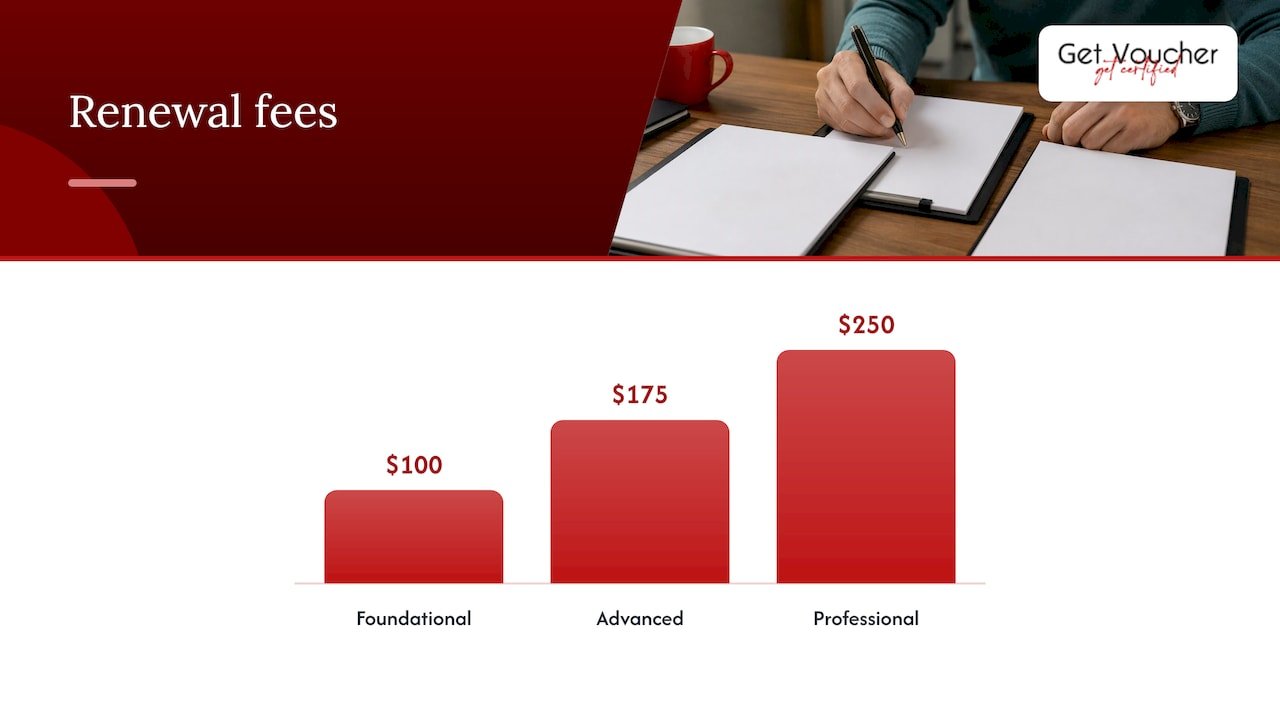
Renewal is on a two-year cycle. Scrum Alliance’s help page, published 27 May 2026, sets out $100 plus 20 SEUs for foundational credentials, $175 plus 30 SEUs for advanced credentials and $250 plus 40 SEUs for professional credentials. SEUs are Scrum Education Units, the continuing-education credits it asks holders to log. The same page states that the fee follows your highest-level credential rather than being charged for every credential you hold.
Scrum.org
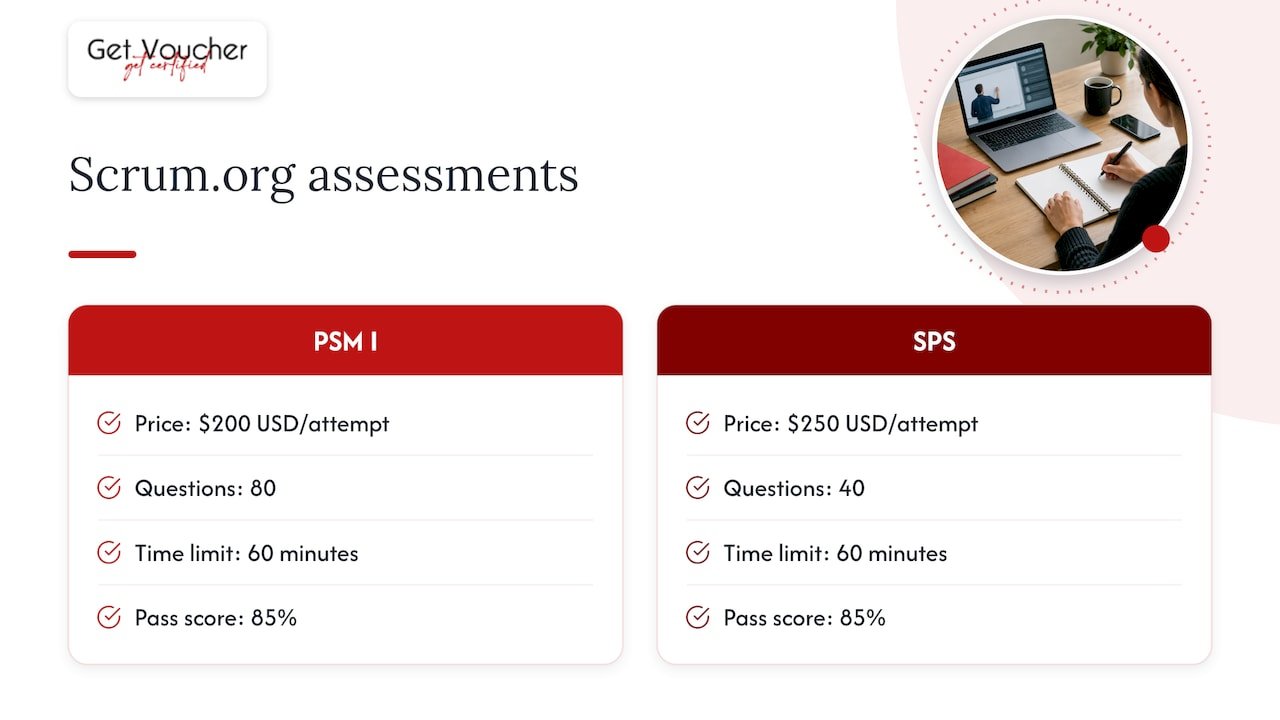
Scrum.org separates the assessment from the course. Its assessments can be taken without attending a class, and each Scrum.org training class includes one associated assessment attempt at no extra charge.
PSM I costs $200 USD per attempt, and attending a course is not a prerequisite. The PSM I assessment has 80 questions, a 60-minute limit and an 85% pass score. Its higher-tier scaling credential, Scaled Professional Scrum, costs $250 USD per attempt, uses 40 questions in 60 minutes with an 85% pass score, and is lifetime with no renewal fee. Official PSPO I pricing is also set by Scrum.org, and PSPO I has lifetime validity with no renewal fees.
Do not assume that Scrum.org and Scrum Alliance assess learning the same way. One is built around a course followed by a test, the other around an assessment that stands alone. Do not infer from this that either one is open-book: the rules are set by each body and should be read on its page.
ICAgile
ICAgile is an accreditation and certification body, so its model is a little different from the two above. Member organisations create courses aligned with ICAgile learning outcomes, and ICAgile certifications have no renewal fee. It suits people who want a broader Agile credential rather than one tied to a single Scrum framework description.
SCRUMstudy
SCRUMstudy is a certification body of VMEdu, and its credentials are built on the SCRUMstudy SBOK® Guide rather than on the Scrum Guide. That is a provider-specific body of knowledge, so the two documents should not be treated as interchangeable. An independent comparison also describes SCRUMstudy’s entry credential as SMC and its framework as SBOK.
The exam rules for SCRUMstudy credentials we offer are:
- Scrum Master Certified (SMC®): a 100-question, 120-minute online unproctored exam.
- SCRUM Agile Master Certified (SAMC™): also an online unproctored exam.
- Scrum Fundamentals Certified (SFC): a 40-question, 60-minute online unproctored exam.
Validity, renewal and prerequisites are SCRUMstudy rules and are confirmed on the SCRUMstudy and product pages for each credential. Treat them as separate from the other bodies’ terms. Whether an exam is proctored or unproctored says nothing about its credibility, only about how it is delivered.
How recognised is each body?
Recognition depends on the employer, the sector and the country, so be wary of any ranking that claims otherwise. Scrum.org calls PSM I a certification recognised by the industry. That is Scrum.org’s own description, and it tells you how the body positions its credential, not how every employer treats it.
Agile Alliance’s practitioner guidance treats recognition as contextual. It advises candidates to look at employer acceptance, geography, maintenance cost and how well the credential fits the role. A certificate shows you have studied a framework and passed an assessment. It does not prove performance in a job, and it does not guarantee a salary or promotion.
A practical way to test recognition for yourself: search five job adverts in the role and region you are targeting, note which credentials they name, and see whether they list any at all. Many UK adverts ask for Scrum knowledge and leave the certifying body open.
How to choose
Use the criteria Agile Alliance lists for judging a certifying organisation: focus, content, training requirements, assessment, maintenance, employer verification, cost and prerequisites, and whether self-study or structured learning suits you. Turn them into questions about your own situation.
- What role are you aiming for? A Scrum Master, Product Owner and Developer each have their own credentials. Our comparison of Scrum Master and Product Owner roles helps you pick. The Scrum Guide makes the Product Owner accountable for maximising product value and for managing the Product Backlog. “Product Manager” is a job title whose responsibilities vary by organisation, not a fixed Scrum role.
- How do you like to learn? Instructor-led courses suit people who want a live group. Online self-paced learning suits people fitting study around work. Our note on self-paced Scrum Alliance and Scrum.org options goes into this.
- What is the full cost? Separate the exam fee, any mandatory course, optional preparation, retakes and renewal. An exam-only price is not automatically the cheapest route once you add the rest.
- How long must you maintain it? Compare renewal fees and continuing-education requirements. Scrum.org’s PSPO I and Scaled Professional Scrum have no renewal fee, Scrum Alliance renews every two years, and SCRUMstudy terms are on its own pages.
- Who will check it? Whichever body you pick, name the issuer on your CV, because the job title alone does not tell a reader which credential you hold.
For a complete beginner, a free starter makes sense before spending money. Our Scrum Fundamentals Certified voucher costs £0 and gives a first look at the framework and at how SCRUMstudy assessments work.
A worked example
Consider a project manager in Manchester who wants a first Scrum credential and has a budget of about £300. The key questions are whether her employer asks for a particular body and how much time she can give to study.
If her employer names Scrum Alliance, she needs an approved instructor-led course, and the CSM test comes after the 16-hour course. If it names Scrum.org, she can book a PSM I attempt for $200 without a class. If no body is named, she can compare self-paced options. Under our catalogue, the SMC® voucher is £249 one-off, and the SAMC™ voucher is £349. In every case she should confirm what is included, because inclusions differ by product and by body.
Perspective
We see Scrum certification as a decision about fit rather than a league table. Each body publishes its own rules, and those rules reflect different ideas about how people learn Scrum.
Scrum.org puts the weight on assessment. Scrum Alliance puts it on the instructor-led course. ICAgile puts it on accredited learning outcomes. SCRUMstudy puts it on a structured online route built around the SBOK® Guide. None of these is the one correct way, and a good choice starts from your role, your schedule and your budget.
What we do at GetVoucher is make the SCRUMstudy route easy to access. A learner can pick a certification, get the voucher and start preparing online without a classroom. For working professionals and career switchers, that flexibility is often what decides whether they begin at all. We also disclose our commercial relationship with VMEdu, the organisation behind SCRUMstudy, so you know where we stand when we compare bodies.
Our advice is to start with the credential that matches the work you do now or want to do next, then add complementary skills over time. A Scrum Master might later add Product Owner knowledge, and a Product Owner might add Six Sigma or marketing skills.
Rayan
GetVoucher’s SCRUMstudy vouchers
If the online SCRUMstudy route suits you, GetVoucher sells vouchers for the whole Scrum range. The Scrum Master Certified (SMC®) voucher is £249, Scrum Product Owner Certified (SPOC®) is £299, SCRUM Agile Master Certified (SAMC™) is £349 and Scrum Developer Certified (SDC®) is £99, all one-off. The Dual Agile Pack combining Scrum Master and Product Owner certifications is £519. You can start with the SMC® voucher, or see the full Scrum range by role.
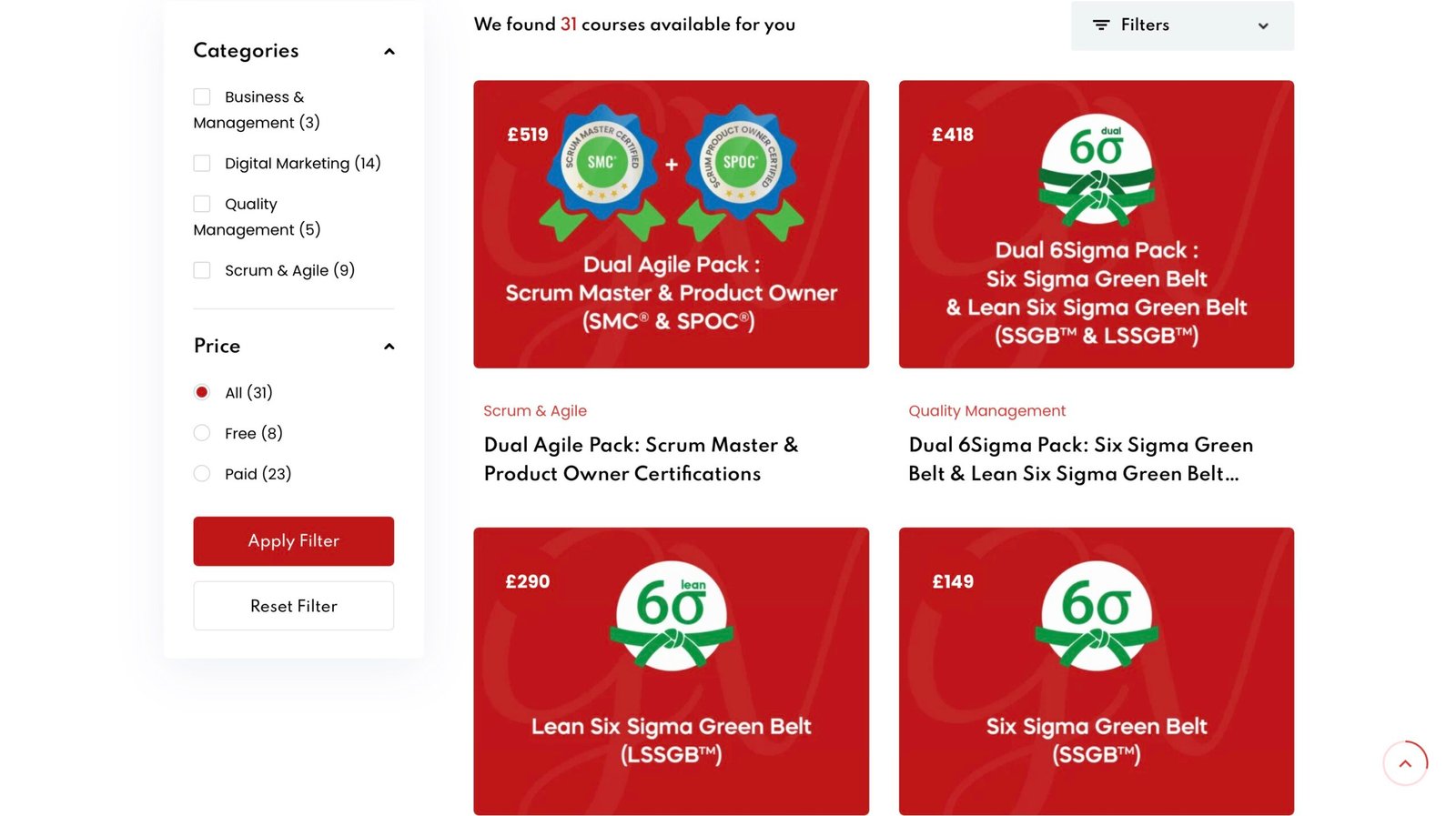
What each voucher includes differs by product, so check the product page before you buy. For a wider overview, our complete Scrum and Agile guide covers frameworks and certification roadmaps.
FAQ
Is there an official Scrum certification?
No. The Scrum Guide does not mention certification, and private organisations issue Scrum credentials. Because no universal authority controls titles such as Certified Scrum Master, always name the issuing organisation when you describe a credential.
Is CSM or PSM better?
Neither is better in every case. CSM is a Scrum Alliance credential that follows a required 16-hour course, while PSM I is a Scrum.org assessment at $200 per attempt with no required class. Choose by how you like to learn, your budget and what employers in your target role ask for.
Does CSPO have an exam?
No. CSPO requires approved training but currently has no certification exam, so there is no CSPO exam fee. It also includes a two-year Scrum Alliance membership. Our SPOC vs CSPO vs PSPO guide compares the Product Owner paths.
Do Scrum certifications expire?
That depends on the body. Scrum Alliance credentials renew every two years with a fee and SEUs, whereas Scrum.org’s PSPO I and Scaled Professional Scrum have no renewal fee and ICAgile certifications have no renewal fee. SCRUMstudy validity is set by SCRUMstudy, so confirm it on the product page.
Sources
- Build Agile Skills Through our Certification Process, Scrum Alliance
- Professional Scrum Certifications, Scrum.org
- Professional Scrum Master I Certification, Scrum.org
- Scaled Professional Scrum Certification, Scrum.org
- What is the cost to renew a certification, Scrum Alliance Help Center
- A Quick Guide to Scrum Alliance and ICAgile, ICAgile
- Is There an Official Scrum Certification?, SCRUM Framework
- Scrum Certificate or Certification: which fits?, iPeople
- 7 Scrum certifications and career paths to pursue, TechTarget
- What to look for in a certifying organization, Agile Alliance