




Most employers that reimburse a certification want three things from you: a clear link to your job, approval before you spend, and proof of payment and of a pass afterwards. If you bring all three, a request for a Scrum, Six Sigma, marketing or negotiation certification is usually easy to say yes to. This guide covers what can be reimbursed, how UK tax treats it, how to write the request, and what to check in any repayment clause. Because we sell certification vouchers with a published one-off price, you can put an exact figure in front of your manager from the start, for example £249 for Scrum Master Certified (SMC®).
Table of Contents
- What employer reimbursement actually covers
- Is reimbursed certification taxable in the UK?
- Making the case: the job-related test in plain terms
- How to request funding, step by step
- Tracking certifications once your employer is paying
- Repayment clauses: read them before you sign
- What if your employer says no?
- Where GetVoucher fits
- Our perspective
- FAQ
- Sources
What employer reimbursement actually covers
Reimbursement means you pay first and your employer pays you back against evidence. Direct payment means the company pays the provider. Both are common, and the choice is set by company policy, so ask which one applies before you buy anything.
What counts as a certification cost varies by policy. Typical lines are:
- the exam or voucher fee;
- the course or training fee, where the certification includes it;
- study materials;
- renewal or retake fees;
- sometimes travel.
The lines differ from employer to employer, so read your own policy rather than assuming. Public examples show the range. One US hospital system covers exam fees, renewals, study materials and some travel, but treats failed exams as the employee’s cost (Carilion). A US city caps certification at $1,500 a year and excludes unsuccessful attempts and study materials (City of Henderson). Treat these as illustrations of how policies are built, not as UK rules.
That is why it helps to know what your own fee includes. Our pages on what a certification fee covers and what an exam voucher means set out the distinction between a voucher, training access and exam scheduling, so your request names the right items.
Is reimbursed certification taxable in the UK?
In the UK, employer-paid work-related training is generally not taxed. HMRC’s manual explains that section 250 of the Income Tax (Earnings and Pensions) Act 2003 removes a tax charge where an employer, or a third party, pays for work-related training, and that it makes no difference whether the employer pays directly or reimburses you.
The test is whether the training is work-related. HMRC’s 2018 consultation paper describes this as training that qualifies you for the duties of your current job or a related employment, and says payments stay taxable if they are a reward, an inducement to take a job, or for entertainment or recreation.
In practice:
| Situation | What to expect |
|---|---|
| A Scrum certification for a project manager moving onto an Agile team | Clearly connected to current or related duties |
| A Six Sigma Green Belt for someone in operations or quality | Clearly connected to current or related duties |
| A certification for a different career you plan to move to | Harder to describe as work-related; ask your payroll or HR team |
The final call on tax belongs to your employer’s payroll and HMRC, so if your case is borderline, ask payroll before you claim.
Other countries differ. In the US, for instance, the first $5,250 of employer educational assistance a year is tax-free under section 127 for 2025 and 2026, and many US public bodies treat certification reimbursement as taxable income. Do not carry US figures into a UK request.
Making the case: the job-related test in plain terms
Managers approve what they can justify. One university’s HR guidance gives managers three questions: does the certification help meet the main requirements of the role, prepare the employee for new responsibilities in their current role, or prepare them for a position they are being considered for? A yes to any one makes it job-related (Vanderbilt University HR). The same logic works as a template for your request.
Here is how that looks for the people we usually hear from:
- Project manager whose team is adopting Scrum. The certification prepares you for new responsibilities in your current role.
- Developer or analyst asked to cover Product Owner duties. The Scrum Guide makes the Product Owner accountable for maximising product value and for managing the Product Backlog, so a certification aligned with that role maps to the new duties.
- Operations or quality lead running improvement work. A Six Sigma belt maps to the process improvement already in your remit.
- Small team marketer who owns email or search. A specialist marketing certification maps to your daily work.
- Sales lead negotiating larger contracts. A negotiation certification maps to a central part of the role.
A certification shows you have met a provider’s assessment. It does not by itself prove performance, a promotion or a salary rise, so present it as skills development for a defined piece of work, not as a promise of results.
How to request funding, step by step

1. Read the policy and ask what it pays for
Find the training or professional development policy on your intranet, or ask HR. Note whether it reimburses or pays directly, whether there is an annual cap, whether you must pass, and whether there is a service period. Employers often require a pass before paying: the Carilion policy above, for example, asks for proof of passing and submission within 90 days.
2. Choose one specific certification and its exact cost
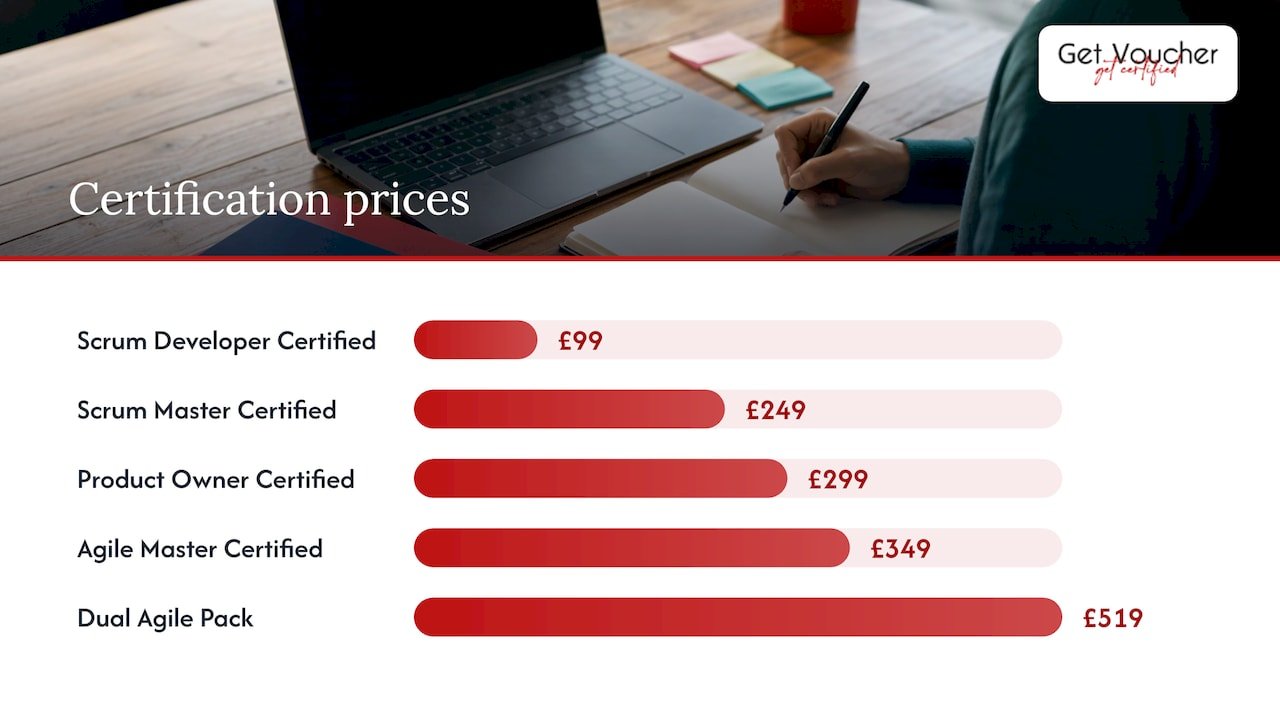
Vague requests stall. Name the credential, the provider, what the fee includes and the price. Check inclusions per product, because they are not the same across a catalogue. Our listed prices are one-off and published in pounds:
| Certification | Price |
|---|---|
| Scrum Fundamentals Certified | £0 |
| Scrum Developer Certified (SDC®) | £99 |
| Scrum Master Certified (SMC®) | £249 |
| Scrum Product Owner Certified (SPOC®) | £299 |
| SCRUM Agile Master Certified (SAMC™) | £349 |
| Six Sigma Green Belt (SSGB™) | £149 |
| Lean Six Sigma Green Belt (LSSGB™) | £290 |
| SMstudy® Certified Digital Marketing Professional | £199 |
| NGstudy™ Certified Negotiation Professional (NCN-P) | £199 |
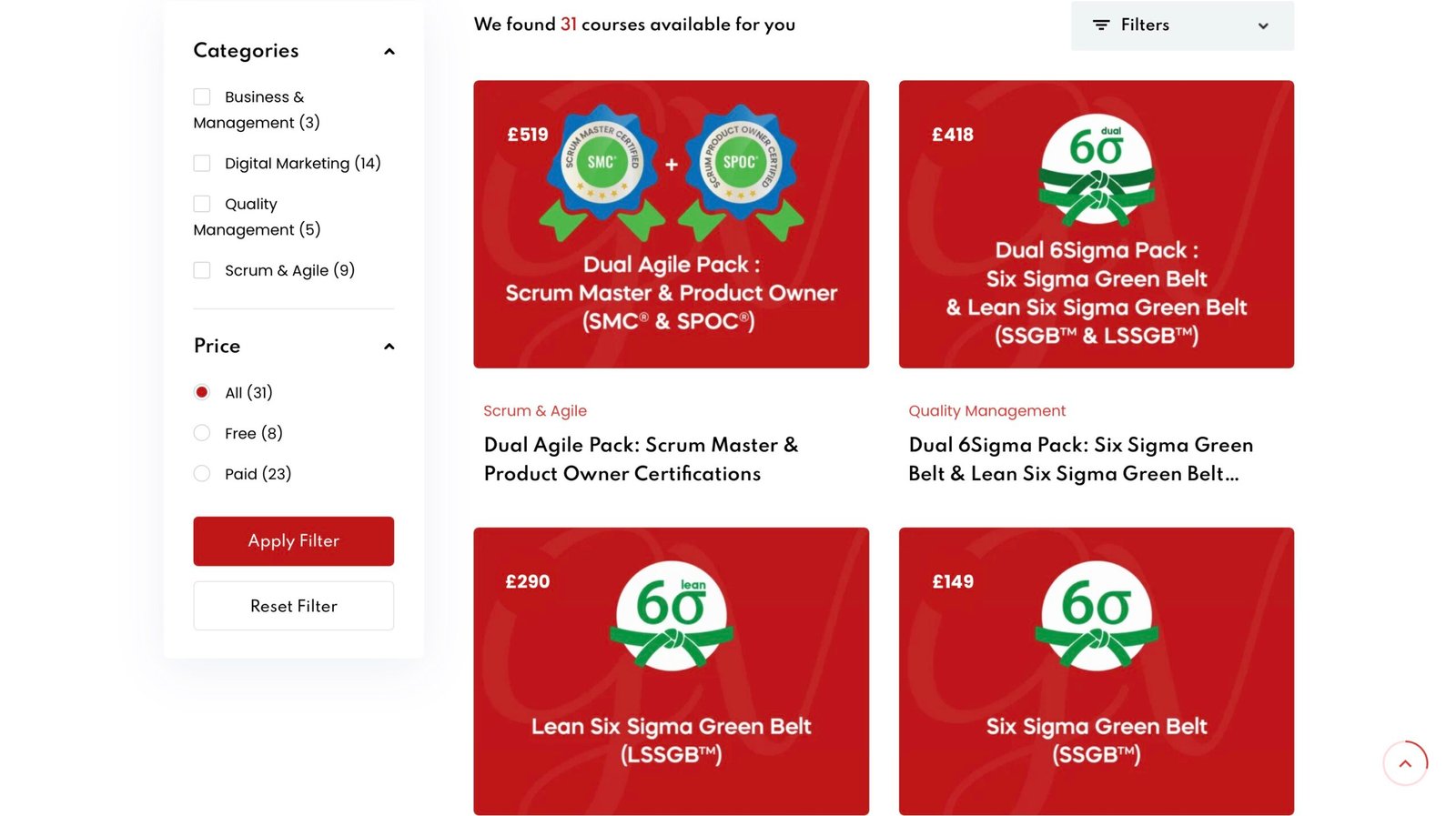
The Dual Agile Pack (Scrum Master and Product Owner) is £519 and the Dual 6Sigma Pack is £418. Check the product page for exactly what each purchase includes.
The providers behind these are SCRUMstudy, SMstudy, 6sigmastudy and NGstudy, and GetVoucher has a commercial relationship with them and with VMEdu. These are SCRUMstudy credentials, not Scrum Alliance or Scrum.org ones. Say so in your request so nobody confuses them.
3. Describe the exam format accurately
Approvers sometimes ask how the assessment works. Keep it provider-specific. The SCRUMstudy SMC® uses a 100-question, 120-minute online unproctored exam, and so does the SAMC™. The SCRUMstudy Scrum Fundamentals Certified exam is 40 questions in 60 minutes, online and unproctored. The SMstudy Digital Marketing Professional has no formal prerequisites, with Fundamentals only preferred, and uses a 100-question, 120-minute online unproctored exam, not a project-based assessment. Unproctored does not mean easier or less credible, and it does not tell you whether an exam is open-book. If your employer wants to understand the format, our guide on how professionals verify unproctored certifications explains it.
4. Get approval in writing before you pay
Many policies need a request form and line manager sign-off before the spend, not after. The Carilion policy requires a certification request form with supervisor approval. Even where your company has no form, an email saying “approved, up to £X, on completion” protects you.
5. Keep every piece of evidence
You will normally need an itemised receipt, proof of payment, and the certificate or pass result. Save them as you go. Then submit promptly: public examples show 30 to 90 day windows, and your finance team will have its own.
6. Ask about timing and tax before you submit
Confirm when the money arrives and that payroll is treating it as work-related training. If your employer chooses to pay the provider directly instead, the same approval and evidence steps apply.
Tracking certifications once your employer is paying
Once a company funds several people, it needs a way to know who holds what and when credentials need attention. HR teams use systems for tracking staff certification expiry dates alongside their training budgets. If you are the one asking, a line in your request about when the credential was awarded and any renewal terms makes your manager’s record-keeping easier. Renewal and validity are provider-specific, so state the rule for the certification you are requesting and not for certifications in general.
Repayment clauses: read them before you sign
A funded certification often comes with a condition. In the UK, an employer can recover training fees if you leave within a set period, provided a clear contractual provision or training agreement exists and the sum is not a penalty out of proportion to the employer’s legitimate interest. A common structure is a sliding scale: you repay more if you leave sooner and less as time passes.
US examples show the same pattern. One Florida public hospital district requires 12 months of service after the exam and deducts the full amount from final pay if the employee leaves earlier (Broward Health).
Before you sign, check:
- how long the service period runs and when it starts;
- whether repayment is a flat sum or reduces over time;
- whether it applies if you are made redundant;
- whether it covers only the exam, or also training and materials.
If the terms are unclear, ask HR to clarify in writing. For a dispute over what you owe, employment law advice from a solicitor or Acas is the right route.
What if your employer says no?
A refusal is often a timing or budget issue. Ask whether there is a later budget window, whether a lower-cost starting point fits, or whether the request can be split. Our free introductory options, Scrum Fundamentals Certified and the Six Sigma Yellow Belt, cost £0, so they let you show initiative and build a case for the paid credential. Self-funding is a separate matter in UK tax terms: you generally cannot deduct self-funded training because the cost must be incurred wholly, exclusively and necessarily in performing your duties, and the Academy of Medical Royal Colleges explains the narrow exception for doctors in training posts. Do not assume you can claim relief on your own.
Where GetVoucher fits
If your request is approved, the easiest thing for an approver to sign off is a named product with a published one-off price and clear inclusions. Our catalogue covers Scrum and Agile, Six Sigma, digital marketing, negotiation and risk management, with online learning and exam support depending on the certification. Start from the certifications overview, or go directly to the Dual Agile Pack if your role spans Scrum Master and Product Owner work.
If you may need to move an exam date, see how to reschedule without losing your fee, and our refund policy states the conditions for orders.
Our perspective
Most reimbursement requests fail on specifics, not on principle. A manager reads “a Scrum course” and sees an open-ended cost. They read “Scrum Master Certified, £249 one-off, for the Agile transition in our team” and see a decision.
That is why we publish fixed prices and keep inclusions product by product. When you can name the credential, the price and the job it supports, approval is far more straightforward than with a vague training wish.
We also think a certification path should be easy to start. Free introductory options such as Scrum Fundamentals Certified let you begin before anyone signs off a budget, and the paid credentials follow when the case is made.
Rayan
FAQ
Can my employer reimburse a certification tax-free in the UK?
Generally yes, where the training is work-related. HMRC’s manual says employer-paid or reimbursed work-related training is exempt under section 250 ITEPA 2003. Payments intended as a reward or inducement remain taxable. Your payroll team makes the final call for your case.
Should I pay first or ask the company to pay directly?
Follow your employer’s policy. Some reimburse after you pass, others pay the provider up front. Ask before you buy, and get approval in writing so reimbursement is not refused afterwards.
Do I have to repay the money if I leave?
Only if your contract or a training agreement says so and the sum is reasonable rather than a penalty. Check the service period and whether repayment reduces over time before you sign.
Does a certification prove I will be promoted or paid more?
No. A certification shows you met a provider’s assessment. Present it to your employer as skills development for specific work, not as a guaranteed career or salary outcome.
Sources
- HMRC Employment Income Manual EIM01210: work-related training
- HMRC consultation on taxation of self-funded work related training (2018)
- IRS: updates to FAQs on educational assistance programs
- Pearson Solicitors: can my employer recover training fees from me?
- Academy of Medical Royal Colleges: claiming tax relief on exam fees
- Vanderbilt University HR: non-degree program manager information
- Carilion: certification reimbursement
- City of Henderson: tuition and certification reimbursement policy
- Broward Health: continuing education tuition and certification reimbursement
- INGENIA: tracking staff certification expiry dates