




For entry-level roles, choose PRINCE2 Foundation or CAPM. For mid-career progression, PMP or PRINCE2 Practitioner carries the most weight with employers. For Agile-driven teams, a Scrum credential such as Certified ScrumMaster fits better than a predictive-methodology qualification. A convenient way to purchase course or exam vouchers for your chosen certification path is available after you determine the credential that suits your career stage.
TL;DR:
- PMP remains the most globally recognized credential for mid-career professionals seeking enterprise-wide project leadership recognition.
- PRINCE2 Foundation and Practitioner are ideal for beginners or organizations in UK government and regulated sectors adopting the method.
- Agile credentials like Certified ScrumMaster suit teams working primarily in Scrum environments and are faster to prepare for than broad traditional certifications.
- Certification costs vary, with entry-level options typically less expensive, and preparing usually requires 20 to 100 hours depending on experience and the credential.
- Using voucher platforms like GetVoucher streamlines access to training, scheduling, and studying materials across multiple certification pathways.
Table of Contents
- Which project management certification suits your career stage?
- How to choose the right certification: a practical checklist
- Profiles of the main project management certifications
- How GetVoucher helps you access and progress through these certifications
- How long does it take to prepare for each certification?
- What does a project management certification actually cost?
- Which certifications carry the most weight globally?
- Why I think most PMs undersell complementary skills
- Buy your certification voucher through GetVoucher
- Where to verify prerequisites, formats, and fees
- Sources
- FAQ
Which project management certification suits your career stage?
Sorting through nineteen credentials without a framework wastes time you don’t have. The fastest filter is career stage combined with methodology: are you starting out, consolidating mid-career authority, or specialising in Agile, quality, or a chartered path?
The table below groups the main options by who they suit, what they demand before you sit the exam, how the exam itself runs, and what keeps the certification current afterwards.
| Certification | Best for | Typical prerequisites | Exam format | Renewal/CPD | Methodology focus |
|---|---|---|---|---|---|
| CompTIA Project+ | IT teams, early-career practitioners | None required | Computer-based test | Renewal every 3 years via CE activities | Vendor-neutral, flexible |
| CAPM | Entry-level project coordinators | Secondary education plus some project experience or training hours | Computer-based, multiple choice | Renewal cycle with continuing education | Predictive-leaning, PMI framework |
| PRINCE2 Foundation | Beginners in PRINCE2-adopting organisations | None formally required | Online proctored or in-person | No PDUs; re-certification via re-exam | Prescriptive, method-based |
| APM Project Fundamentals Qualification (PFQ) | UK-based beginners wanting employer recognition | None required | Multiple-choice exam | No mandatory CPD at this level | UK practitioner grounding |
| PMP | Mid-career managers seeking enterprise recognition | Degree plus 36 months’ leading projects, or equivalent experience/education combination per PMI | Computer-based, 180 questions | 60 PDUs every 3 years | Predictive, Agile, and hybrid |
| PRINCE2 Practitioner | Mid-career staff in PRINCE2 or public-sector environments | PRINCE2 Foundation pass | Online proctored, objective test | Re-registration every 3 years | Prescriptive, method-based |
| AgilePM Foundation/Practitioner | Practitioners in DSDM-based Agile delivery | Foundation before Practitioner | Foundation multiple-choice; Practitioner scenario-based | Practitioner re-certifies periodically | Agile, DSDM framework |
| PRINCE2 Agile Foundation/Practitioner | Teams blending PRINCE2 governance with Agile delivery | PRINCE2 Foundation for the Agile Practitioner route | Combined PRINCE2 and Agile assessment | Follows PRINCE2 re-registration cycle | Hybrid, PRINCE2 plus Agile |
| Certified ScrumMaster (CSM) | Scrum team members and Scrum Masters | None formal; training attendance typical | Online exam after training | Renewal every 2 years | Agile, Scrum-specific |
| IAPM Certified Project Manager | Practitioners wanting an internationally accessible route | Varies by level | Online assessment | Provider-specific renewal | Flexible, international |
| APM Project Management Qualification (PMQ) | Practitioners building toward chartership | PFQ helpful but not always mandatory | Written exam | Feeds into ChPP pathway | UK practitioner, broad |
| Chartered Project Professional (ChPP) | Senior practitioners seeking chartered status | Substantial demonstrated experience plus APM qualifications | Portfolio and interview-based assessment | Ongoing CPD to maintain charter | Senior, strategic |
A few patterns stand out once the options sit side by side:
- If your organisation runs PRINCE2 governance, sitting PRINCE2 Foundation before PRINCE2 Practitioner builds a coherent, method-specific pathway.
- If you want a credential enterprise recruiters recognise anywhere, PMP remains the most widely recognised global credential across sectors and geographies.
- If your day-to-day work is Scrum ceremonies and sprint planning, CSM teaches the vocabulary and roles you’ll actually use, faster than a generalist PM certification would.
- If you’re UK-based and building toward chartered status, the APM PFQ to PMQ to ChPP progression is the only route that ends in chartership.
- GetVoucher works as the procurement layer across most of these paths: rather than hunting separate vendor sites for exam slots and study materials, you can consolidate voucher purchases through the certifications page.
How to choose the right certification: a practical checklist
Before you commit money and study hours, run through six questions honestly:
- Experience level — Have you led a full project lifecycle, or are you supporting someone else’s?
- Industry expectations — Does your sector or employer name a specific credential in job specs (PRINCE2 in UK public sector; PMP in multinational corporates)?
- Methodology in use — Does your organisation run Waterfall, Scrum, Kanban, or a hybrid?
- Time availability — Can you commit 60 to 100 hours over several weeks, or only a few hours weekly over months?
- Budget — Does the total cost include training, the exam voucher, and any retake fee?
- Renewal commitment — Are you willing to log PDUs or CPD hours annually to keep the credential active?
Once you’ve answered those, follow this sequence:
- Assess your current experience against the prerequisites listed on the issuing body’s own site.
- Shortlist two or three credentials that match your stage and methodology, using the comparison table above.
- Verify prerequisites directly on the issuing body’s page — PMI, APM, or AXELOS — since requirements are occasionally revised.
- Prepare using structured study materials rather than scattered videos and forum posts.
- Book your exam, using a voucher route such as GetVoucher where the certification is listed, to consolidate purchase and scheduling in one place.
Pro Tip: Don’t stop at one core credential. Pairing a delivery certification like PMP with a short complementary course, such as a negotiation certification or an Agile credential like Scrum Master Certified (SMC®), tends to broaden what you can credibly offer an employer more than collecting a second broad PM qualification would.
Profiles of the main project management certifications
Each credential below follows the same structure: issuing body, who it suits, prerequisites, exam format, and renewal, so you can compare like for like.
- Project Management Professional (PMP) — Issued by PMI. Best for mid-career managers wanting enterprise-wide recognition. Requires a degree plus 36 months leading projects, or a lesser education level with more project hours. Sat as a 180-question computer-based exam. Renewed via 60 PDUs every three years. PMI describes PMP as validating the ability to lead and direct projects across predictive, agile, and hybrid approaches, which is why it isn’t tied to one delivery method.
- Certified Associate in Project Management (CAPM) — Issued by PMI. Best for entry-level coordinators building toward PMP later. Requires secondary education plus a modest amount of project experience or training hours. Computer-based multiple-choice format. Renewed through a continuing education cycle.
- APM Project Fundamentals Qualification (PFQ) — Issued by APM. Best for UK beginners wanting an employer-recognised foundation. No formal prerequisites. Multiple-choice exam. No mandatory CPD at this entry level.
- APM Project Management Qualification (PMQ) — Issued by APM. Best for practitioners building toward chartered status. Written exam format, feeding into the ChPP pathway.
- Chartered Project Professional (ChPP) — Issued by APM. Best for senior practitioners with substantial demonstrated experience. Assessed via portfolio and interview rather than a single sitting.
- PRINCE2 Foundation and Practitioner — Issued under the PRINCE2 brand, widely adopted in UK government and regulated sectors. Foundation needs no prerequisites; Practitioner requires a Foundation pass. Both use online proctored or in-person testing, with Practitioner requiring periodic re-registration.
- PRINCE2 Agile Foundation and Practitioner — Combines PRINCE2 governance with Agile delivery. Best for teams running hybrid projects.
- AgilePM Foundation and Practitioner — Best for practitioners in DSDM-based Agile environments; Foundation precedes Practitioner.
- Certified ScrumMaster (CSM) — Best for Scrum team members and Scrum Masters. Typically follows attendance-based training, assessed via an online exam, renewed every two years.
- CompTIA Project+ — Positioned as an accessible, vendor-neutral entry point for IT teams. No strict prerequisites, computer-based test, three-year renewal via continuing education.
- IAPM Certified Project Manager — Best for practitioners seeking an internationally accessible, flexible route with online assessment.
- Professional in Project Management (PPM) and Six Sigma certifications — PPM sits at a professional generalist level; Six Sigma and Lean Six Sigma credentials focus on process improvement and quality rather than project leadership alone, making them strong complements to a core PM qualification.
- British Computer Society (BCS) project management certifications — IT-sector-specific credentials useful where technology delivery and PM skills intersect.
How GetVoucher helps you access and progress through these certifications
GetVoucher partners with VMEdu as the main training provider and with certification bodies including SCRUMstudy, SMstudy, and 6sigmastudy, giving you one checkout for vouchers that would otherwise mean separate accounts across multiple provider sites.
- Buy course and exam vouchers together rather than sourcing them separately.
- Study at your own pace using self-paced video training instead of scheduling around fixed classroom slots.
- Get support scheduling your online proctored exam once you’re ready.
- Progress along a natural entry-to-specialist pathway, such as the Dual Agile Pack covering Scrum Master and Product Owner roles together.
Pro Tip: If a certification you want isn’t listed on GetVoucher yet, contact the team directly. Coverage is expanding across VMEdu’s catalogue, including KANBANstudy, NGstudy, RMstudy, and BAlearning, and availability and pricing for those are best confirmed directly.
How long does it take to prepare for each certification?
Preparation time depends far more on your existing experience than on the credential’s reputation. A PRINCE2 Foundation candidate with no prior exposure to project terminology might need 20 to 30 hours of focused study across two or three weeks, since the exam tests recall of a defined method rather than judgement calls.
PMP sits at the other end. Because the exam draws on the full breadth of predictive, Agile, and hybrid practice, most candidates spread preparation across 60 to 100 hours over two to three months, often combining a structured course with practice exams. CAPM, being a lighter entry credential from the same issuing body, typically takes less: many candidates prepare in four to six weeks of part-time study.
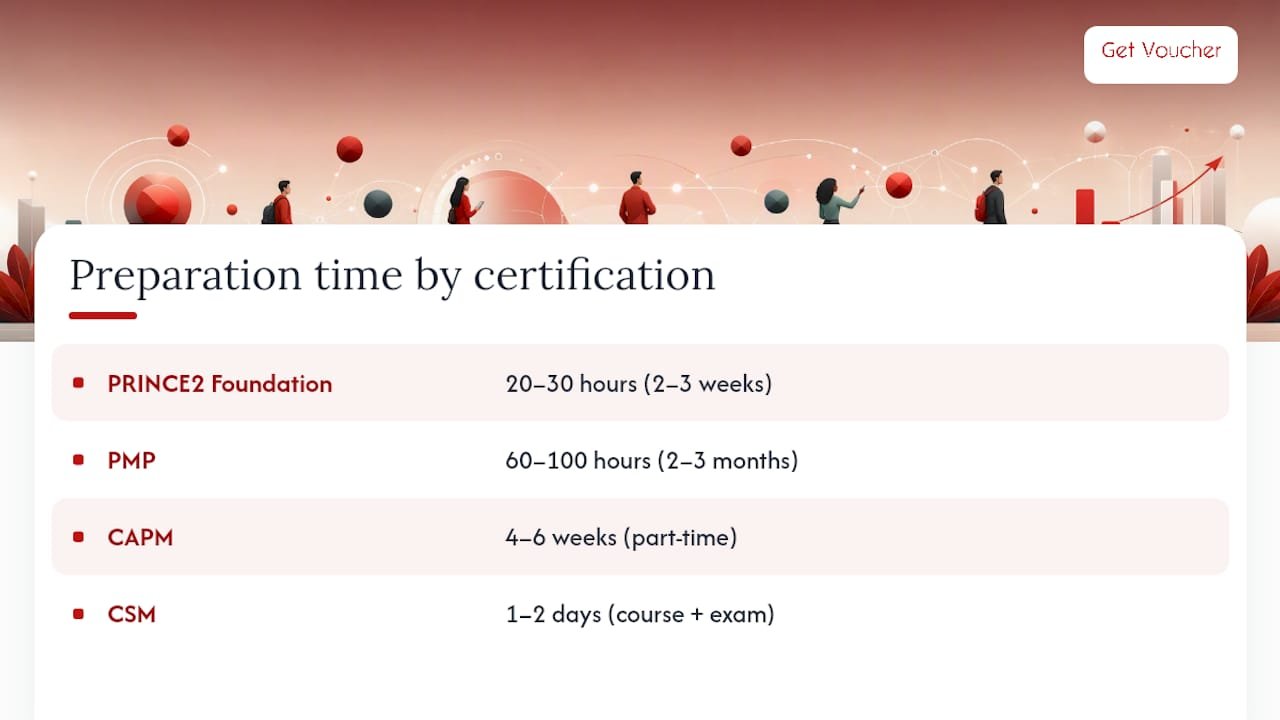
Agile-specific credentials like CSM often bundle a short instructor-led course (commonly one to two days) with the exam itself, meaning the formal time commitment is shorter, even though ongoing Scrum experience matters more than pure study hours for actually passing comfortably.
PRINCE2 Practitioner adds a layer beyond Foundation, since it tests application of the method to scenarios rather than simple recall, and candidates who move straight from Foundation without a gap often need another 15 to 20 hours of scenario practice.
Chartered Project Professional (ChPP) is different again: because it’s assessed through a portfolio and interview rather than a single exam sitting, preparation is really an ongoing process of documenting experience over months, not a fixed revision block. Building in buffer time before any exam booking, rather than cutting it close, tends to produce steadier results than cramming.
What does a project management certification actually cost?
Costs break into three components you should budget separately: the exam fee itself, study materials or a training course, and, in some cases, a retake fee if you don’t pass first time.
Entry-level credentials like PRINCE2 Foundation or CAPM tend to sit at the lower end of the cost spectrum, since they test a narrower scope of knowledge and often don’t mandate accredited training beforehand. PMP sits higher, reflecting both the exam’s depth and PMI’s requirement that many candidates complete a set number of formal training hours before they’re eligible to sit it. CSM training is usually bundled as a package: a short course fee that includes the exam attempt, rather than two separate line items.
Beyond the exam fee itself, factor in study materials. Self-paced video training, official guides, and practice question banks vary widely in cost depending on the provider, and buying them piecemeal from multiple sources often costs more in total than a bundled route. This is where a voucher platform earns its place in the budget conversation: consolidating course access and exam scheduling through one checkout, rather than juggling separate provider accounts, tends to simplify the total spend even before any specific price is quoted.
Whatever the credential, verify the current fee directly on the issuing body’s own page before you budget, since PMI, AXELOS, and APM occasionally revise pricing, and third-party guides can lag behind the official figure.
Which certifications carry the most weight globally?
Ranking credentials purely on brand recognition misses the point: value depends on where you work and which methodology your employer runs. That said, a rough hierarchy of global acceptance does exist.
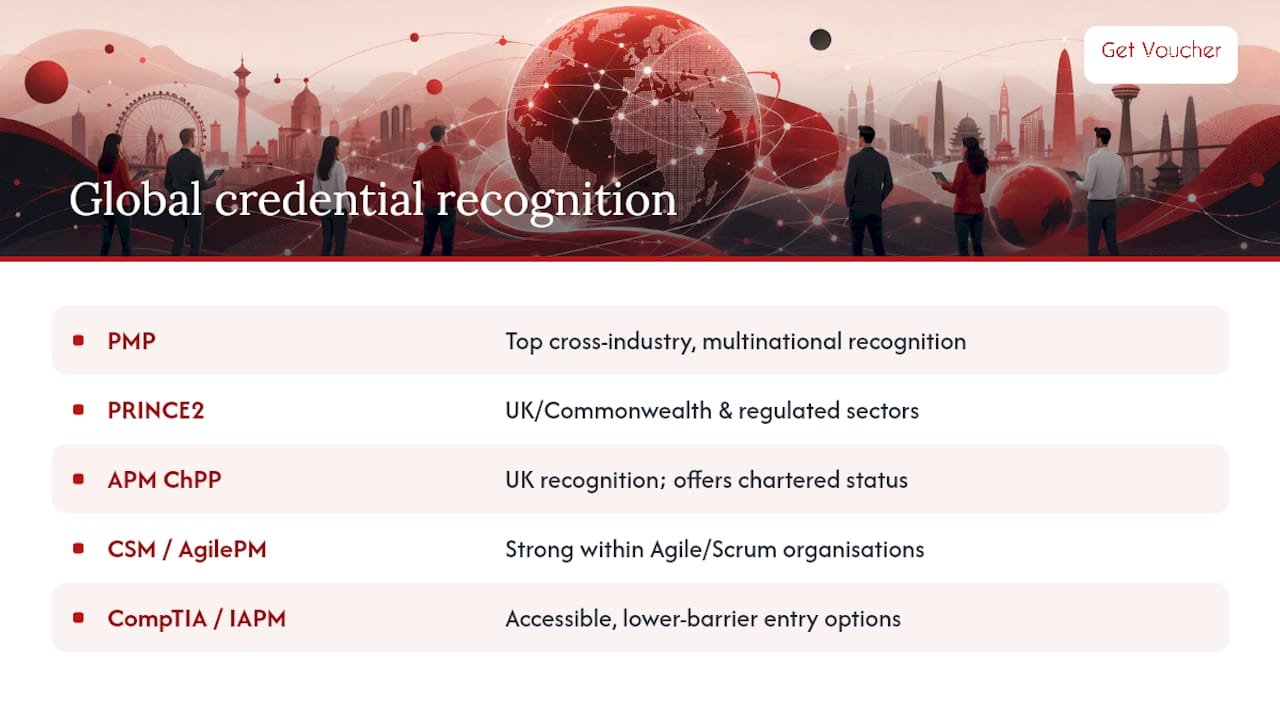
PMP sits at the top for cross-industry, multinational recognition. PMI positions it as validating leadership across predictive, Agile, and hybrid delivery, which is precisely why it travels well between sectors and countries. PRINCE2 (Foundation and Practitioner) holds comparable weight within the UK, Commonwealth nations, and government or regulated-sector contexts specifically, though its prescriptive, method-based structure means it’s less universally requested outside those environments than PMP.
APM’s PFQ, PMQ, and ChPP carry strong recognition specifically within the UK, with ChPP offering a chartered status that PMP and PRINCE2 don’t replicate. CAPM functions well as a stepping stone toward PMP rather than a destination credential in itself. Agile-specific credentials like CSM and AgilePM qualifications carry serious weight specifically within Agile and Scrum-run organisations, but they don’t substitute for a broader delivery credential in traditionally structured enterprises.
CompTIA Project+ and IAPM Certified Project Manager occupy accessible, lower-barrier positions, useful for candidates early in their careers or working internationally without a fixed employer preference. Ultimately, choosing by where you want to work matters more than chasing whichever credential ranks highest on a generic list.
Why I think most PMs undersell complementary skills
Most people treat certification as a single decision: pick the “best” one and stop. That’s the wrong frame. A core delivery credential like PMP or PRINCE2 Practitioner proves you can run a project. It says nothing about whether you can negotiate scope with a difficult stakeholder, spot a quality defect before it compounds, or read a risk register properly.
My honest recommendation is a two-year roadmap: an entry credential in year one, a mid-career credential plus one adjacent skill, such as negotiation or Six Sigma, by year two. The adjacent skill usually costs less and takes less time than a second broad PM credential, yet it changes what you can credibly claim in an interview.
— Rayan
Buy your certification voucher through GetVoucher
This platform offers a practical alternative to hunting across multiple provider websites for course access, study materials, and exam booking. Instead of juggling multiple logins, vouchers can be purchased once to access self-paced video training plus scheduling support for your online proctored exam through a single account.
Whether you’re starting with an entry-level credential or building toward a specialist Agile or Six Sigma pathway, the certifications page lists what’s currently available, including bundles like the Dual Agile Pack for Scrum Master and Product Owner roles together. If a certification you want isn’t listed yet, get in touch with GetVoucher directly to ask about pricing and availability, since coverage across VMEdu’s wider brand catalogue is being added over the coming months. Browse the current list and pick your starting point today.
Where to verify prerequisites, formats, and fees
Confirm exact requirements directly with the issuing bodies before booking: PMI’s certification pages for PMP and CAPM, APM’s qualifications hub for PFQ, PMQ, and ChPP, and AXELOS for PRINCE2 Foundation and Practitioner. A current comparative guide is also useful for cross-checking exam format and renewal expectations, though official pages take precedence on fees and dates.
Sources
- Project Management & Specialized Certifications | PMI
- Best project management certifications for every career stage
- Project management qualifications & training | PFQ | PMQ
- APM, PRINCE2®️, PMP – Which project management qualification is right for you?
FAQ
Which is the best certification for project management?
There isn’t a single best option; it depends on your career stage and sector. PMP suits mid-career professionals wanting broad enterprise recognition, while PRINCE2 Foundation or CAPM suit those starting out, and GetVoucher can help you access training for either path once you’ve decided.
How much does PRINCE2 cost in the UK?
Exam and training costs vary by provider and training route, so check the current fee directly on the official PRINCE2/AXELOS pages before budgeting, since third-party estimates can be outdated.
Which is better, PRINCE2 or APM?
Neither is universally “better”: PRINCE2 is a prescriptive delivery method widely used in UK government and regulated sectors, while APM’s PFQ, PMQ, and ChPP qualifications build toward chartered status and suit UK professionals focused on long-term career development.
Which is better, PMP or PRINCE2?
PMP is often preferred in multinational, enterprise contexts across various delivery methodologies, while PRINCE2 is more recognised in UK public-sector and regulated environments, so the right choice depends on where you plan to work.
Recommended
- Scrum Master vs Product Owner: Which Agile Role and Certification Is Right for You?
- The Complete Scrum & Agile Guide (2026): Certifications, Frameworks & Career Roadmap
- Becoming an Effective Scrum Master: Essential Skills and Best Practices
- Becoming an Effective Product Owner: Essential Skills and Best Practices