




Start with the NGstudy Certified Negotiation Associate, a free entry-level negotiation certification, then progress to the Negotiation Management Professional (NCN-P) once you’ve put the fundamentals into practice. This pathway suits managers, sales leads, procurement professionals and project managers who need structured, assessed proof of negotiation skill rather than another unfinished online course. The rest of this guide breaks down the curriculum, compares both levels in detail, and explains exactly how to prepare and progress.
TL;DR:
- The entry-level negotiation certification is free and suited for beginners, helping them learn basic vocabulary, principles, and preparation techniques without prior experience.
- Moving to the professional NCN-P credential requires documented practice in low-stakes negotiations, a habit that improves application skills more than course content alone.
- Effective preparation for exams emphasizes simulation and debriefing over passive review, reinforcing applied judgment in real negotiations.
- Certification cost varies from free for entry-level to paid for advanced credentials, with renewal requiring ongoing engagement in negotiation practice.
- Formal credentials signal structured knowledge, with practical benefits noticeable early through better negotiation habits and improved stakeholder communication.
Table of Contents
- What is a negotiation certification and how does it differ from a course?
- Who should get negotiation certified?
- NGstudy Certified Negotiation Associate vs Negotiation Management Professional (NCN-P)
- The core skills a serious negotiation curriculum should teach
- How to progress from entry-level to professional certification
- Preparing for your negotiation certification exam
- How GetVoucher supports your negotiation certification pathway
- Why a negotiation certification actually moves your career forward
- What negotiation certification programmes typically cost
- Keeping your negotiation certification valid
- How certified negotiators apply these skills in practice
- The gap between negotiation theory and negotiation practice
- Get your negotiation certification voucher through GetVoucher
- Sources
- FAQ
What is a negotiation certification and how does it differ from a course?
A negotiation certification is a structured learning pathway that ends in formal assessment, not just a certificate of attendance. That distinction matters: a short course teaches concepts, while a certification tests whether you can apply them.
Formats vary considerably. Some negotiation certificate programmes run as self-paced online modules with video lessons and downloadable workbooks. Others use live online cohorts with facilitator feedback, and a smaller number still run as in-person workshops with proctored exams at the end. Whichever format you choose, practice matters more than theory. Online negotiation certifications work best as a structured starting point, but genuine skill growth comes from role-play, simulation and feedback loops rather than passive video-watching. A certification without built-in practice opportunities teaches vocabulary, not capability.
Who should get negotiation certified?
Different roles need different negotiation muscles, and a formal credential tends to pay off fastest for people who negotiate as a core part of their job rather than occasionally.
- Early-career managers benefit from structured frameworks for salary discussions, performance conversations and cross-team resourcing debates.
- Procurement professionals use certification to sharpen contract negotiation, where preparation and contract structure directly shape outcomes on price, scope and governance terms.
- Sales leads apply the same skills to deal structuring, discount management and multi-stakeholder buying committees.
- Project managers rely on negotiation training to protect scope, manage vendor relationships and resolve stakeholder conflict without escalation.
If your negotiations are low-stakes and infrequent, informal practice may suffice. Once contract value, team size or client relationships are on the line, a professional negotiation certification gives you a repeatable process rather than instinct alone.
NGstudy Certified Negotiation Associate vs Negotiation Management Professional (NCN-P)
These two credentials sit at opposite ends of the same pathway, and understanding the gap between them helps you choose your starting point honestly.
The NGstudy Certified Negotiation Associate is the free, entry-level certification. It’s built for people with little to no formal negotiation training. It introduces the vocabulary and mental models negotiators use daily: interests versus positions, basic preparation techniques and foundational communication tactics. There’s no prior negotiation credential required to begin.
The Negotiation Management Professional (NCN-P) is the paid, advanced credential. It assumes you already understand the basics and pushes into applied, higher-stakes scenarios: multi-party negotiations, value creation across competing interests, and structured negotiation planning for complex deals or contracts.
Key differences at a glance:
- Entry level suits first-time negotiators; professional level suits those with some negotiating experience under their belt.
- Entry level emphasises foundational vocabulary and single-issue bargaining; professional level emphasises multi-issue trade-offs and strategic planning.
- Assessment formats typically scale with the level, with entry-level courses using shorter knowledge checks and professional-level programmes involving deeper applied assessment.
How to choose between them:
- If you’ve never studied negotiation formally, start with the NGstudy Certified Negotiation Associate — it costs nothing to begin.
- If you already negotiate regularly and want a credential that reflects applied skill, look at the Negotiation Management Professional (NCN-P).
- If you’re unsure, complete the entry-level course first. It clarifies where your gaps actually are before you invest in the paid credential.
The core skills a serious negotiation curriculum should teach
Not every negotiation certificate programme covers the same ground, and some skip the parts that matter most. A credible curriculum should include the following:
- Principled negotiation: separating people from the problem so relationships survive disagreement.
- BATNA, WATNA and ZOPA analysis: knowing your best and worst alternatives to a negotiated agreement, and where the zone of possible agreement actually sits.
- Value creation and claiming: expanding the pie before dividing it, particularly across multi-issue deals.
- Tactical communication: anchoring, framing, active listening and probing questions that surface hidden interests.
- Cross-cultural negotiation and ethics: adapting style without compromising integrity.
A strong negotiation curriculum consistently covers these five areas, and their absence is a fair reason to question a programme’s depth.
Pro Tip: Before enrolling in any negotiation certificate programme, ask whether BATNA and ZOPA are taught as standalone concepts or actually practised through role-play scenarios. The difference between “explained” and “rehearsed” is where most certifications either earn their reputation or lose it.
How to progress from entry-level to professional certification
Moving from the free NGstudy credential to the paid NCN-P isn’t just a matter of enrolling in the next course. It works better as a deliberate sequence.
- Complete the NGstudy Certified Negotiation Associate and treat every exercise as practice, not a box-ticking exercise.
- Run low-stakes negotiations in real work settings, such as internal resourcing discussions or small vendor terms, and debrief each one immediately afterwards.
- Document your debriefs using a simple template: objective, BATNA, outcome, and what you’d change next time. A repeated loop of setting objectives, rehearsing, negotiating and debriefing is how theoretical knowledge becomes applied skill.
- Seek employer sponsorship for the NCN-P once you can point to several documented negotiations, since many managers will support a paid credential when they see evidence of applied learning first.
- Enrol in the NCN-P once you’re negotiating regularly enough that a professional-level framework would sharpen, not just formalise, what you already do.
Preparing for your negotiation certification exam
Efficient preparation beats last-minute cramming, particularly for assessments that test applied judgement rather than recall.
Focus study time on repeated case simulations and peer feedback rather than re-reading course notes. Preparation that maps objectives, BATNA and acceptable ranges in advance consistently produces better negotiation outcomes, and the same discipline helps in exam scenarios that present case studies for analysis.
Before exam day, confirm:
- Exam format: online proctored, computer-based at a testing centre, or in-person.
- Permitted materials during the assessment.
- Scheduling deadlines and identification requirements.
- Technical requirements if the exam is online proctored (webcam, stable connection, quiet room).
Pro Tip: Build a one-page negotiation debrief template covering objective, BATNA, outcome and lesson learned. Use it after every practice negotiation in the run-up to your exam, then keep using it afterwards. It doubles as evidence to show a manager when you’re arguing for sponsorship toward the next credential.
How GetVoucher supports your negotiation certification pathway
GetVoucher works with VMEdu, the parent provider behind NGstudy, to give professionals direct access to both negotiation credentials without navigating multiple external sites for materials, scheduling and exam access.
Through GetVoucher, you get voucher access to the NGstudy Certified Negotiation Associate at no cost, alongside structured online learning resources and downloadable study materials. When you’re ready to progress, the Negotiation Management Professional (NCN-P) course page gives you the same streamlined access to the paid, advanced credential.
The Certifications landing page brings vouchers, scheduling support and study materials together in one place, which cuts down the friction busy professionals usually face when juggling course logins, exam bookings and scattered PDFs across different provider platforms.
Why a negotiation certification actually moves your career forward
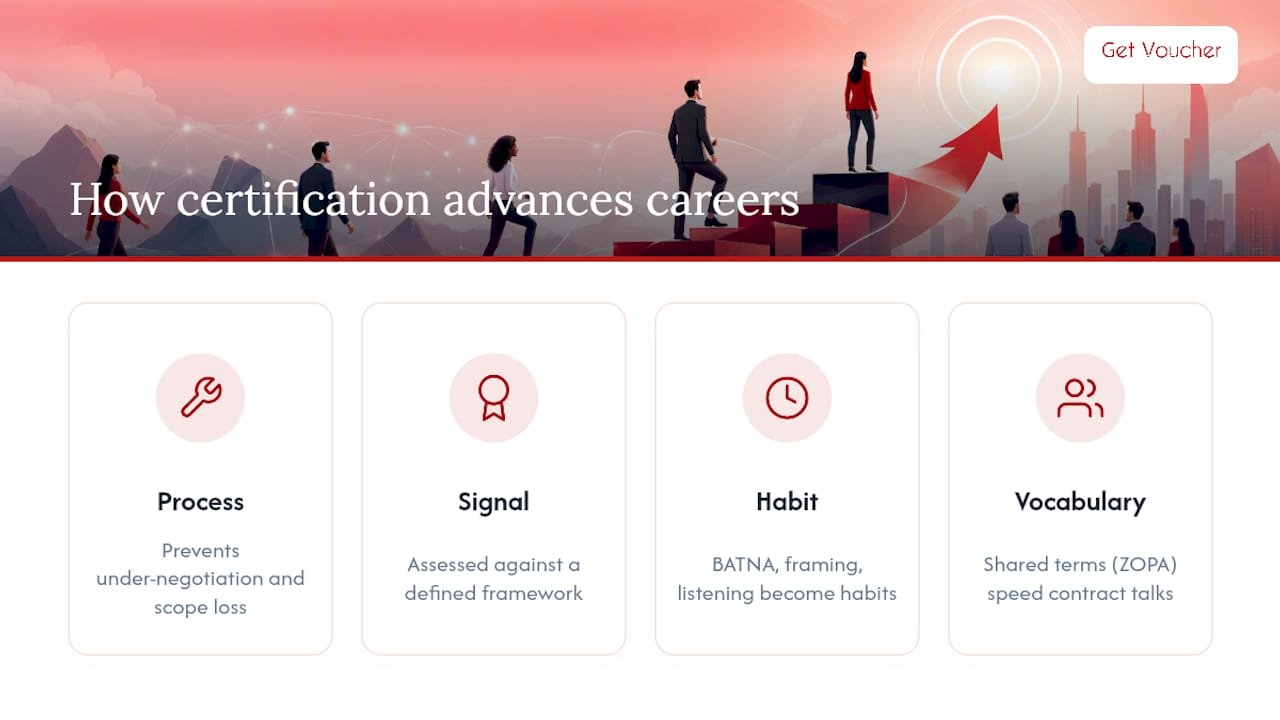
The clearest benefit of a professional negotiation certification is structural: it gives you a repeatable process instead of relying on instinct or copying whatever your manager does in a room. That matters because negotiation skill gaps show up in specific, costly ways. Sales leads under-negotiate discount terms. Procurement professionals accept vendor terms without pressure-testing alternatives. Project managers concede scope rather than defend it, because they haven’t rehearsed the conversation.
A certified negotiation expert credential signals to employers and clients that you’ve been assessed against a defined framework, not just that you’ve attended a workshop. For managers overseeing high-stakes vendor or client relationships, that distinction can support internal promotion cases or client-facing credibility, particularly in procurement and project delivery roles where negotiation directly affects budget and scope outcomes.
The practical gain often shows up before any formal recognition does. Once you’ve internalised BATNA analysis, framing and active listening as habits rather than theory, you start preparing differently for every negotiation, not just the ones tied to a certification exam. That preparation habit, more than the credential itself, is what tends to compound over a career.
Certification also gives you a shared vocabulary with peers and stakeholders. When a procurement team and a project delivery team both understand ZOPA and value creation, contract discussions move faster because everyone’s negotiating from the same framework rather than talking past each other.
What negotiation certification programmes typically cost
Pricing structures for negotiation certificate programmes vary widely depending on provider, level and whether the credential includes proctored assessment or ongoing access to materials.
Entry-level credentials, including the NGstudy Certified Negotiation Associate, are available at no cost through GetVoucher, which removes the financial barrier to getting started. That’s a deliberate design choice: it lets professionals test whether formal negotiation training suits their working style before committing money to an advanced credential.
Professional-level credentials like the NCN-P typically involve a paid voucher, reflecting the deeper assessment and more advanced curriculum content involved. Exact pricing for the NCN-P and other advanced negotiation certifications is best confirmed directly on the course page or by contacting GetVoucher, since fees can be adjusted by the certification provider over time. For any negotiation-adjacent credential not yet listed on the platform, GetVoucher plans to expand its catalogue in the coming months. If you need pricing or availability for a specific pathway now, contact GetVoucher directly rather than guessing from third-party listings.
Budgeting for a professional negotiation certification should also account for time, not just fees. Programmes with genuine simulation and feedback components take longer to complete properly than a passive video course, and rushing through them tends to undermine the applied skill the credential is meant to prove.
Keeping your negotiation certification valid
Certification bodies typically require some form of renewal to keep a credential current, whether that’s continuing education, a refresher assessment, or periodic recertification tied to a set validity period.
Renewal requirements exist because negotiation practice evolves, and a credential earned years ago without any refresh doesn’t necessarily reflect current best practice or your current skill level. For professionals holding a paid credential like the NCN-P, staying alert to renewal windows protects the investment you made in the certification in the first place.
Practical habits that support renewal readiness include logging negotiation debriefs on an ongoing basis (not just during exam preparation), revisiting core frameworks like BATNA and ZOPA periodically rather than treating them as one-time learning, and staying engaged with any continuing education options the certification body offers.
Specific renewal cycles, fees and requirements differ by certification body and can change over time, so always confirm current renewal terms directly through the certification provider’s official channels or by contacting GetVoucher for the latest guidance on maintaining a specific credential.
How certified negotiators apply these skills in practice
The frameworks taught in a negotiation certification aren’t abstract. They map directly onto situations professionals face weekly.
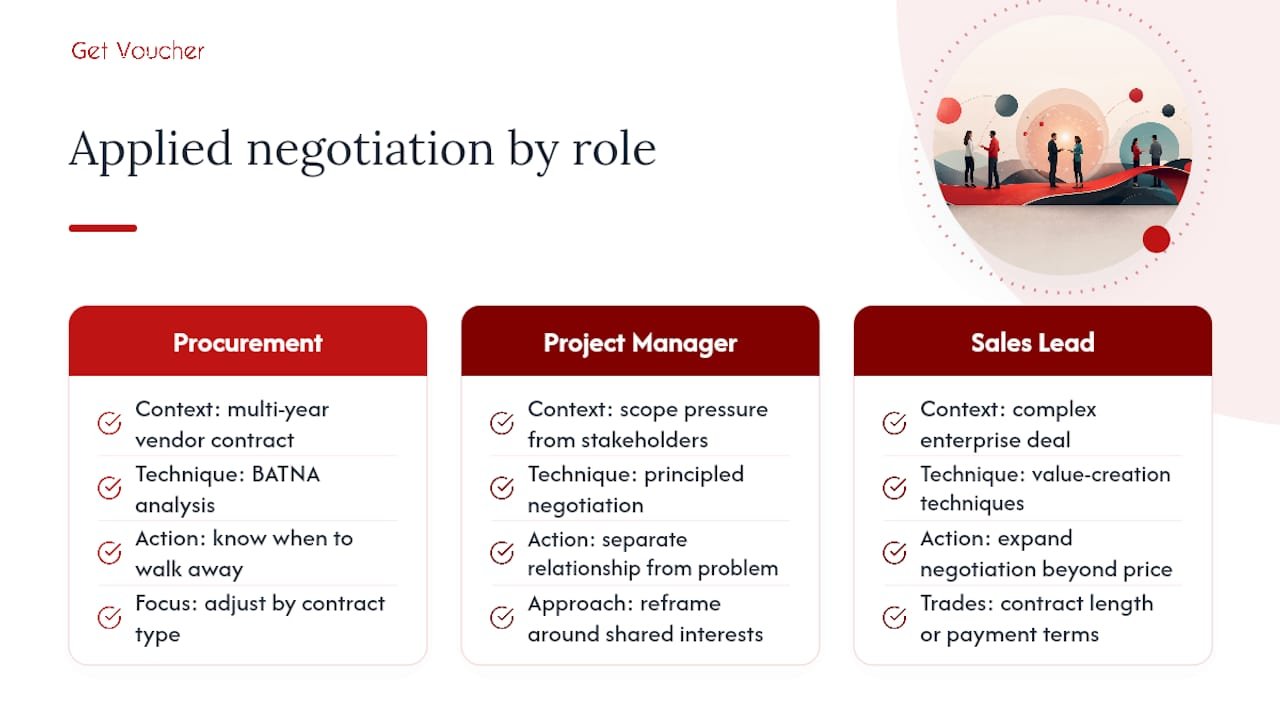
A procurement professional negotiating a multi-year vendor contract uses BATNA analysis to know exactly when to walk away from unfavourable pricing, and uses awareness of contract type to shift focus between price, scope and governance terms rather than negotiating every clause the same way. That distinction, treating a fixed-price contract differently from a time-and-materials agreement, is exactly the kind of applied judgement a strong curriculum should build.
A project manager defending scope against stakeholder pressure applies principled negotiation to separate the relationship (staying collaborative with a difficult stakeholder) from the problem (an unreasonable deadline change). Rather than either caving or escalating, they reframe the conversation around shared interests, protecting the project timeline while keeping the relationship workable.
A sales lead structuring a complex enterprise deal applies value creation techniques to expand the negotiation beyond price alone, trading contract length or payment terms for a better headline number. This is the multi-issue bargaining that separates a certified negotiation expert from someone negotiating on instinct alone.
None of these examples require a dramatic, high-pressure scenario. Most real negotiation practice happens in ordinary contract renewals, internal resourcing debates and everyday client conversations, which is exactly why structured practice through certification tends to outperform sporadic on-the-job learning.
The gap between negotiation theory and negotiation practice
Most negotiation certifications get sold on the strength of their frameworks: BATNA, ZOPA, principled negotiation. These concepts are genuinely useful, but the framework itself was never the hard part. The hard part is applying it under pressure, in real time, when the other side is not following the script your course taught you.
That’s where I think the conventional advice on negotiation certification gets it backwards. Too many programmes measure success by how well you can define ZOPA on a written exam, not by how you handle a stakeholder who won’t budge on scope. A credential that skips role-play and simulation is teaching you to recognise negotiation concepts, not to negotiate.
The role-based, progression-first approach using the NGstudy entry route and the NCN-P aims to sequence learning properly: learn the vocabulary for free, then practise it in real low-stakes settings before paying for a professional credential that assumes you can already apply the basics. Skipping straight to an advanced certification without that practice foundation is the single most common mistake I see professionals make, and it’s why so many certified negotiators still freeze in their first genuinely difficult contract discussion.
Prioritise the debrief habit over the credential itself. The certificate is proof you learned something. The debrief log is proof you can actually use it.
— Rayan
Get your negotiation certification voucher through GetVoucher
This platform removes the usual friction of hunting across separate provider sites for course access, exam scheduling and study materials, giving you one place to start your negotiation credential and progress toward the professional level.

Begin with the free NGstudy Certified Negotiation Associate voucher, which carries no cost barrier to entry, and use it to test whether formal negotiation training fits how you learn before committing further. Once you’ve logged some real practice negotiations, move on to the Negotiation Management Professional (NCN-P) for the applied, professional-level credential. Browse the full Certifications landing page to see other management-adjacent pathways, including negotiation-related credentials planned for the coming months, and contact GetVoucher directly for current pricing and availability on any course not yet listed.
Sources
- What is a Negotiation Certification and is It Worth It?
- Negotiation in Procurement – Project Management Formula
- Online Negotiation Certifications: Are They Worth It? A Complete Guide
FAQ
What qualifications do I need to become a negotiator?
There’s no universal formal qualification required to negotiate professionally, but a structured credential like the NGstudy Certified Negotiation Associate gives you validated grounding in core frameworks that experience alone doesn’t guarantee.
What are the five C’s of negotiation?
Definitions of the “five C’s” vary across sources and aren’t standardised the way BATNA or ZOPA are, so treat any specific list you encounter as one interpretation rather than a fixed industry framework.
What are the main types of negotiation?
Negotiation styles are commonly grouped around distributive (competitive, fixed-pie) and integrative (collaborative, value-creating) approaches, with variations like multi-party, cross-cultural and principled negotiation building on those two core categories.
What’s the best course for learning negotiation?
The best starting point depends on your experience level: complete beginners benefit most from a free, foundational credential like the NGstudy Certified Negotiation Associate, while those with some negotiating experience should look toward an applied, professional-level programme like the NCN-P.
Is negotiation certification worth it for procurement and project roles?
Yes, particularly because contract structure and preparation directly shape negotiation outcomes in procurement and project delivery, and a structured certification builds that preparation discipline systematically rather than leaving it to trial and error.