




An OKR certification is a practical credential that teaches you to write measurable objectives, run OKR cycles, and coach teams through them. It suits team leads, product managers, Agile coaches, and strategy leads who need a shared language for goal setting. The immediate next step is straightforward: pick the level that matches your current role and favour courses built around live practice, not just video lectures.
TL;DR:
- Certification mainly improves your ability to write effective OKRs, run cycles, and facilitate outcome-oriented conversations rather than fixing organizational culture.
- Practical skills, such as drafting real OKRs and coaching teams, are essential for meaningful application and are emphasized in well-designed courses.
- Progression through certification levels from foundation to advanced builds the capability to coach and align across departments, with assessment difficulty increasing at each step.
- Choosing the right program depends on your role, with focus on hands-on practice, credible accreditation, and post-course support rather than marketing claims.
- Certification supports ongoing development through alumni networks, refresher modules, and case studies, but real impact depends on subsequent application in actual cycles.
Table of Contents
- What does an OKR certification actually teach you?
- Who should get certified, and what should you expect?
- What are the OKR certification levels and the recommended pathway?
- How do you choose the right OKR certification programme?
- What formats and assessment styles do OKR courses use?
- How should you prepare, and where does GetVoucher fit in?
- Is OKR certification recognised by industry bodies?
- What happens after you’re certified?
- Certification is a starting point, not a finish line
- How GetVoucher supports your certification path
- Sources
- FAQ
What does an OKR certification actually teach you?
Strip away the marketing and most OKR courses cover the same practical ground: how to write an objective that is ambitious but not vague, how to attach two to five key results that are genuinely measurable, and how to run a quarterly or trimestral cycle without it collapsing into a spreadsheet exercise nobody updates. Coursera’s own OKR programme, for instance, structures its modules around introducing the framework, applying it inside a real organisation, running Conversations, Feedback and Recognition (CFRs), and building what it calls the “goal-setting muscle” through repetition rather than theory alone, as the OKR course on Coursera sets out.
Expect a mix of the following, whichever provider you choose:
- Writing objectives and key results that survive contact with a real team
- Running a full OKR cycle: planning, mid-cycle check-ins, and scoring
- Facilitating CFRs so conversations stay focused on outcomes, not activity
- Grading and tracking OKRs using templates, trackers, or dashboards
- Coaching others through their first one or two cycles
The best courses pair this with workshops, case studies, and reusable templates rather than pure theory. Training that includes hands-on exercises and follow-up materials is consistently flagged as the differentiator between a certificate that sits in a drawer and one that changes how a team actually works, according to analysis from The OKR Hub. Employers tend to value the outcome more than the badge: can you align a team around three priorities instead of fifteen, and can you prove delivery against a number rather than a feeling?
Who should get certified, and what should you expect?
Four profiles get the most out of OKR certification: team leads who need to cascade company objectives without diluting them, product managers translating roadmap decisions into measurable outcomes, Agile coaches adding a strategic layer to their Scrum or Kanban toolkit, and strategy leads responsible for cross-team alignment.
The organisational upside is real but specific. Certification tends to sharpen how people write objectives, run cycles, and facilitate the check-in conversations that keep OKRs alive past week three. Where it falls short is expecting a course alone to fix a culture that resists prioritisation.
Pro Tip: If your organisation has never run an OKR cycle before, get one senior sponsor certified before enrolling a whole department. A single champion who can coach the first cycle is worth more than ten people who finished the same course in isolation.
Industry commentary is blunt about this trade-off: certification only delivers value when it is paired with practical implementation, ongoing coaching, and follow-up support back at work, not treated as a one-off event, per analysis on what OKR certification really brings. Expect the credential to build capability. Do not expect it to replace the messy, iterative work of actually running your first two or three cycles.
- Team leads: cascading and translating company objectives downward
- Product managers: connecting roadmap work to measurable outcomes
- Agile coaches: adding strategic alignment skills to delivery facilitation
- Strategy leads: coordinating OKRs across departments and functions
What are the OKR certification levels and the recommended pathway?
Most OKR-focused providers structure their catalogue around a rising sequence of credentials rather than a single exam. The OKR Institute (OKRI) publishes one of the clearest examples of this progression, and it is a useful reference point regardless of which brand you eventually study with.
- Foundation — establishes the vocabulary: objectives, key results, cycles, and CFRs. Suited to anyone new to the framework, with no prior OKR experience assumed.
- Practitioner (C-OKRP®) — moves into applied skills: writing OKRs for a real team, running a cycle end to end, and basic scoring. This is where most team leads and product managers should aim first.
- Leader (C-OKRL®) — focused on cascading OKRs across a department or function and coaching others through their first cycles. Suited to managers and Agile coaches with foundation and practitioner experience already under their belt.
- Chief / Advanced (C-OKRO® / C-OKRPro®) — aimed at those setting OKR strategy organisation-wide, typically after practical experience running multiple cycles.
OKRI’s own guidance recommends completing these in order, foundation through to practitioner, leader, and then the advanced tier, rather than skipping straight to an advanced credential, as detailed in the OKRI Help Center’s recommended certification order. Assessment expectations rise at each level too: foundation is largely knowledge-based, while practitioner and leader tiers usually expect you to bring a real or simulated OKR set to demonstrate against.
How do you choose the right OKR certification programme?
Choosing well comes down to matching the syllabus to your actual job, not the provider’s marketing page. Start with what the course teaches versus what you need to do on Monday morning: if you are about to run your first cycle, a foundation course heavy on theory and light on templates will leave you under-prepared.
Run through this checklist before enrolling:
- Syllabus match: does it cover writing OKRs, cycle management, and CFRs, or just definitions?
- Hands-on practice: are there workshops, exercises, or a template you keep afterwards?
- Trainer experience: has the instructor actually run OKR cycles inside an organisation, or only taught the theory?
- Accreditation and partners: is the certifying body credible and transparent about its standards, rather than relying on vague badges?
- Post-course support: is there an alumni community, coaching add-on, or follow-up material?
Watch for red flags. A course built entirely around slide decks with no practical assignment is a warning sign, as is a provider that cannot clearly explain who accredits the credential or what the assessment actually involves. Checking a credentialing body’s own published standards, rather than taking a marketing claim at face value, is a sound habit; resources from bodies such as Credentialing Excellence set out what legitimate credential management looks like in practice.
Before paying, ask the provider directly: what is the typical cohort size, how is the final assessment structured, and is there any coaching or check-in after the course ends? If you are buying across borders and want a second opinion on a provider’s terms, the EU’s online dispute resolution portal is a useful reference point for cross-border consumer purchases within the EU.
Pro Tip: Ask to see a sample OKR template or tracker before you enrol. If a provider can’t show you one, that tells you how “hands-on” the course really is.
What formats and assessment styles do OKR courses use?
Delivery falls into three broad categories, and each suits a different working pattern. Self-paced video courses give you flexibility but demand discipline; instructor-led live workshops force a schedule and real-time feedback but cost more in calendar time; blended formats try to combine both, typically pairing recorded modules with live practice sessions.
Duration varies by level and provider, but foundation-tier courses are usually the shortest, with practitioner and leader tiers requiring more time for applied assignments. Assessment formats you will commonly meet include:
- Multiple-choice or scenario-based quizzes for foundation-level knowledge checks
- Practical assignments, such as drafting a full OKR set for a real or sample team
- Online proctored exams for higher-tier or formal credentials
- Portfolio evidence, where you submit an actual cycle you have run
Check the exact assessment format before enrolling. “Online proctored” and “self-graded assignment” are very different commitments, and providers do not always make the distinction obvious on their sales page.
How should you prepare, and where does GetVoucher fit in?
A sensible preparation plan runs in five steps: audit your current OKR knowledge and gaps, decide which level actually matches your role, study the syllabus in detail rather than skimming a summary page, practise using real or simulated team templates, and finally seek coaching or peer review before you sit any formal assessment.
- Audit: honestly assess whether you need foundation basics or can start at practitioner level.
- Decide the level: match the credential to your actual responsibilities, not your ambition.
- Study the syllabus: read the provider’s module list closely, not just the course title.
- Practise with templates: draft OKRs for your real team, even before the course starts.
- Get feedback: a coach, mentor, or peer review catches mistakes theory alone won’t.
Beyond the course itself, ongoing venues like the World OKR Summit give practitioners access to case studies and workshops that keep skills current well after certification.
Pro Tip: Draft one full OKR set for your actual team before you even start a course. You’ll get far more out of the modules when you’re testing them against a real problem instead of a hypothetical one.
On the GetVoucher side, it’s worth being upfront: GetVoucher does not currently sell the OKR certification exam or its voucher. Where course access is available, GetVoucher can support preparation through self-paced learning and study resources, and OKR-specific certifications may be added to the catalogue in the coming months. If you want details or availability, get in touch with GetVoucher directly.
Is OKR certification recognised by industry bodies?
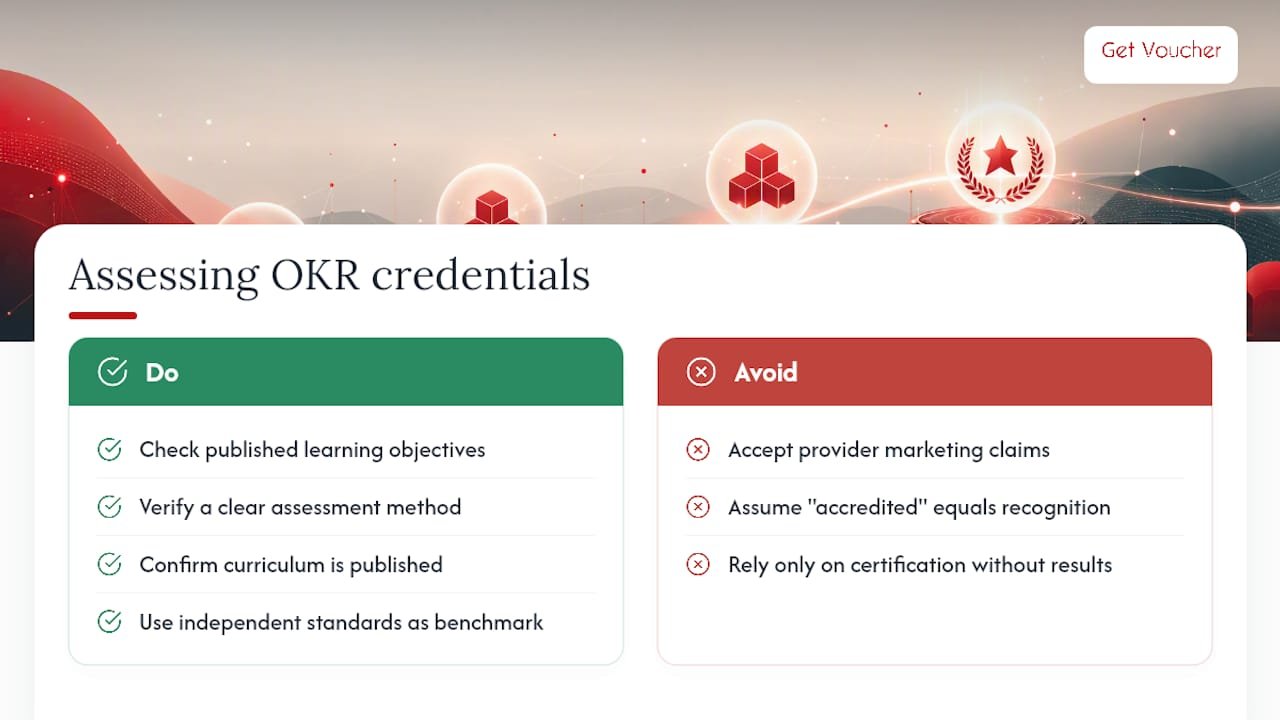
Recognition in the OKR space works differently to more heavily regulated professional fields. There is no single global regulator that accredits OKR training the way, say, a national engineering body accredits an engineering degree. Instead, credibility tends to rest on the certifying organisation’s own transparency: published learning objectives, a clear assessment method, and a track record of practitioners actually using the framework at work.
VMEdu operates as a training provider across several professional disciplines, working with certification bodies that set the standards for each credential. When you are assessing whether an OKR credential carries weight in your industry, look at the certifying body’s own published criteria rather than a provider’s marketing claims. Ask what the assessment actually measures, whether the body publishes its curriculum, and whether the credential is renewed or reviewed over time.
This is also where established credentialing standards bodies add value. Organisations such as Credentialing Excellence publish guidance on what responsible credential management looks like, covering everything from renewal cycles to the transparency a legitimate certifying body should offer. Using that kind of independent standard as a benchmark, rather than taking a provider’s own “accredited” label at face value, is the more reliable way to judge whether a certification will mean something to a future employer or client.
Because OKR as a discipline is still relatively young compared with, say, project management or Six Sigma, expect the recognition landscape to keep evolving. Treat any certification as one input into your credibility, alongside demonstrable results from running real OKR cycles.
What happens after you’re certified?
Certification is rarely the finish line, and the better providers treat it that way. Post-course support typically falls into three categories: alumni communities where practitioners trade real implementation problems, refresher or advanced modules for people moving into a higher-tier role, and access to ongoing events where the framework itself keeps being tested against new organisational contexts.
Providers that build in coaching or an alumni network after the course report higher adoption back at work than those offering a purely self-paced, one-and-done experience, a pattern that shows up repeatedly in independent commentary on what OKR certification really delivers. That matters more than it sounds: the gap between finishing a course and actually running a confident second or third OKR cycle at work is usually where certification value is won or lost.
Continuing education does not have to mean another paid credential. Annual events such as the World OKR Summit bring practitioners together around live case studies, which tends to be more useful for a working professional than repeating foundation-level content. If your provider offers a template library, tracker, or dashboard as part of the course, keep using it well past the exam. The skill degrades quickly if the only OKRs you ever write are the ones inside a practice assignment.
Certification is a starting point, not a finish line
The most overlooked truth about OKR certification is that the credential itself changes very little. What changes outcomes is whether someone applies what they learned inside their first real cycle, ideally with a coach or experienced peer checking their work. Certification builds vocabulary and confidence. Practice builds the judgement to know when a key result is genuinely measurable versus when it’s just a task wearing a disguise. Treat the course as the on ramp, not the destination, and be sceptical of any provider that implies otherwise.
— Rayan
How GetVoucher supports your certification path
If you’re building capability alongside OKRs, there are platforms that provide access to complementary certification vouchers and self-paced study resources without needing to approach multiple providers separately. The platform currently covers pathways across Agile, Scrum, and management disciplines, including courses like the Scrum Product Owner Certified (SPOC®), which pairs well with OKR skills since both rest on prioritisation and measurable delivery.
To be clear: The OKR certification exam or voucher is not currently sold through the platform discussed here. OKR-specific certifications may be added to some catalogues in the future, and interested learners can contact the provider directly for details on pricing and availability. In the meantime, browse the certifications catalogue for related Agile and leadership credentials, or read the complete Scrum and Agile guide for a broader view of how these certifications fit together on a career roadmap.
Sources
FAQ
What is an OKR certification?
An OKR certification is a structured credential that teaches you to write objectives and key results, run OKR cycles, and facilitate CFRs, typically progressing from a foundation level through to practitioner and leader tiers.
Are OKRs still relevant?
Yes. OKRs remain widely used for strategy execution and organisational alignment, and ongoing events like the World OKR Summit continue to showcase active implementation case studies across industries.
What is the difference between an OKR and a KPI?
An OKR is a goal-setting framework combining an ambitious objective with measurable key results over a set cycle, while a KPI is typically an ongoing metric used to monitor the health of a process or business area rather than a time-boxed goal.
What are the core elements of OKR practice?
Most OKR frameworks centre on writing clear objectives, defining measurable key results, running a fixed cycle, tracking progress through grading, and holding CFRs to keep the conversation focused on outcomes.
Does GetVoucher sell OKR certification vouchers?
Not yet. GetVoucher does not currently offer the OKR certification exam or voucher, though OKR credentials may be added to the certifications catalogue in the coming months, so contact GetVoucher for current availability.