




If you want a broad foundation, GetVoucher’s Digital Marketing Fundamentals course is the sensible starting point. Career switchers who want a certificated, assessed pathway should look at Digital Marketing Professional, while channel specialists should match their course to the skill they actually need, whether that is social content or search visibility. The right choice depends less on the course title and more on whether it maps to a recognised qualification framework such as CIM.
Table of Contents
- Expert-vetted shortlist: which content marketing course suits you
- How to choose: a checklist before you pay for any course
- Strategy courses versus production courses: what each one actually teaches
- Accreditation and career value: what a recognised qualification looks like
- A 90-day starter plan once you have picked a course
- Why we favour assessed, employer-aligned courses
- Getting your course voucher through GetVoucher
- FAQ
- Sources
Expert-vetted shortlist: which content marketing course suits you
Picking a course gets easier once you sort options by outcome rather than by marketing copy. Here is a shortlist built around what each course actually prepares you to do, with GetVoucher-hosted pathways first.
- Digital Marketing Fundamentals (GetVoucher): best for absolute beginners who need a broad, structured introduction before specialising. Self-paced video study, typically completed over several weeks, with no prior assessed portfolio expected.
- Digital Marketing Professional (GetVoucher): best for career switchers who want a certificated pathway with assessed modules rather than a loose collection of videos. Self-paced online study with structured modules building towards a proctored exam.
- Social Media Marketing Expert (GetVoucher): best for practitioners focused on social channels and short-form content who already understand the marketing fundamentals. Self-paced study geared towards channel strategy and creative formats.
- Search Marketing Expert (GetVoucher): best for anyone who needs SEO and discoverability skills to make content findable rather than just well written. Self-paced study covering search visibility and optimisation practices.
Beyond these four, CIM’s practitioner courses are worth knowing about if you want a qualification with a long institutional track record. The CIM content marketing course and its companion copywriting workshop are built around producing and refining real assets rather than passive video watching, which is the single biggest differentiator between a course that teaches theory and one that builds a portfolio.
How to choose: a checklist before you pay for any course
Every course page reads well. The difference between a good investment and a wasted voucher usually comes down to six specifics you should check before paying.
- Syllabus coverage: does it name the modules and learning outcomes, or just the topic areas?
- Practical outputs: will you produce a brief, a content calendar or finished assets you can show an employer?
- Assessment method: is it online proctored, onscreen at a test centre, or portfolio-based?
- Accreditation: does it map to a recognised qualification level, such as a CIM award, or is it a standalone certificate?
- Guided learning hours: how many hours of structured study does the provider state?
- CPD credits: are continuing professional development credits awarded, and by whom?
Ask providers directly how their exam is proctored, whether a portfolio submission is required, and what happens if you fail the assessment once. Three answers should make you walk away: no stated assessment method at all, no indication of guided learning hours, and marketing language that implies the certificate alone guarantees a job or salary increase.
Pro Tip: Ask for a sample module or syllabus PDF before paying. A provider confident in its content will usually share one on request.
Strategy courses versus production courses: what each one actually teaches
Content marketing training splits broadly into two camps, and confusing them is the most common reason people pick the wrong course.
- Strategy courses cover audience insight, governance and measurement, closer to CIM’s content marketing strategy masterclass, which frames strategy as a nine-step, commercially focused process linking insight to measurable return.
- Production courses cover copywriting, video and repurposing skills, the kind of hands-on project work found in short, practical workshops.
- Stacking order matters: a fundamentals or strategy qualification gives you the framework, and a specialist production or channel course then builds the hands-on skill on top of it.
- AI modules should be evaluated as support tools that speed up drafting and optimisation, not as replacements for understanding audience segmentation or governance.
If you are already managing a content function, a strategy-first course will do more for you. If you are producing day-to-day assets, prioritise the course that gets you making things.
Accreditation and career value: what a recognised qualification looks like
Not every certificate carries the same weight, and the gap often comes down to whether a recognised body stands behind it. The Skills England Level 3 content creator apprenticeship standard describes workplace capability across briefing, channel selection, content management systems and audience segmentation.

The Level 3 content creator apprenticeship runs for about a year and a half, with government training and assessment funding capped at a notable amount specific to the UK apprenticeship system., a figure specific to the UK apprenticeship system rather than a global benchmark. CIM’s own qualifications work differently again: the Level 4 Award in Content Marketing carries roughly 80 guided learning hours against its module specification, which gives you a concrete sense of study commitment before you commit money or time.
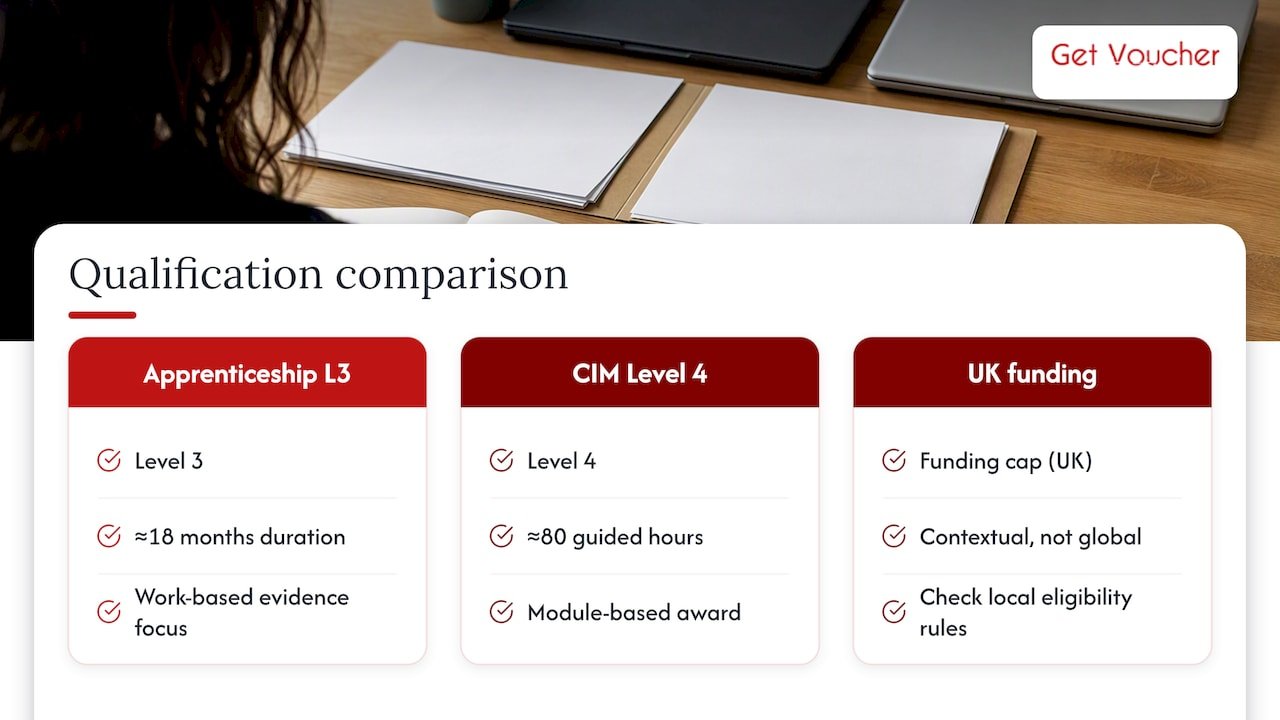
Employers and occupational standards tend to weight demonstrable work, briefs, assets and optimisation evidence, more heavily than a certificate title on its own. Funding, eligibility and guided learning hours are set by national bodies and vary by country, so check the rules that apply where you live before assuming a figure transfers.
A 90-day starter plan once you have picked a course
A course only pays off if you turn the learning into evidence you can show an employer or client within a few months.
- Weeks 1 to 2: audit your existing content or a chosen brand’s content, and note the gaps.
- Weeks 3 to 6: work through the fundamentals modules of your chosen course.
- Weeks 7 to 10: create three assets (a blog post, a short video script and a social campaign brief) using what you have learned.
- Weeks 11 to 12: publish or pitch the assets, and set up basic measurement for each one.
- Ongoing: review performance monthly and feed the findings back into your portfolio.
Your portfolio checklist should include three finished assets, the metrics attached to each, and a one-line brief describing the role you played. Once the fundamentals are solid, a short specialist module in social or search can be layered on top without repeating ground you already cover.
Why we favour assessed, employer-aligned courses
The content marketing courses worth paying for are the ones that force you to produce something real and grade it against a defined standard, not the ones with the longest list of video hours. We built GetVoucher around getting learners from an introductory certification towards a credential that reflects actual assessed capability, because that is the version employers tend to respect.
— Rayan
Getting your course voucher through GetVoucher
Buying the right course should not mean juggling five different provider logins or paying full price for a classroom seat you will never attend. We give you direct voucher access to structured, self-paced SMstudy® Certified Digital Marketing Professional training for £199 one-off, alongside the free SMstudy® Certified Digital Marketing Fundamentals course if you want to test the waters first.

If social channels are your focus, our Social Media Marketing Expert voucher follows the same self-paced model. Every pathway includes online learning resources and support for scheduling your proctored exam, so you can study around a full-time job rather than around a classroom timetable. Browse the full certification catalogue and pick the voucher that matches the plan you just built.
FAQ
What are the five C’s of content marketing?
Definitions vary across providers and training bodies, so there is no single universal version worth quoting as canonical. Most practical frameworks revolve around consistent themes: audience clarity, content creation, channel selection, consistency and measurement of results.
Is digital marketing still worth it in 2026?
Digital skills requirements keep shifting as UK government standards updated for 2026 now explicitly reflect AI-driven change in workplace expectations. That update signals continued demand for people who can combine core digital marketing skills with an understanding of AI tools, rather than a decline in the field’s relevance.
How do I start content marketing?
Start with a fundamentals course to build vocabulary and a framework, then create a small number of real assets you can measure and show, following a structure similar to the content creator apprenticeship standard: research, brief, produce, publish and review. A free course such as Digital Marketing Fundamentals is a low-risk way to begin.
What is the best social media marketing course?
The best fit depends on whether you need channel strategy or just posting tactics, so prioritise a course covering measurement, creative formats and discoverability rather than one focused only on scheduling content. For a structured, certificated route, Social Media Marketing Expert covers channel strategy and short-form content as a dedicated specialist pathway.
Sources
- Content creator (level 3) – Skills England apprenticeship standard
- Content Marketing Strategy Masterclass | CIM
- Digital Copywriting Techniques Course | CIM
- Essential digital skills standards: 2026