




For most professionals, the strongest path is an accredited Green Belt for contributor roles or a Black Belt for project leadership, chosen from a provider that aligns its assessment to the ISO 18404 or RSS 18404 competency standards rather than relying on exam-only testing. Programme leads and transformation heads should look further, towards a Master Black Belt pathway. Flexible voucher platforms make this progression affordable for working professionals who cannot commit to classroom-based study, unlike many traditional professional training courses that rely on in-person attendance.
Table of Contents
- 1. Belt levels explained: what Yellow, Green, Black and Master mean in practice
- 2. Which accreditation and recognition matter: ASQ, CSSC, ISO 18404 and reading accreditation claims
- 3. How to choose: a checklist, questions to ask, and red flags
- 4. Which belt is best for common roles and career aims
- 5. Exam formats, assessment centres, recertification and typical cost ranges
- 6. How GetVoucher supports Six Sigma learning
- 7. The real test isn’t the belt colour, it’s the evidence behind it
- 8. Start here: how to buy a GetVoucher Six Sigma pathway
- FAQ
- Sources
1. Belt levels explained: what Yellow, Green, Black and Master mean in practice
Six Sigmas belt system signals how much statistical depth and project responsibility a credential holder is expected to carry, though exact scope varies by provider, so prerequisites and syllabus details should always be checked against the issuing body’s own pages.
- Yellow Belt: covers foundational DMAIC vocabulary and basic process-mapping skills, aimed at team members who support improvement projects rather than lead them.
- Green Belt: builds statistical competence (control charts, hypothesis testing, root-cause tools) and typically expects candidates to run or contribute substantially to a project.
- Black Belt: adds project leadership, change management and more advanced statistical methods, with most providers expecting evidence of applied project work.
- Master Black Belt: focused on coaching other belts, setting improvement strategy and aligning Six Sigma work with wider business goals.
The practical difference between providers often comes down to how they prove competence. The Council for Six Sigma Certification draws a clear distinction between training providers and accredited certification bodies, noting that some credentials are awarded on passing an exam alone, while others require documented project evidence or assessment-centre evaluation. That distinction matters more than the belt colour itself: two Green Belts from different providers can represent very different levels of demonstrated capability.
2. Which accreditation and recognition matter: ASQ, CSSC, ISO 18404 and reading accreditation claims
Accreditation claims on a provider’s course page are easy to write and hard to verify, so it helps to know what each type of recognition actually means before comparing options.
General certification catalogues, of the kind ASQ maintains, list belt types and outline application and recertification processes, which gives candidates a reference point for what a given level typically includes. These catalogue-style credentials are useful for benchmarking terminology, but they do not, on their own, guarantee that an employer will treat the certificate as proof of applied competence.
A more rigorous layer comes from ISO 18404:2015, which sets international competency requirements for Six Sigma and Lean personnel and organisations. In the UK, this is implemented through the RSS 18404 sector scheme, which enables both individuals and organisations to be certified against defined competency criteria for roles such as Green Belt, Black Belt and Master Black Belt.
Royal Statistical Society commentary on the scheme stresses competency-based assessment over tool memorisation, pushing employers and professionals to favour credentials that demonstrate applied project impact and managerial alignment, according to the RSS training resources.
When reading a provider’s accreditation claims, look for:
- A named standard (ISO 18404, RSS sector scheme) rather than vague references to “international recognition”.
- Clarity on whether assessment is exam-only, portfolio-based or assessment-centre based.
- A published recertification cycle, not just a one-time certificate.
- Transparency about which specific belt levels the accreditation covers.
3. How to choose: a checklist, questions to ask, and red flags
Comparing providers gets easier once you have a short, repeatable process rather than judging marketing pages on tone alone.
- Check employer recognition first. If your industry or employer has a preferred standard, that should outweigh any general ranking of providers.
- Identify the assessment style. Decide whether you need an exam-only credential for quick signalling or a portfolio or assessment-centre route for deeper assurance.
- Confirm the practical project requirement. Ask whether the provider requires a real improvement project, and whether that project is reviewed or simply self-reported.
- Ask about recertification. Find out the renewal period, whether it involves reassessment or continuing education, and what evidence is required.
- Compare time and cost against your schedule. Self-paced online study suits a different working pattern than fixed-date assessment centres.
When you contact a provider, ask directly for their accreditation documentation, their pass rates or assessment criteria where published, and a sample of what project evidence they expect. A provider that cannot answer these clearly is a red flag, as is any course that promises certification without any form of assessment.
Pro Tip: Request the provider’s recertification policy in writing before you pay. A credential with no renewal requirement tells you less about current competence than one with a defined cycle.
4. Which belt is best for common roles and career aims
The right belt depends more on your current responsibilities than on ambition alone.
- Early-career or operational staff benefit most from a Yellow Belt or entry-level Green Belt, which build the vocabulary and basic tools needed to contribute to improvement teams.
- Project managers and process leads usually suit a Green Belt if they support projects, or a Black Belt if they are expected to own project outcomes and lead cross-functional teams.
- Quality managers and continuous improvement leaders often need a Black Belt at minimum, moving towards Master Black Belt where the role includes coaching other belts or setting improvement strategy across departments.
- Industry context changes the picture. Manufacturing environments have historically driven most Six Sigma adoption and tend to expect project-based evidence; healthcare and services organisations are more varied in which level they expect, so this guidance should be treated as general direction rather than a fixed rule for any one sector.
5. Exam formats, assessment centres, recertification and typical cost ranges
Logistics vary enough between providers that it is worth treating every figure below as an editorial range to verify on the specific provider’s page before committing.
Assessment formats generally fall into three categories: computer-based exams taken remotely, online proctored exams that monitor the candidate during the test, and in-person assessment centres that combine interviews, written tests and review of project evidence. The RSS 18404 sector scheme specifies assessment-centre and portfolio-based routes, and recertification is normally required on a three-year cycle for many roles, with annual revalidation expected inside certified organisations.
That recertification model differs meaningfully from a one-off exam credential, which may never require renewal at all, so candidates should ask explicitly which model a provider follows rather than assuming either applies. Organisations pursuing RSS 18404 certification alongside ISO 9001 can also see surveillance and reassessment audit durations reduced by around 30% when the two are combined, which is a useful data point for quality managers weighing up organisational certification rather than individual belts.
- Study time for a Green Belt typically spans several weeks of part-time preparation; Black Belt study tends to take longer given the added statistical and leadership content.
- Where a project portfolio is required, start documenting baseline data, root-cause analysis and results early, since reconstructing evidence after the fact is harder than capturing it during the project.
- Always confirm current pricing and format directly on the provider’s own course page rather than relying on third-party summaries.
6. How GetVoucher supports Six Sigma learning
We offer voucher-based access to several Six Sigma pathways designed for professionals who want structured preparation without committing to classroom training. Our relevant courses include the Six Sigma Yellow Belt (SSYB™), the Six Sigma Green Belt (SSGB™), the Lean Six Sigma Green Belt (LSSGB™), and a combined Dual 6Sigma Pack pairing the Green Belt with its Lean counterpart.
- Self-paced video training lets you prepare around existing work commitments rather than fixed class schedules.
- Bundled vouchers, such as the Dual 6Sigma Pack, suit candidates planning to progress through more than one Green Belt credential.
- Online proctored exam scheduling is available where the issuing provider supports it.
Whichever pathway you choose, cross-check the specific accreditation and assessment format for that exact credential before purchase, since standards and requirements differ between belts and providers.
7. The real test isn’t the belt colour, it’s the evidence behind it
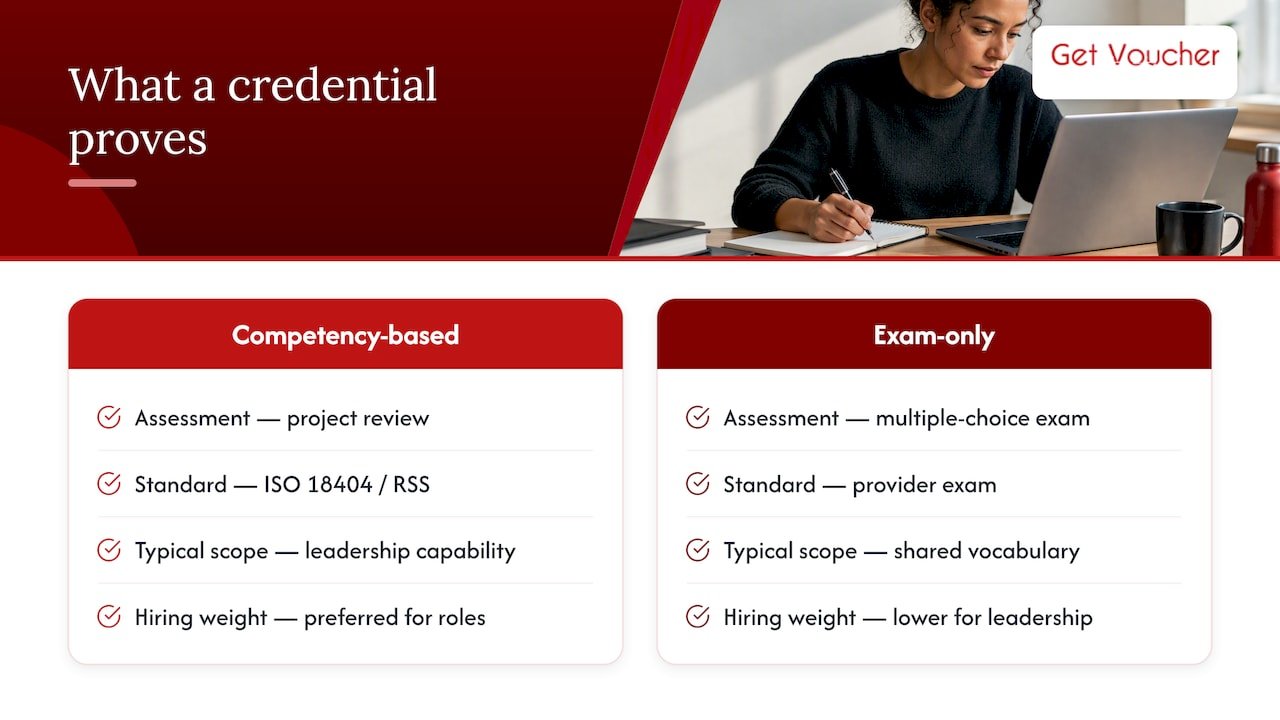
The conventional advice on Six Sigma certification spends too much energy ranking providers by brand recognition and not enough on what the credential actually requires you to prove. A Black Belt earned from a multiple-choice exam and a Black Belt earned through an assessment centre reviewing a completed project are not equivalent, even though they carry the same name on a certificate.
Our view is that competency-based assurance, of the kind ISO 18404 and the RSS sector scheme are built around, deserves more weight in hiring and promotion decisions than it currently gets. Exam-only credentials still have a place, particularly for Yellow Belt or introductory Green Belt learning where the goal is shared vocabulary rather than leadership capability. But once a role involves running or owning improvement projects, the question worth asking is not “which provider is most recognised” but “does this credential require me to demonstrate something real”. Readers who prioritise that question over brand comparisons will make better certification decisions than those chasing the most familiar name.
— Rayan
8. Start here: how to buy a GetVoucher Six Sigma pathway
Choosing a certification shouldn’t mean weeks of comparing providers one tab at a time. Our platform brings Six Sigma voucher pathways together in one place, so you can match a belt to your current role and move straight to preparation instead of research.

Before you buy, run through a short checklist:
- Confirm whether the credential you want is exam-only, portfolio-based or assessment-centre based.
- Check the provider’s accreditation claims against a named standard, such as ISO 18404, rather than general wording.
- Note the recertification terms so you know what maintaining the credential will involve later.
| Step | What to check | Where to look |
|---|---|---|
| Pick your belt | Matches your current responsibilities | Role-based guidance above |
| Check assessment type | Exam, portfolio or assessment centre | Provider’s own course page |
| Confirm recertification | Renewal cycle and evidence required | Provider’s accreditation documentation |
If you already know you want Green Belt-level competence across both Six Sigma and Lean methods, the Dual 6Sigma Pack bundles both for one price, or you can browse the full range on our certifications page and start with whichever belt matches your immediate role.
FAQ
What is the most respected Six Sigma certification?
There is no single universally agreed “most respected” certification, since recognition depends on your industry and employer. Credentials assessed against the ISO 18404 / RSS 18404 competency standard carry stronger assurance than exam-only badges because they require demonstrated project competence rather than test performance alone.
Which Six Sigma certification is best in the UK?
In the UK, the RSS 18404 sector scheme is the clearest implementation of the international ISO 18404 competency standard, covering individual and organisational certification. Professionals working towards UK employer expectations should check whether a provider’s assessment aligns with this scheme rather than relying on exam-only certificates.
Is Six Sigma worth it in 2026?
Six Sigma certification remains relevant where organisations run structured process improvement programmes, particularly in manufacturing, healthcare and service operations. Its value depends on whether the credential required applied project evidence rather than an exam alone, since that evidence is what employers tend to value most.
Which is better, IASSC or ASQ?
Both are established Six Sigma certification bodies that offer belt-level credentials, and neither is universally “better”; the right choice depends on your industry’s expectations and whether you need exam-only certification or a more competency-focused route. The Council for Six Sigma Certification recommends comparing assessment method and accreditation type rather than provider name alone.
How much does Six Sigma certification typically cost?
Costs vary widely by provider, belt level and assessment format, so figures should always be checked directly on the issuing provider’s own pricing page. Our Six Sigma Green Belt (SSGB™) voucher is listed at £149 one-off, and the combined Dual 6Sigma Pack is available for those planning to pursue both Six Sigma and Lean Six Sigma Green Belt credentials together.