




The usual Six Sigma belt order runs White, Yellow, Green, Black, then Master Black. You rarely need to climb every rung. PeopleCert/IASSC, for example, does not require Yellow Belt before Green, though rules differ by provider. If you are new to process improvement, start at Yellow. If you already work with data, start at Green. If you have led documented projects, look at Black.
Table of Contents
- What does each Six Sigma belt actually mean?
- White and Yellow belt: who should start here?
- Green belt explained: syllabus, exam facts and who benefits most
- Black belt: advanced curriculum, project requirements and experience thresholds
- Master Black Belt: role, prerequisites and when to aim for it
- Common routes through the belts and how providers differ on entry rules
- Eligibility details and how to evidence Black Belt projects
- Exam formats, durations, pass marks and recertification cycles
- Quick diagnostic: choose your starting belt in under five minutes
- A pragmatic view on balancing study, work and projects
- How we help you build a Six Sigma path
- FAQ
- Sources
What does each Six Sigma belt actually mean?
Six Sigma belts describe how deep your statistical skill goes and how much of a project you can lead. Lean Six Sigma combines Six Sigmas focus on reducing defects with Lean’s focus on removing waste, and both use the DMAIC cycle (Define, Measure, Analyse, Improve, Control). The IASSC body of knowledge grows progressively from Yellow through Master Black, and each level adds tools rather than replacing earlier ones.
Here is how the levels usually break down:
- White Belt: awareness of the vocabulary and purpose of improvement work, usually a short introduction.
- Yellow Belt: understands DMAIC basics and supports projects led by others.
- Green Belt: applies the full DMAIC cycle and statistical tools, often leading smaller projects alongside a day job.
- Black Belt: leads complex, cross-functional projects and coaches Green Belts, using advanced methods such as designed experiments.
- Master Black Belt: shapes programme strategy and mentors Black Belts across an organisation.
Training effort scales with the level. The IASSC and PeopleCert materials give guidance of roughly 16 training hours for Yellow, 80 for Green and 120 for Black. DMAIC runs through every belt, and the difference is how much of it you are expected to own. Neither DMAIC nor any other cycle is automatically heavy or slow: a Yellow Belt applies it in small, focused ways, while a Black Belt applies it to larger problems.
White and Yellow belt: who should start here?
White Belt content is awareness training. It typically takes a short session or module and teaches the language of process improvement, which is useful if your team has just started a quality initiative and you want to follow the conversation.
Yellow Belt is the more meaningful entry credential. It covers DMAIC basics, SIPOC diagrams (suppliers, inputs, process, outputs, customers), process mapping and simple statistical process control. PeopleCert’s IASSC Yellow Belt summary lists no prerequisites, an exam offered in multiple languages, a reference document inside the exam interface, and renewal every three years.
According to PeopleCert and IASSC, the Yellow Belt exam has 60 questions, lasts 120 minutes and uses a 70% pass mark. Combined with the guidance of about 16 training hours, that makes it a realistic first step for someone fitting study around a job. Many people can finish preparation within a few weeks, though your pace will depend on your background.
Who benefits most from starting here?
- Operations, HR, finance or customer service staff who support improvement projects but do not lead them.
- Career changers who want to test their interest before committing to heavier study.
- Managers who need to read project reports and challenge assumptions without running the analysis themselves.
We offer a Six Sigma Yellow Belt (SSYB™) voucher at £0, which gives you a no-cost way to validate your interest. The SSYB belongs to the 6sigmastudy scheme we resell, so its structure differs from the IASSC exam described above.
Pro Tip: Choose a real process from your own workplace, such as an approval delay or a recurring error, and map it with SIPOC while you study. A concrete example makes the terminology stick and gives you something to discuss in interviews.
A Yellow Belt does not prove you can run a project, and it should not be sold as proof of performance. It shows you understand the method and can contribute to a team using it.
Green belt explained: syllabus, exam facts and who benefits most
The Green Belt is where Six Sigma becomes a working toolkit. It covers the full DMAIC cycle, advanced statistics including hypothesis testing and regression, statistical process control and Lean controls. The IASSC and PeopleCert Green Belt syllabus recommends around 80 training hours and recommends accredited training, while listing no formal entry prerequisites.
That last point matters for the question many candidates ask: do you need Yellow before Green? Under PeopleCert’s IASSC Green Belt page, Yellow is not a formal prerequisite. Prior process-improvement knowledge helps, and accredited training is recommended rather than mandated. Other providers set their own rules, so always check the scheme you intend to use.
The IASSC Green Belt exam has 100 questions, runs for 180 minutes and requires a 70% pass mark, according to PeopleCert and IASSC. That puts it at a clear step up in time and depth from Yellow, and the pass mark stays the same, so the added difficulty comes from the breadth of statistical content.
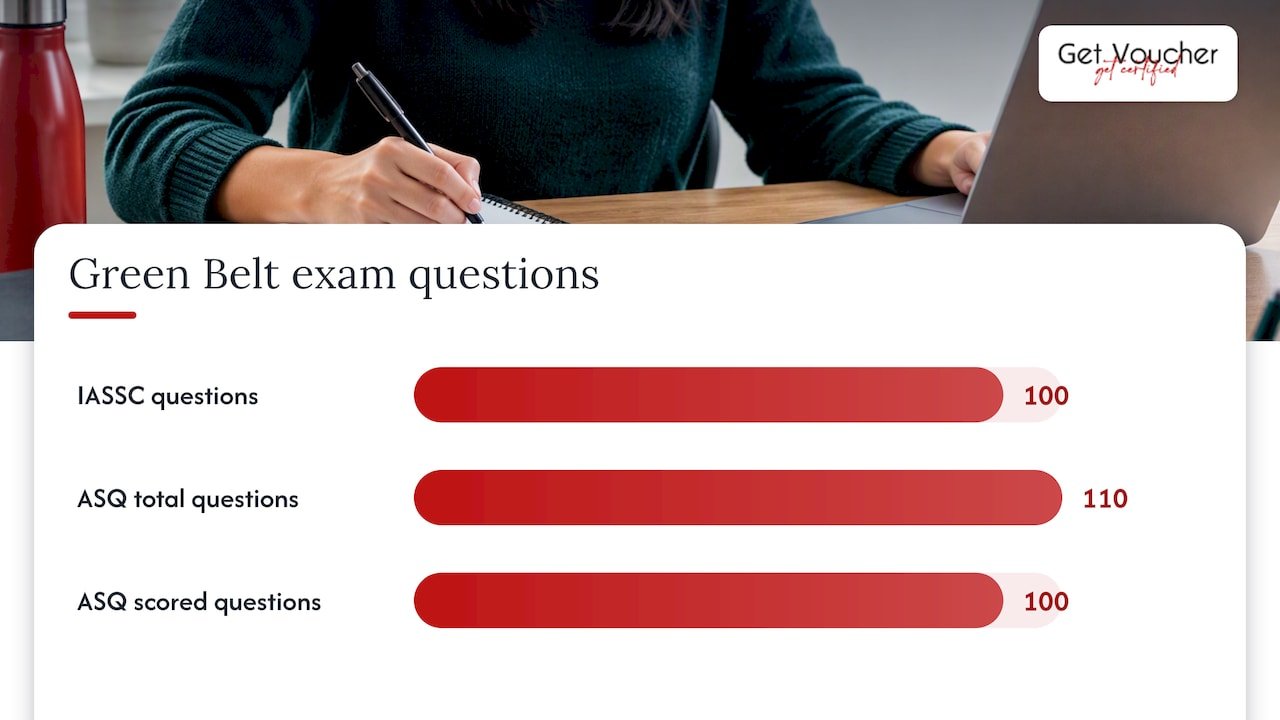
ASQ’s Green Belt is a separate scheme with its own rules. The Certified Six Sigma Green Belt page notes candidates must have worked in a full-time, paid role, and it documents a one-part, 110-question exam with a four-and-a-half-hour appointment (100 scored questions). ASQ requires relevant work experience but not a documented project at Green level.
What does a Green Belt equip you to do?
- Lead or co-lead improvement projects while keeping your normal role.
- Collect and test data, then use regression and hypothesis tests to separate real causes from noise.
- Build control plans so improvements last after the project team moves on.
- Speak credibly to Black Belts and sponsors about the evidence behind your recommendations.
Green suits analysts, engineers, project coordinators, quality staff and supervisors who already handle data. If you want a structured study plan, our guide to reaching Green Belt in 80 hours walks through how working professionals can pace the effort.
Black belt: advanced curriculum, project requirements and experience thresholds
Black Belt content builds on Green with designed experiments, more advanced hypothesis testing and leadership of the Improve phase in larger DMAIC projects. A Black Belt is expected to manage stakeholders, coach Green Belts and take responsibility for results that matter at business level. The IASSC guidance suggests about 120 recommended training hours.
Requirements differ sharply by provider, so we separate them here. According to ASQ’s Certified Six Sigma Black Belt page, you need project evidence plus work experience: either two completed projects with signed affidavits, or one completed project with signed affidavit plus three years of relevant on-the-job experience. The exam is computer-delivered and has 165 questions, with 150 scored. The exam time is 4 hours 18 minutes, within a four-and-a-half-hour appointment.
This is a good moment to name an important point. ASQ’s project requirement is specific to ASQ. It is not a universal rule for all Six Sigma providers, and a documented project is not automatically superior to an exam-only route. Choose the scheme that matches your employer’s expectations and your circumstances.
Here is how a candidate typically builds a credible ASQ-style route:
- Confirm that your current role is full-time and paid, because ASQ requires work experience gained in that kind of role.
- Select a project with measurable before-and-after results, rather than a general improvement activity.
- Record start and end dates, the Six Sigma tools you used and the data behind the results from the first week.
- Ask your project champion early whether they will sign the affidavit, and agree what they can verify.
- Complete the affidavit and submit it within the application timelines ASQ publishes.
- Book the exam only after your documentation is complete.
Pro Tip: Keep a simple project log with dated entries and screenshots of your baseline data. Reconstructing figures months later is the most common reason documentation feels weak, and a log takes minutes a week.
We do not currently list Six Sigma Black Belt vouchers. If Black is your target, our Green Belt offerings can serve as a foundation while you build project experience.
Master Black Belt: role, prerequisites and when to aim for it
The Master Black Belt works at programme level rather than project level. Where a Black Belt delivers an improvement, a Master Black Belt decides which improvements an organisation pursues, how the programme is governed and how people are trained to deliver it.
Typical responsibilities include:
- Coaching and mentoring Black Belts and reviewing their project plans.
- Providing statistical leadership when problems exceed the standard toolkit.
- Setting standards for how projects are selected, tracked and closed.
- Reporting programme results to executives and aligning projects with strategy.
Prerequisites vary and are often set by the employer or the training body rather than a single universal exam. In practice, expect a recognised Black Belt credential, substantial project experience and a track record of coaching others. The IASSC material treats Master Black as the top of the progressive body of knowledge, but few candidates reach it.
Should you aim for it? Most practitioners stop at Black Belt, and that is a sensible endpoint. Black Belt already covers leading complex projects and developing others. Master Black becomes attractive when you want to build or run an improvement function, work as an internal consultant across several business units or move into a deployment leadership role.
If your goal is better pay or a promotion in a specific job, ask whether the employer values the title in that role. We would not claim a particular belt guarantees employment or salary outcomes, because those depend on the organisation and the market. Treat Master Black as a long-term goal that follows real experience, and not a credential to chase on its own.
Common routes through the belts and how providers differ on entry rules
The belt ladder is a reference model, not a legal requirement. In practice, entry rules belong to each certification scheme. IASSC and PeopleCert do not require Yellow Belt before Green, and many candidates sit Green directly if they have enough prior knowledge. ASQ asks for work experience and, at Black level, documented project evidence. The 6sigmastudy credentials we resell follow their own structure. Keep each provider’s rules separate and read the current requirements before you commit.
Dual packs suit time-limited learners because the two Green credentials share a lot of ground. Our Dual 6Sigma Pack combines Six Sigma Green Belt and Lean Six Sigma Green Belt, so you study overlapping DMAIC and statistics content once and sit two credentials. Lean, Six Sigma and Lean Six Sigma remain distinct, with their own scopes and assessments, so confirm which one your employer or target role asks for.
Here is a sample working-professional route over 6 to 12 months. Treat it as an illustration, not a guaranteed timeline, since your pace will vary:
- Months 1 to 2: complete a Yellow Belt to learn the vocabulary and test your interest.
- Months 3 to 6: study for Green Belt alongside work, using a real workplace process as your practice case.
- Months 6 to 9: sit the Green exam and apply the tools in a small project with measurable results.
- Later: if Black is your aim, scope a larger project, document it carefully and check the target provider’s experience rules.
Skipping Yellow is reasonable if you already read process data, use basic statistics or have worked on improvement teams. Skipping Green to reach Black is more constrained, and it depends on the specific scheme and your documented experience. For cost planning, our Six Sigma exam cost breakdown covers fees, rescheduling and extras.
Eligibility details and how to evidence Black Belt projects
ASQ’s paperwork is the part of the Black Belt journey that catches people out, so plan it from the start. The ASQ affidavit form asks for project dates, the Six Sigma tools used, measured before-and-after benefits and the project champion’s contact details for verification.
According to ASQ, applicants who do not supply the affidavits within the required timeframe may have their application cancelled with only a partial refund, as the affidavit guidance explains. Treat that deadline as seriously as the exam date.
The ASQ certification FAQs add that work experience must come from a full-time, paid role, and that affidavits must be signed by a project champion and received within published application timelines. Provider differences matter here: ASQ’s Green Belt needs relevant work experience but no documented project, its Black Belt has separate project requirements, and PeopleCert’s IASSC exams list no formal prerequisites at Yellow or Green level.
Use this checklist while a project runs:
- Record the project start date, end date and your role from day one.
- Save the baseline measurements before any change is made.
- List each Six Sigma tool you use and why, such as a process map, a regression or a control chart.
- Capture the final measurements and express the benefit in the unit your employer already tracks.
- Confirm your champion’s current contact details and preferred way to be reached.
- Keep copies of reports and sign-offs in one folder so verification is quick.
Optional portfolio work, such as write-ups or presentations, can strengthen your case with an employer, but it is separate from what any certification body formally requires.
Exam formats, durations, pass marks and recertification cycles
Exam logistics are worth knowing before you set a study calendar. The figures below come from PeopleCert and IASSC for the IASSC route, and from ASQ for its own scheme.
| Credential | Provider | Questions | Time allowed | Pass mark |
|---|---|---|---|---|
| Yellow Belt | IASSC/PeopleCert | 60 | 120 minutes | 70% |
| Green Belt | IASSC/PeopleCert | 100 | 180 minutes | 70% |
| Black Belt | IASSC/PeopleCert | 150 | 180 minutes | 70% |
| CSSGB | ASQ | 110 (100 scored) | four-and-a-half-hour appointment | Not stated in our source |
| CSSBB | ASQ | 165 (150 scored) | four-and-a-half-hour appointment | Not stated in our source |
ASQ figures come from its Green Belt page and Black Belt page. We leave the ASQ pass marks off because our sources do not state them, so check ASQ before you book.
For IASSC credentials, PeopleCert states that certification is valid for three years and requires a recertification exam to maintain validity. Exams are computer-delivered and may be web-proctored or classroom-delivered, depending on the arrangement. Proctoring simply describes how the exam is supervised; it does not make one credential more credible than another.
Start your renewal planning well before expiry. Give yourself a preparation window of several weeks, refresh the statistics content you use least and check rescheduling rules and fees, which apply on PeopleCert exams. Regional scheduling and language options can also vary, so confirm them on the provider page.
Quick diagnostic: choose your starting belt in under five minutes
Answer these questions honestly, then match your answers to a starting point:
- What is your current role? If you support processes but do not analyse data, lean towards Yellow. If you analyse, report or improve processes, lean towards Green.
- How comfortable are you with statistics? If averages, charts and basic tests feel unfamiliar, begin with Yellow. If you have used regression or hypothesis tests, Green is realistic.
- Can you access a real project? If you can lead or join a measurable improvement at work, Green is useful now, and Black becomes possible later. If not, build exposure first.
- Will your employer support you? Sponsorship, protected study time or a project champion can affect what is achievable.
Use your answers to choose a starting point.
- Mostly new to the field: start at Yellow and fit your study around your job.
- Some data experience and project access: go to Green, or consider the dual pack if you want both Lean and Six Sigma coverage.
- Documented projects and leadership experience: research Black Belt rules for your chosen provider, and use Green to fill any gaps.
Your next steps are to set a weekly study plan, pick a provider whose rules fit your situation, decide on a voucher and start scoping a workplace project.
Pro Tip: If you are torn between two belts, begin with the lower one and bank the early win. A passed exam builds momentum and tells you whether the work suits you before you commit to heavier study.
A pragmatic view on balancing study, work and projects
Most candidates over-focus on exams and under-invest in evidence. A practical approach is to pick a small, measurable workplace problem and document it as you go. Optional project evidence can complement a certificate, but certification requirements differ by provider. Use an entry belt to explore the subject before committing to further study.
How we help you build a Six Sigma path

At GetVoucher, we sell exam vouchers that let you start your Six Sigma path at the right belt without hunting through separate providers. Our Six Sigma range currently includes:
- Six Sigma Yellow Belt (SSYB™) at £0.
- Six Sigma Green Belt (SSGB™) at £149.
- Lean Six Sigma Green Belt (LSSGB™) at £290.
- The Dual 6Sigma Pack at £418, covering Six Sigma Green Belt and Lean Six Sigma Green Belt.
Vouchers pair well with self-paced online study if you are working full time. Included resources differ by product, so check each product page for what comes with it. These are 6sigmastudy credentials, separate from the ASQ and IASSC/PeopleCert schemes described above, so confirm the one your employer expects. Check our bundles and voucher options to match your chosen starting point.
FAQ
Is Six Sigma worth it in 2026?
It can be, if the skills match your role. Six Sigma teaches structured problem solving with data, which is useful in operations, quality, finance and project work. A certificate on its own does not guarantee a job or a pay rise, so pair it with real project results.
Do you need a Green Belt before a Black Belt?
It depends on the provider. ASQ’s Black Belt asks for project affidavits and work experience rather than naming Green as a prerequisite. In practice, Green Belt skills are a sensible foundation for the Black Belt syllabus.
Which Six Sigma certification is the most recognised?
Recognition depends on your employer, sector and region, so we cannot name a single winner. ASQ and IASSC/PeopleCert are two well-known providers with different rules. Ask employers in your target field which credentials they value before you choose.
What is the usual Six Sigma belt order?
The usual order is White, Yellow, Green, Black and Master Black. Many schemes do not require you to complete every level, so check the entry rules of your chosen provider.