




Self-paced training suits you if you are disciplined, short of fixed hours and learning knowledge-heavy material. Instructor-led training suits you if you need a timetable, live questions and other people in the room. Neither is better in general. The right choice depends on what you are learning, how you handle deadlines and what you can spend.
This guide sets out what each format involves, what the research says, and a practical way to decide. It then applies the choice to professional certifications, where the format question is often tangled up with exam rules and pricing.
Table of Contents
- What each format means
- Self-paced vs instructor-led at a glance
- The advantages of self-paced learning
- Where instructor-led training earns its price
- What the research says about effectiveness
- The real risk of self-paced study: finishing
- A quick way to decide
- How this plays out for certifications
- Our perspective
- Choosing a certification you can study at your own pace
- FAQ
- Sources
What each format means
Self-paced learning means you get the materials, such as recorded video, reading and quizzes, and you work through them whenever you like. There is no cohort and no fixed start date. Support, if any, comes through forums, email or a mentor you contact when you need to.
Instructor-led training (ILT) means a trainer delivers the course on a schedule, either in a classroom or live online. You attend set sessions, ask questions in real time and work alongside a group.
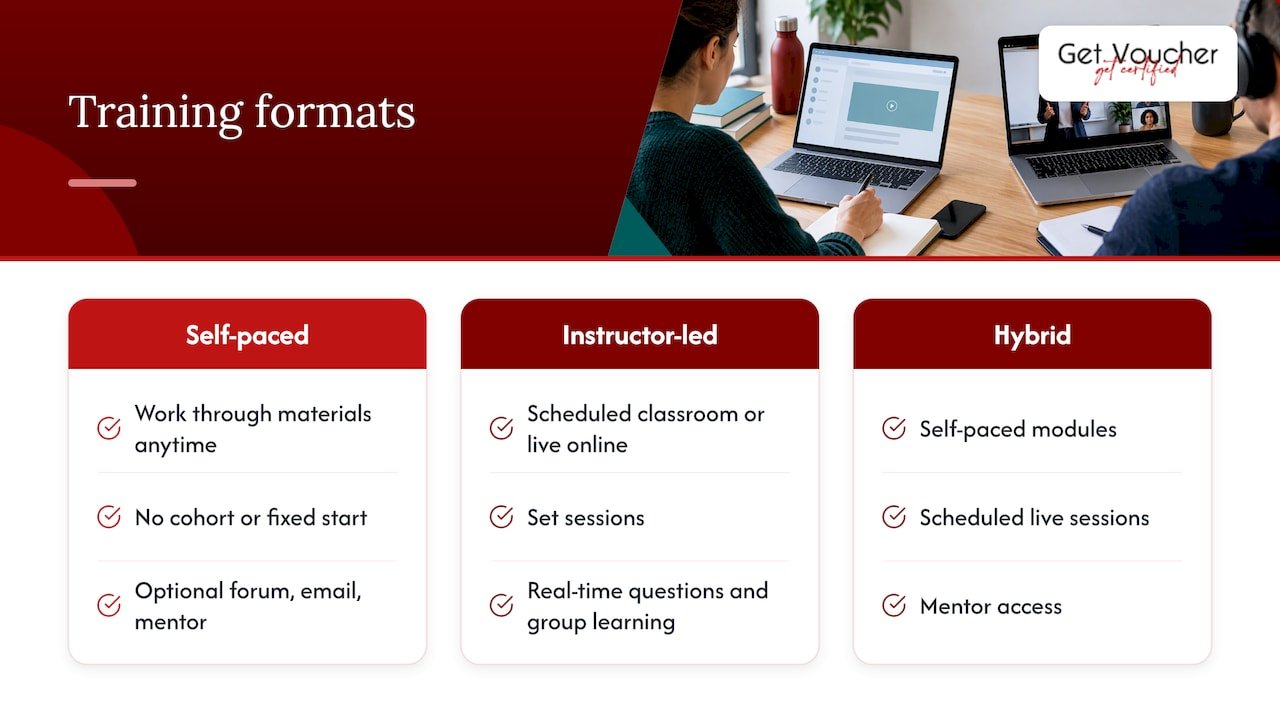
The edX help centre draws the same line for its own courses: self-paced courses let you progress at your own speed, while instructor-paced courses run on a course schedule. Many providers also sell a hybrid, with self-paced modules plus scheduled live sessions or mentor access.
Self-paced vs instructor-led at a glance
| Factor | Self-paced | Instructor-led |
|---|---|---|
| Schedule | You choose when and where | Fixed dates and times |
| Pace | Fast if you know the topic, slow if you need to | Set by the trainer and the group |
| Questions | Asked after the fact, through forums or email, where offered | Answered live |
| Accountability | Comes from you | Comes from the timetable and the group |
| Cost | Often lower, with no trainer day to pay for | Often higher, because trainer time is part of the price |
| Practice and discussion | Depends on how the course is designed | Built in through exercises and group work |
| Best for | Knowledge you can read, test and revisit | Skills that need feedback, debate or physical practice |
Treat the cost row as a tendency, not a rule. A live course from a premium trainer can cost far more than a self-paced alternative, but a well-supported self-paced programme with mentors can cost more than a basic live session.
The advantages of self-paced learning
Most people who search for the benefits of self-paced training are really asking one question: will it fit around my job? In practice, the advantages are these.
- Flexibility. You can study on a train, after the children are in bed or in a quiet week at work. That matters if you cannot commit to eight hours across two fixed days.
- Speed control. If you already know half of a topic, you can skim it. If a concept does not land, you can replay it.
- Repeat access. Recorded material can be revisited before an exam or when you meet the concept at work.
- Lower cost, often. There is no trainer day, room or travel to pay for.
- Practice at work. The National Careers Service notes that online courses usually give you a website with course materials, and that some courses have an online tutor. You can apply each lesson to your job the same week.
Those advantages come with conditions. A self-paced course gives you freedom, but it doesn’t supply motivation.
Where instructor-led training earns its price
Live training is stronger in four situations.
- You procrastinate. A fixed session in your calendar is hard to postpone. Self-paced courses make it easy to put learning aside when work gets busy.
- The skill is practical or sensory. A 2024 randomised controlled trial from the University of Manchester compared teaching formats for practical skills. Only 17% of online learners reached competency, against 75% in face-to-face groups. The skills in that study needed touch and sensory feedback, so do not stretch the result to every subject. It does show that the format matters most when the skill is physical.
- You learn through discussion. Debating a scenario with peers and a trainer exposes assumptions that a video never challenges.
- You want a mandatory route. Some credentials require a course with an approved trainer before you can sit the exam. In that case the format is not your choice at all.
What the research says about effectiveness
The evidence is more balanced than either side’s marketing suggests.
A systematic review of online versus alternative training for health professionals found that, for knowledge, the differences were small and not significant. The standardised mean differences were 0.04 against workshops and 0.22 against lectures. The same review warns that low-quality evidence rules out firm conclusions about practical skills.
A 2021 field experiment on online professional training found that active learning, meaning purposeful self-reflection on the materials, predicted outcomes more strongly than instructor accessibility. Having an instructor to call on helped, but engaging actively with the content helped more. That finding is encouraging for self-paced learners, provided they study actively rather than just watching.
Two caveats apply. The studies cover health care, teaching and corporate training, not Scrum or Six Sigma exams specifically. And none of them shows that a given format guarantees a job outcome. Read them as a guide to how people learn, not a verdict.
The real risk of self-paced study: finishing
The usual weakness of self-paced learning is completion. A review of blended approaches to professional development reports that learners with lower digital confidence, or no structured study plan, drop out more, and it recommends blended models that combine self-paced modules with group reflection.
The design of the course matters too. A Department for Education international review of online adult learning describes courses where materials are available at your own pace while mentors give support by videoconference and learners can post questions on forums. Human contact is what separates a passive course from an engaging one.
If you go self-paced, these habits help:
- Book study slots like meetings. Two 45-minute blocks a week that you protect beat a vague plan to study when free.
- Set up a dedicated place. East Riding of Yorkshire Council’s learning guidance suggests a workspace free from distractions that the people you live with know about.
- Test yourself early. Take practice questions after each module, not only in the final week.
- Use a deadline. Book your exam attempt or tell a colleague your target date.
- Find a human. Join the provider’s forum, or ask a colleague to study alongside you.
For more tactics on motivation and finishing, see these strategies for completing self-paced study.
A quick way to decide
Answer these five questions honestly.
- Can you hold a fixed timetable? If your shifts or family life change weekly, live sessions will be missed and self-paced wins.
- Do you finish things without outside pressure? If yes, self-paced is low risk. If you have abandoned online courses before, pay for structure.
- Is the content mostly knowledge, or mostly practice? Frameworks, terminology and exam syllabuses suit self-study. Negotiation role-play or hands-on technique benefits from live feedback.
- How much do you already know? Experienced practitioners can compress a self-paced course. Newcomers often gain from a trainer explaining why, not just what.
- Does the credential dictate the route? Check the provider’s own requirements before you compare formats.
If you answered “yes, mostly knowledge, flexible and self-motivated” three or more times, start self-paced. If not, or if you are unsure, consider a blended route: self-paced content plus scheduled live support.
How this plays out for certifications
Professional certifications add a second layer. You are choosing a learning format and also an exam format, and providers set both differently. Never assume one provider’s rules apply to another.
Scrum certifications
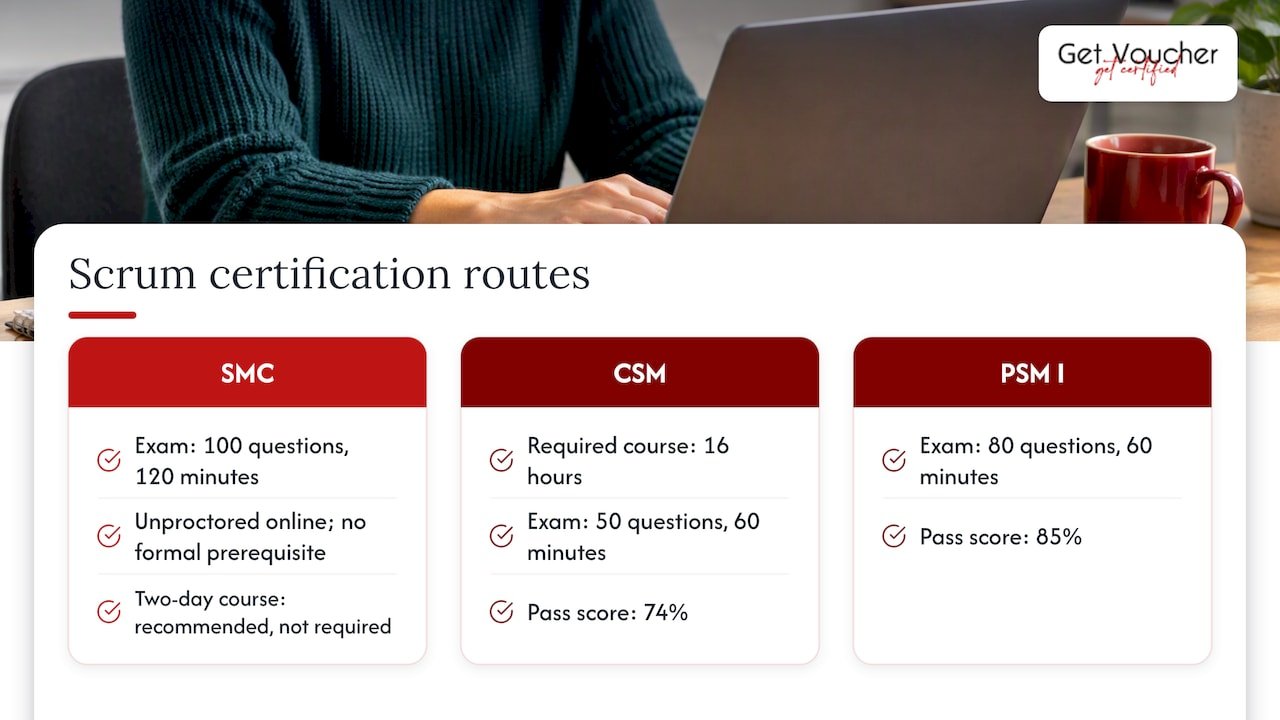
The SCRUMstudy Scrum Master Certified (SMC®) page lists a 100-question, 120-minute unproctored online exam with no formal prerequisite. SCRUMstudy states that attending a two-day classroom course with an authorised training partner is highly recommended, not required. So with SMC the live course is optional and self-paced study is a legitimate route.
Other providers work differently. The Scrum Alliance CSM® requires a 16-hour course before the exam, and the exam has 50 questions in 60 minutes with a 74% pass score. Scrum.org’s PSM I uses an 80-question, 60-minute exam with an 85% pass score. Those are separate credentials from the ones we sell, and the two bodies do not assess learning in the same way. If you are weighing those routes, our comparison of Scrum Alliance and Scrum.org options for busy professionals covers them.
If you are unsure what an unproctored exam means for you, read how professionals verify unproctored certifications before buying. An unproctored exam is not automatically easier, and a proctored one is not automatically more credible. They are different delivery formats. To see the other format, there is a guide to what an online proctored exam involves.
Digital marketing and other SMstudy certifications
The SMstudy Digital Marketing Professional has no formal prerequisites, with the Fundamentals certificate only preferred. It uses a 100-question, 120-minute online unproctored exam, not a project-based assessment. A knowledge-based exam like that fits self-paced preparation well. If you are moving into marketing, Digital Marketing Fundamentals is the natural first step.
The SMstudy Social Media Marketing Professional is different. It requires the Digital Marketing Professional prerequisite and an 80-question, 90-minute online unproctored exam, and it focuses on social-media strategy, not on producing short-form content.
Six Sigma
Six Sigma credentials vary even more by body. ASQ, IASSC/PeopleCert, CSSC and 6sigmastudy each set their own prerequisites, exam formats, project requirements and renewal rules, and they should not be mixed up. A project requirement belongs to specific credentials, not to Six Sigma as a whole. Before choosing between self-paced and live preparation, read the body’s own handbook, then pick the format that fits.
Do not assume the format proves competence
Completing a course in either format shows you completed it and, where there is an exam, passed it. It does not prove that you can perform in a role, and we make no promise about employer preference, salary or promotion. Use the certificate to structure your learning and to signal your commitment, then build the practice at work.
Our perspective
We sell certification vouchers, so we see the same pattern in learners again and again. The people who stall are rarely the ones who lack ability. They are the ones who bought access, planned to study “when things calm down” and never booked the time.
For knowledge-based credentials with online exams, we think self-paced study is often the sensible default for working professionals and career switchers. It avoids a classroom commitment, and depending on the certification, the provider’s own video training and downloadable materials can reduce the time spent hunting through unrelated courses and documents. That is why our catalogue is built around self-paced pathways. Inclusions differ by product, so check each product page for what you get.
But we do not think self-paced is right for everyone. If you know you need live discussion, or if a credential you want requires an approved trainer, pay for that route. A cheaper format you abandon is the most expensive choice. Our advice is to choose the format you will actually finish, and to put a date on your exam attempt.
We also think pricing should be transparent and not treated as the whole decision. An exam-only voucher is not always the cheapest route overall. Mandatory training, optional preparation, retakes and renewal can all change what you pay, and those rules vary by provider.
— Rayan
Choosing a certification you can study at your own pace
If you have decided self-paced suits you, our catalogue gives you a place to start. Prices below are as published on our site.
| Certification | Price |
|---|---|
| Scrum Fundamentals Certified | £0 |
| Six Sigma Yellow Belt (SSYB™) | £0 |
| Scrum Developer Certified (SDC®) | £99 |
| Six Sigma Green Belt (SSGB™) | £149 |
| SMstudy® Certified Digital Marketing Professional | £199 |
| Scrum Master Certified (SMC®) | £249 |
| Scrum Product Owner Certified (SPOC®) | £299 |
Start with a free option if you are new, such as Scrum Fundamentals Certified, to test whether self-paced study works for you before you spend. When you are ready for more, browse the full range on our certifications page. Each certification has its own exam format, prerequisites and inclusions, so read the product page before you buy.
FAQ
Are self-paced courses worth it?
They are worth it if you will finish them. For knowledge-based material, research on online professional training has found little significant difference in knowledge gains compared with workshops or lectures. The risk is not quality but dropout, so set a schedule and a deadline before you start.
What is a blended or mentor-led course?
It combines self-paced modules with human contact, such as scheduled group sessions, a mentor or a discussion forum. Experts in professional development often favour this model because it keeps the flexibility while reducing isolation and dropout. Check what support a course actually offers, because the label varies between providers.
What counts as instructor-led training?
Any course where a trainer delivers content to a group on a set schedule, whether in a classroom or live online. You attend at fixed times and can ask questions in real time. Some certifications, such as the Scrum Alliance CSM®, require this kind of course before the exam.
Can I switch from self-paced to instructor-led later?
Often yes, but it depends on the provider. If you want a live option as a fallback, check the provider’s own training partners and any certification requirements first. Our Scrum Fundamentals Certified option costs £0, so it is a low-risk way to find out how you cope with self-study.
Sources
- edX help centre: self-paced or instructor-paced
- National Careers Service: get the most out of online learning
- University of Manchester: face-to-face, blended and online teaching for practical skills (2024)
- Systematic review and meta-analysis of online versus alternative training
- University of Huddersfield: active learning and instructor accessibility (2021)
- Blended approaches to teacher continuing professional development
- Department for Education: online adult learning international review
- East Riding of Yorkshire Council: ways to learn
- SCRUMstudy: Scrum Master Certified exam format