




The usual Six Sigma path runs Yellow Belt, Green Belt, Black Belt, with Master Black Belt above. That order is common guidance, not a single rulebook. Each certifying body sets its own prerequisites, exam format and renewal terms, so the route that works at one provider may not transfer to another. This guide shows the typical order, compares what ASQ, IASSC (PeopleCert) and 6sigmastudy ask of you, and helps you decide where to start.
Table of Contents
- In this guide
- The belt order at a glance
- Four providers, four sets of rules
- Exam formats compared
- Do you need a Green Belt before a Black Belt?
- Where should you start? A short diagnostic
- Lean Six Sigma and Six Sigma: not the same credential
- Our view on choosing a path
- What the path costs with GetVoucher
- A cautious timeline
- FAQ
- Sources
In this guide
- The belt order at a glance
- Four providers, four sets of rules
- Exam formats compared
- Do you need a Green Belt before a Black Belt?
- Where should you start? A short diagnostic
- Lean Six Sigma and Six Sigma: not the same credential
- Our view on choosing a path
- What the path costs with GetVoucher
- FAQ
- Sources
The belt order at a glance
Most providers describe the same ladder, and most readers searching for the order of the belts want exactly this:
| Level | Typical focus | Common reading |
|---|---|---|
| White Belt | Awareness of the vocabulary | Offered by some providers only |
| Yellow Belt | Foundations, supporting improvement work | Entry point |
| Green Belt | Using the toolkit, often on part-time projects | Core practitioner level |
| Black Belt | Leading complex improvement work, coaching | Advanced practitioner level |
| Master Black Belt | Programme leadership, mentoring Black Belts | Senior level |
Treat the “typical focus” column as common guidance. Role responsibilities are not universal: a Green Belt in a hospital and a Green Belt in a factory may do quite different work, and employers define the titles themselves. A certificate also does not prove you can deliver results. It shows you met one provider’s standard at one point in time.
Most of the practical differences sit in the rules that sit behind each belt, which is where providers diverge.
Four providers, four sets of rules
Keep these bodies separate in your mind. They are different organisations with different models, and their credentials are not interchangeable.
ASQ
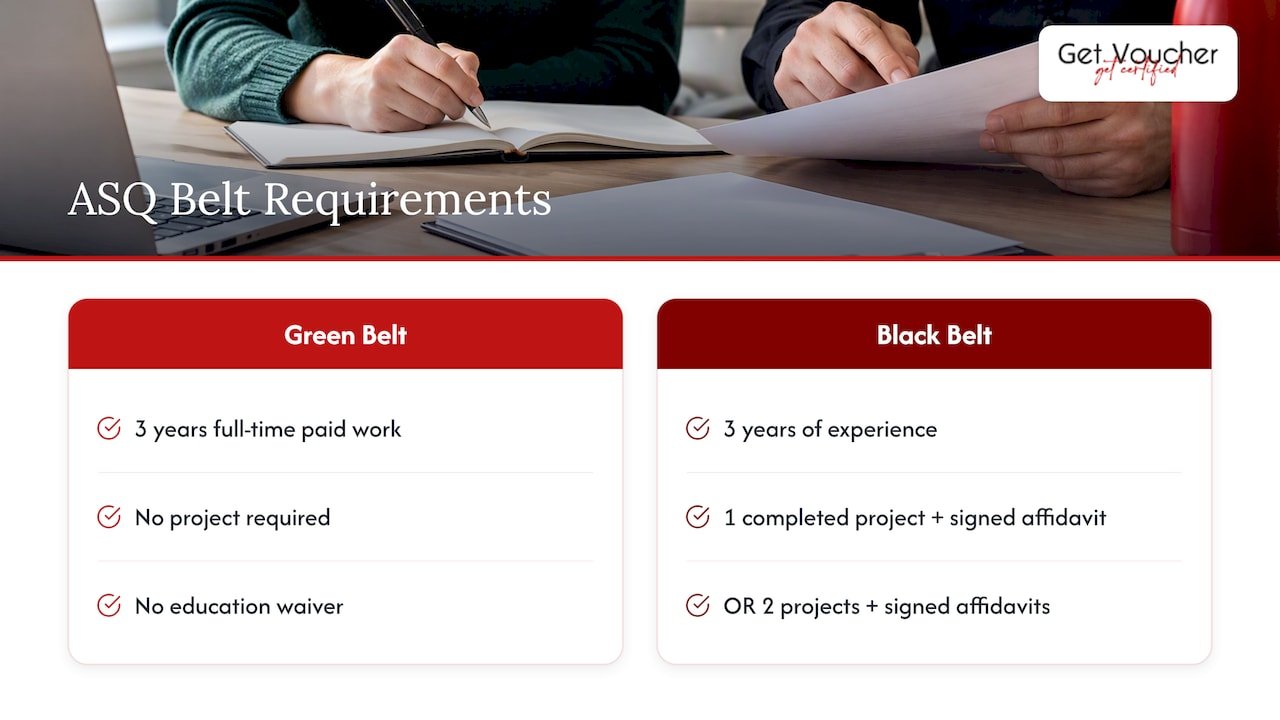
ASQ certifications are tied to work history. For the Green Belt, ASQ asks for three years of full-time, paid on-the-job experience in one or more areas of the Body of Knowledge. A documented project is not part of the Green Belt requirement. ASQ does not offer an educational waiver for that experience.
The Black Belt is stricter. ASQ states that the CSSBB needs three years of experience plus one completed project with a signed affidavit, or two completed projects with signed affidavits. ASQ’s own career pages put the point plainly: the move to Black Belt is earned with delivered projects, not seat time. The practical lesson is to lead real DMAIC work and collect the sponsor sign-off before you book the exam, not after. Two ASQ pages word the project and experience combination slightly differently, so check the current CSSBB page and the affidavit form before you plan.
IASSC (PeopleCert)
IASSC takes a different approach: it separates knowledge from application. For the Green Belt exam, IASSC lists no prerequisites and a 70% minimum score, and says training from a qualified institution is recommended rather than required. The exam is closed-book and proctored. Do not attach ASQ’s experience or affidavit rules to IASSC credentials, or the reverse.
CSSC
The Council for Six Sigma Certification runs its own standards and its own routes to certification. Read its current requirements directly if a course you are considering says it is recognised by the Council, because those terms are separate from ASQ’s and IASSC’s.
6sigmastudy
6sigmastudy structures its belts as a ladder of its own credentials. For the Black Belt, it lists no prerequisite experience but requires SSGB™ certification as the prerequisite education. Its page also describes an online course supplied with the exam, and recertification every three years or by earning another 6sigmastudy certification. Check whether another body accepts a 6sigmastudy belt before you assume a switch is possible.
None of these models is universally superior. Project-based assessment, work-experience rules and exam-only routes answer different questions, and no one of them is required for every Six Sigma credential.
Exam formats compared
The formats below come from the providers. Confirm them again on the official page before you pay, since providers change them.
| Credential | Questions | Time | Pass mark / delivery |
|---|---|---|---|
| PeopleCert IASSC Yellow Belt | 60 | 120 minutes | 70% |
| PeopleCert IASSC Green Belt | 100 | 180 minutes | 70%, closed-book, proctored |
| PeopleCert IASSC Black Belt | 150 | 240 minutes | 70% |
| ASQ CSSBB, computer delivered | 165 (150 scored, 15 unscored) | 4 hours 18 minutes exam time | Plus project affidavit(s) and experience |
| 6sigmastudy SSBB | 125 | 180 minutes | Online, no negative marking |
Do not read difficulty across the rows. A longer exam is not automatically harder, and a proctored exam is not inherently more credible than an unproctored one. They measure different things under different conditions.
Do you need a Green Belt before a Black Belt?
It depends on the provider, which is the honest answer to the question many readers type.
- 6sigmastudy: yes. SSGB™ is the listed prerequisite for SSBB™.
- ASQ: no belt certificate is required as such. The gate is experience in the Body of Knowledge plus completed projects. In practice, Green Belt-level project work is often how people build that record.
- IASSC: the Green Belt exam lists no prerequisites, and you should read the Black Belt page for its own current terms.
If you may later switch providers, ask the new body in writing whether it accepts your current belt. Do not assume it does.
Where should you start? A short diagnostic
Answer these four questions honestly.
- Have you used process-improvement tools at work? If not, begin at Yellow Belt. It is a low-risk way to learn the vocabulary and check that the field suits you.
- Do you have three years of full-time, paid experience in a relevant area? If you do, the ASQ Green Belt route is open to you. If not, a provider without an experience gate may suit you better now, and you can pursue ASQ later.
- Can you access a real improvement project? If yes, a Green Belt makes sense, and the project becomes your evidence for any later Black Belt application. If no, a Green Belt can still teach you the toolkit, but be realistic about the Black Belt timeline.
- Does your workplace use Lean, Six Sigma or both? The answer decides whether you want Six Sigma Green Belt, Lean Six Sigma Green Belt, or the two together.
If you are unsure after these, our ROI diagnostic helps you weigh a certification against your goals, and our guide to best Six Sigma certifications compares exam-only and project-proof routes.
Lean Six Sigma and Six Sigma: not the same credential
Six Sigma centres on reducing variation and defects. Lean centres on removing waste and improving flow. Lean Six Sigma combines them. The names look similar, but the syllabus, prerequisites and assessments are set by each provider, so a Lean Six Sigma Green Belt from one body is not interchangeable with a Six Sigma Green Belt from another.
DMAIC (Define, Measure, Analyse, Improve, Control) is used in Six Sigma, in Lean, and in wider process improvement. It is not inherently slow or complex, and PDCA is not always the simpler choice. Neither is mandated by the other: regulatory work does not automatically call for DMAIC, and PDCA does not have to come first. Pick the method that fits the problem.
Our view on choosing a path
We see the same mistake again and again: people treat the belt colour as the goal. The better question is what you need the credential to show. If you want to prove you understand the toolkit, an exam-based credential may be enough. If you want to show delivered results, you need projects, whichever body you choose.
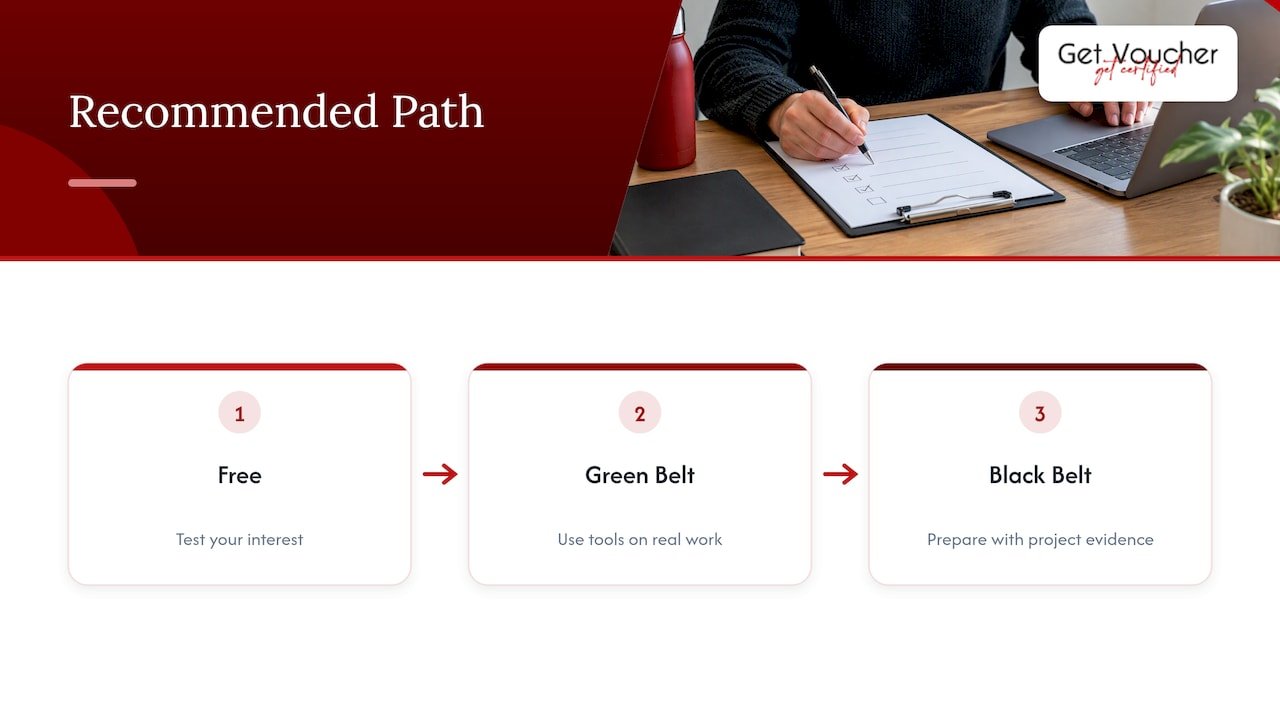
Our advice is to build in this order. Start free to test your interest. Move to a Green Belt once you can use the tools on something real. Treat the Black Belt as a step you prepare for with project evidence, especially if you may later go to a body that checks it. We would also say what we do not claim: a belt does not guarantee a job, a salary or a promotion, and we cannot speak for how every employer reads each credential.
We sell 6sigmastudy-based vouchers at each stage, so our catalogue follows that ladder. We also say openly that ASQ and IASSC are separate routes we do not sell, and that for some careers they may be the right choice.
— Rayan
What the path costs with GetVoucher
Here are our published voucher prices for the 6sigmastudy ladder. They are one-off prices, and what each purchase includes is described product by product on its page.
| Step | Voucher | Price |
|---|---|---|
| Foundation | Six Sigma Yellow Belt (SSYB™) | £0 |
| Practitioner | Six Sigma Green Belt (SSGB™) | £149 |
| Practitioner, Lean | Lean Six Sigma Green Belt (LSSGB™) | £290 |
| Both Green Belts | Dual 6Sigma Pack | £418 |
| Advanced | Six Sigma Black Belt Certified (SSBB™) | £299 |
The Dual Pack costs £418 against £439 for the two Green Belts bought separately. That is a £21 difference, and it only matters if you want both credentials. For a full breakdown of fees and extras, see our Six Sigma exam cost guide. An exam-only voucher is not always the cheapest option overall, so compare the total cost including preparation, retakes and renewal.
If you are ready to begin, start with the Yellow Belt at no cost, or read how the Green Belt route works for working professionals. Our Six Sigma certification path guide goes deeper on belt rules, and the Understanding Six Sigma overview covers the basics.
A cautious timeline
People ask how long it takes. Anyone who gives you one number is guessing, because it depends on your starting knowledge, hours per week and provider. For ASQ routes, the experience requirement alone sets a floor of years, not weeks. For exam-based routes, plan your preparation around the published syllabus and sample questions, and build in time for a retake you hope not to need.
FAQ
What is the correct order of the Six Sigma belts?
The common order is White (where offered), Yellow, Green, Black, then Master Black Belt. Providers define each level differently, so check the specific body’s requirements. Do not assume the same prerequisites apply across ASQ, IASSC and 6sigmastudy.
What are the requirements for a Black Belt?
They are provider-specific. ASQ asks for three years of experience plus one or two completed projects with signed affidavits. 6sigmastudy lists SSGB™ as the prerequisite for SSBB™. Check the current page of the body you choose.
Can I skip Yellow Belt and go straight to Green Belt?
Often yes, but confirm with the provider. IASSC lists no prerequisites for its Green Belt exam, and ASQ’s Green Belt depends on work experience rather than a prior belt. If you are new to the field, Yellow Belt is still a useful and, with us, free way to start.
Is a Six Sigma certificate worth it?
It can help you show structured knowledge and commitment, but it does not prove competence or guarantee a role, salary or promotion. Its value depends on your employer, your sector and the projects you can show alongside it.
Sources
- ASQ Six Sigma Green Belt certification
- ASQ Six Sigma Black Belt certification
- ASQ: From Six Sigma Green Belt to Six Sigma Black Belt
- IASSC Green Belt certification
- 6sigmastudy Six Sigma Black Belt (SSBB)